
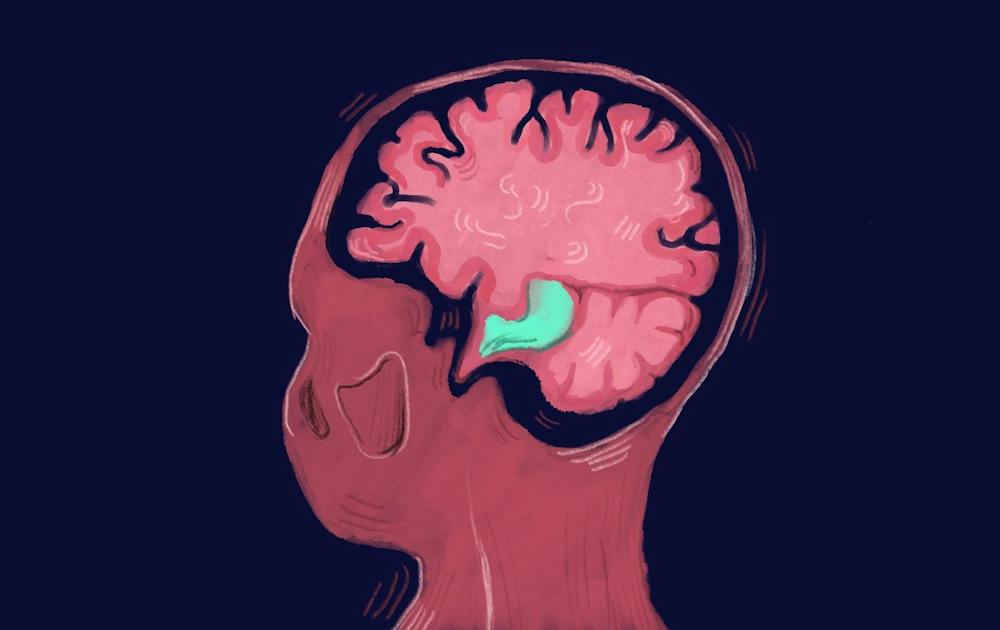
Since her undergraduate years at Stanford University, Serra Favila, an assistant professor of cognitive and psychological sciences, has been fascinated by memory. Now at Brown, more than a decade later, she not only teaches CPSY 1480I: “Memory, Space and the Hippocampus,” but also leads a research lab focused on how people differentiate between memories.
In Favila’s most recent study published earlier this month, researchers focused on understanding how similar memories can compete with each other and influence attention in the present.
Participants were shown similar, but slightly different images of scenes on different days. Their brain activity was recorded using fMRI scanner records as they attempted to identify distortions from the original image. At the same time, the researchers were also monitoring participant eye movement. The researchers found that the brain guides the eyes toward relevant information to differentiate the scenes from a previous day.
“We were really interested in the interaction between memory systems and attention systems in the brain,” Favila said. “Attention influences memory, and memory influences attention.”
Favila’s lab built on existing research that focuses on how memory organizes in the brain. Humans often compartmentalize specific memories — like a specific food preference or a parked car location — to serve as a practical record for the future. These memories can be important to keep separate, Favila said.
“Attention is something that helps you focus on specific pieces of information when there’s a lot going on,” Favila said.
According to Mariam Aly, an associate professor of psychology at the University of California, Berkeley and co-author of the paper, “one way that we figure out where to pay attention is by using our memories for similar experiences that we’ve had in the past.”
“When you’re operating in your daily life, you rarely get instructions about what you should be paying attention to in a given moment,” she added. Instead, “you are remembering relevant experiences you had in the past to figure out where you should direct your attention and your eye movements so you could behave in an adaptive way.”
According to Aly, the hippocampus may play a role in differentiating memories. “The more distinct the memories are in the hippocampus, the more accurate your eye movements are to locations associated with those memories and the more your visual cortex is able to suppress the competing memory,” she added.
Looking forward, Aly said this research could inform follow-up studies that track learning over time and examine how the hippocampus could connect certain memories with visual space.
“It was super cool and a little bit surprising that we saw such strong effects of memory on attention,” Favila said.
Favila also explores how memory and vision systems interact with the brain in the classroom.
There, she offers a quantifiable perspective on the hippocampus, according to Andrew Hudak ’28, who took CPSY 1480I and will serve as a teaching assistant for Favila’s CPSY 0400: “Cognitive Neuroscience.”
“Even the most unquantifiable memory in your life, like visiting your favorite city in the world, was encoded using a sort of topographical map of neurons in the hippocampus and surrounding areas,” Hudak wrote in an email to The Herald. “The class content simply blew my mind.”
Amrita Rajpal is a senior staff writer covering science and research.


