
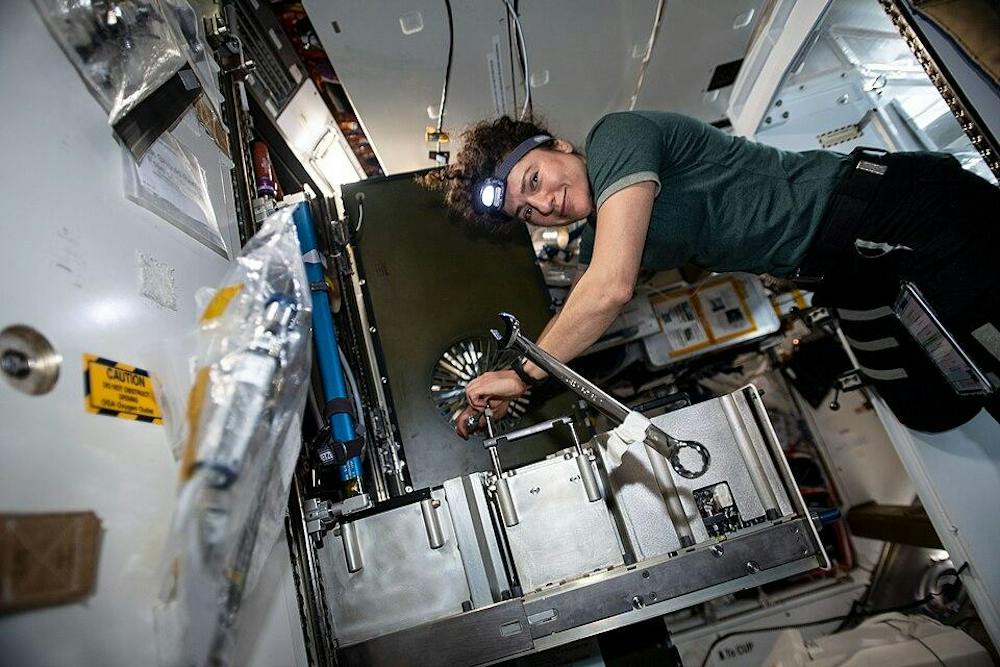
At her Brown graduation, Jessica Meir ’99 walked through the Van Wickle gates in common University tradition. Her family held up a sign that read, “Congrats, Space Girl.”
“While I was there at Brown, everybody knew this was my dream,” Meir said during a Wednesday press conference, tuning in from the International Space Station.
“I didn’t necessarily think that it would come true because we all know there’s such a small chance of it happening,” Meir added. Now, she is more than six months into a February launch with NASA’s SpaceX Crew-12, which includes NASA astronauts Meir and Jack Hathaway, European Space Agency astronaut Sophie Adenot and Roscosmos cosmonaut Andrey Fedyaev.
The crew is expected to return following a brief handover period after the arrival of Crew-13, scheduled for early October.
Meir, who is serving as expedition commander for the first time, said her new role is “rewarding,” particularly when working with crew members who had never traveled to space before.
“I think on your first mission, you’re early on in your selection, and you’re wanting to make sure to prove yourself,” she said. “This time I’m really focused instead on the goodness, the good of the team, and thinking about the team as a whole.”
After more than two decades of use, NASA outlined plans to deorbit the ISS — the largest single structure built in space — by 2030.
The engineering team and crew took many steps to “get ready for the end of station life,” Adenot said, including the installation of extra solar panels and ISS Roll-Out Array modification kits to extend the station’s electricity supply.
“I would say more than ever, we are using the full potential of science,” Adenot said.
Meir detailed other experiments done aboard the station, including the examination of stem cells, which are known to divide for longer periods of time in microgravity.
The research done aboard the station has applications beyond low-earth orbit. According to Meir, “if it becomes cost effective, we could produce stem cells up here to be used for targeted therapies back on Earth.”
She added that the “logistical” aspects of microgravity experiments are most challenging, particularly due to the difference in fluid behavior in space compared to Earth.
“Sometimes it’s difficult, even for scientists that have had experience working in microgravity, to predict and understand,” she said.
As a biologist, Meir said that some of her favorite experiments were done in the “life sciences glove box.” Meir and the crew explored how tension affects the formation of fat cartilage, which is often used in transplants for humans.
Meir said that when she returns to Earth, she will “very much miss being weightless all the time”
“Space is very cool, and I think that a lot of people agree,” she said.
In a message to Brown students, Meir encouraged them to “take risks and not be afraid to fail along the way. If you do all those things and work hard and persevere, anybody’s dreams can actually come true.”

Samah Hamid is a university news editor covering faculty and career & alumni. She is from Sharon, Massachusetts and plans to concentrate in Biology. In her free time, you can find her taking a nap, reading, or baking a sweet treat.


