
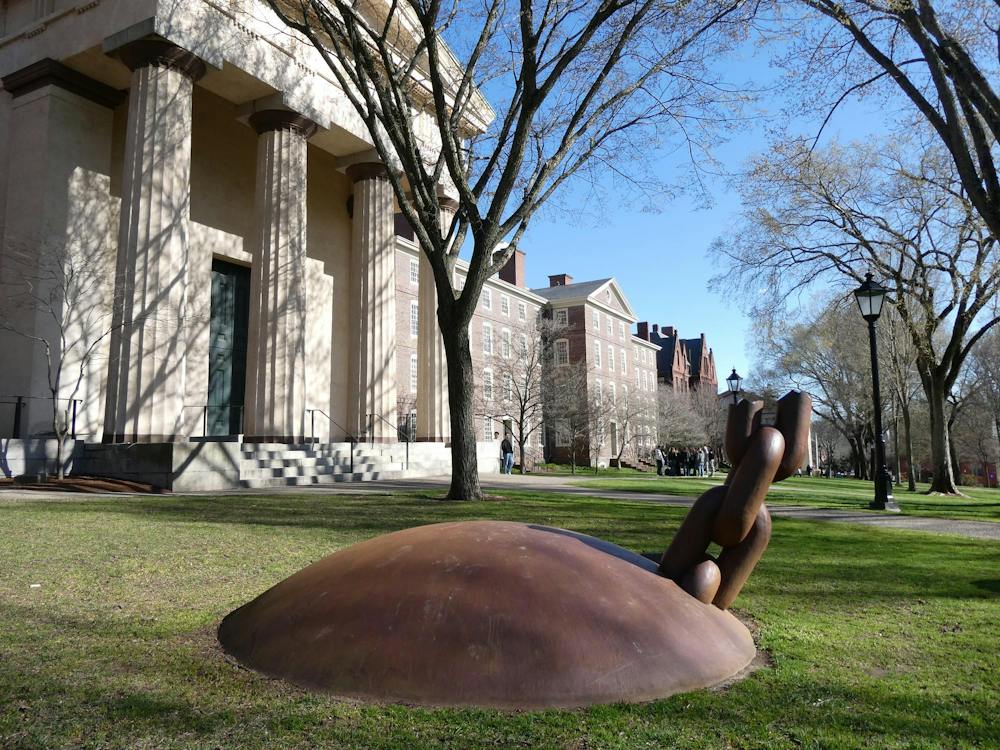
Last spring, a year after the University retired its first-year reading program, I wrote a column arguing that Brown should find a way to continue teaching its students about its relations with slavery. I openly criticized the school for turning its back on former President Ruth J. Simmons’s mission to educate us about ourselves and offered alternative ways that the University could continue fostering discussion of the report’s findings on campus. One of my suggestions was a lecture series.
After the column was published, I finished my first year at Brown and went home for the summer. I never expected anything more to come from my opinion. So when I sat in the crowd at the Inaugural Slavery and Justice Lecture two weeks ago, I was deeply surprised to hear my column brought up as a source of inspiration for the event.
Writing columns can feel like tossing ideas and hours of work into a deep void. But seeing my argument come to fruition in a real University initiative reminded me of why I came to Brown in the first place: for an education where student voices are challenged and respected. In the midst of a national debate over the purpose and worth of higher education, we should remember that the changes we want to see are possible if we continue to push for them.
The fact of the Slavery and Justice Report’s existence highlights Brown’s tradition of listening to its students and challenging preconceived notions about what higher education should be. The report examining Brown’s role in and profit from chattel slavery was first advocated by students. After a racist, anti-reparations advertisement was printed in The Herald, students protested across campus and spurred former President Simmons to commission a committee of faculty and students to investigate the University’s historical ties to slavery. As I noted in my column, the report also found records of the original Brown family’s financial records that tied their wealth to slave vessels, and the building of University Hall to slave labor. The report had reverberations across the American higher education landscape and helped further cement Brown’s commitment to listening to its students.
This history of open dialogue at Brown extends back even further. In the crowd next to me at the Slavery and Justice Lecture sat Brown alums who participated in the 1968 student walkout to demand the University enroll more Black students. These alums and their fellow students risked their place at Brown to urge the administration to increase diversity. It took a three-day sit-in at the Congdon Street Baptist Church until former Brown President Ray Heffner promised to take steps to meet students' demands. The agreement resulted in an increased enrollment of Black women and $1.2 million set aside for further recruitment efforts. It is a risk for students to push back against their university institutions, but fostering an environment that acknowledges this risk and supports students' ideas is a tenet of Brown that can lead us into the future.
The Open Curriculum, arguably the most quintessential aspect of education on College Hill, testifies to the Brown experience in large part because it was created by Brown students themselves. The original idea for the “New Curriculum” came from a report written by students who envisioned an exploratory education that would more fully challenge them. After vigorous student advocacy for the proposal, it was the faculty’s final agreement with the students’ ideas that allowed for the creation of the Open Curriculum, whose academic freedom we all enjoy today.
In recent years, there has been increased tension between student demands and the University that can make it difficult to believe in the possibility of open discussion, but even in these strenuous situations, Brown students and the school have worked at understanding each other. While dozens of schools experienced student protests over the Israel-Hamas war in 2023 and 2024, Brown was one of the few to facilitate discussions between administration and students over divestment.
Even if student activists didn’t get the result they wanted when Brown decided not to divest, Brown’s commitment to transparent communication between students and administration was one of the biggest factors that drew me here. When Brown’s Ivy peer Columbia closed its gates on its neighbors to corral students and keep people out, Brown at least tried to hear students out. Those closed gates, compared to Brown’s open discussion, epitomized what I wanted and didn’t want from my college experience. I hoped that in coming to Brown, I would find a place where shouts into the void might eventually be heard.
Hard conversations rarely result in a solution that makes everyone happy, but promising to hear students out is a commitment that schools need to maintain if they want their students to continue to engage difficult questions. There is no one way to make a college education “worth it” to every single student; calculating the value added to one’s life that four years on College Hill provides is impossible. What is worthwhile is ensuring that all students can have their voices heard.
Clara Murray ’28 can be reached at clara_murray@brown.edu. Please send responses to this column to letters@browndailyherald.com and other opinions to opinions@browndailyherald.com.


