
Last week, the University announced revised plans for its new economics building following community feedback on the original proposal shared in April. But many community members and nearby residents are still pushing back and are unsatisfied with Brown’s new proposal.
At a Tuesday community meeting hosted by Providence Ward 1 city councilor John Goncalves ’13 MA’15, nearby residents and community members came together to voice their concerns regarding the proposal. The meeting was attended by Executive Vice President for Planning and Policy Russell Carey ’91 MA’06 and architects from the firm Höweler + Yoon, the selected architect for the project.
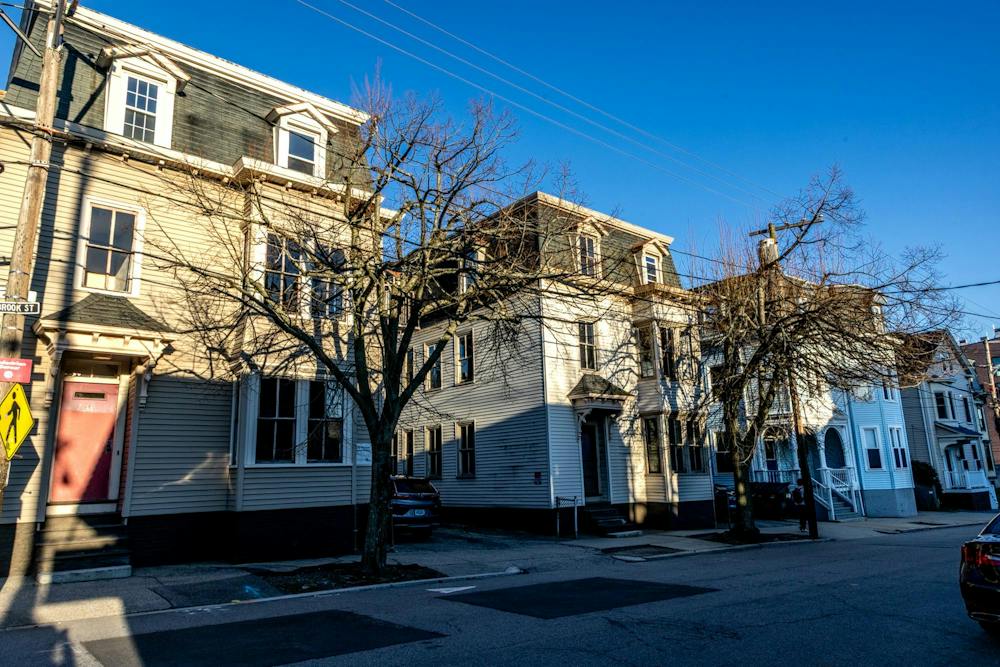
The original proposal held the potential for four residential houses, including two historic houses, to be demolished. The new proposal no longer includes the potential to demolish the two historic buildings, which were built in 1886 by Alexander Gorham, a Black real estate developer. In their new proposal, the University has committed to preserving and restoring these homes.
The preservation of the Gorham houses is a “good effort on the University’s part,” Ray Rickman — executive director of Stages of Freedom, an advocacy nonprofit aimed at reducing racial disparities — said in an interview with The Herald. “It’s a real win for Black history, Black culture,” added Rickman, who is also a former state representative for College Hill and Rhode Island Deputy Secretary of State.
During the meeting, Carey shared an overview of the building plan and the changes made over the summer. “A department that is spread across multiple buildings is less effective, less impactful and less attractive to students and faculty,” said Carey.
In the meeting, Goncalves asked whether the University has plans to integrate the historical home structures into the new building.
“We would make an effort to see if they can be relocated. Other homes in this area have been relocated,” responded Carey. “If not, to salvage as much as possible. But no, I do not anticipate any effort to incorporate them into the new economics building.”
Other attendees of the meeting mentioned worries such as construction noise and building designs not matching surrounding neighborhood buildings.
Marisa Angell Brown, executive director of the Providence Preservation Society, has been advocating for the preservation of the houses on the proposed building site, each of which the society considers historic.
The PPS, with the help of interns, is working on researching Brown’s history of demolition and development in Providence after the University told her that they do not keep records of this data.
She called for a moratorium on Brown demolition and development until the University does “a real accounting of their clearance and redevelopment history and the impacts in Providence,” she said.
In the Zoom chat, multiple community members repeatedly asked for a copy of the request for proposals.
“This has been a kind of a show of checking the box of community engagement by hosting a couple of Zoom meetings,” Angell Brown said in an interview with The Herald. “There is a sense that nothing being said is shaping outcomes.”
In response to residents’ criticisms of the University’s level of community engagement, University spokesperson Brian Clark wrote in an email to The Herald that the “significant” revision of the original plan was due to community feedback.
“Hearing from neighbors early in the design process allowed us to respond meaningfully to feedback in the feasibility stage while continuing to advance our institutional priorities,” Clark wrote.
Rickman said he believes Brown is unwilling to pay the price to move the historic buildings and they are being disingenuous when talking about moving them. “They wish to tear those houses down,” he said.
Brown has offered to sell the houses for $10 to anyone who is willing to pay for the relocation of the houses. The University has relocated and adapted houses in the past.
“If those efforts are unsuccessful, both (houses) would be offered to organizations for architectural salvage before the remaining structures are removed,” Clark wrote. “Many factors — e.g., the condition of the buildings, site and relocation considerations, project plans — impact decisions on when it is and isn’t feasible for the University to undertake building relocations.”
“It’s not realistic,” nearby resident Peter Brown said of offering buyers to move the houses. “It’s basically a way for them to buy themselves time, and say that they’re not destroying houses.”
Community members continue to advocate for all four houses to be preserved.
Peter Brown said that he is happy that Brown is keeping and restoring the two Gorham houses, but he believes that the University “should do even more” and keep all four houses.
“We’re not opposed to them building and growing, but try and work within the confines of what we have,” Peter Brown said. “Brown has a lot of resources and a lot of smart architects. Do something creative and don’t tear down more houses.”
Peter Brown believes that the reduced 60-foot height is still too tall and will tower over the four residential houses adjacent to the building.
“The proposed height is well below the height allowed in the area by city zoning ordinances, and is comparable to the residence halls and academic buildings located nearby,” Clark wrote. He noted that the sites are located within an I-2 Educational Institutional District Zone, which allows the “planned growth of educational institutions while maintaining compatibility with surrounding neighborhoods.”

Roma Shah is a section editor covering University Hall & Higher Education and Admissions & Financial Aid. She's a junior from Morgan Hill, CA studying Neuroscience and International & Public Affairs. In her free time, she can be found doing puzzles, hiking or playing Catan.
Jeremiah Farr is a senior staff writer covering university hall and higher education.


