This past weekend, “CLIMATE-CULTURE-COMMUNITY” was the central theme behind the Brown Political Review’s inaugural documentary film festival PROV/DOC. The two-day festival showcased documentaries from student, faculty and local filmmakers that spotlighted underreported issues, according to Julianna Muzyczyszyn ’27, BPR’s co-editor-in-chief.
Clara Baisinger-Rosen ’27, BPR’s head of multimedia production, said the organizers wanted to “create many opportunities on campus for filmmakers to present their work.”
“We are in a social moment where long-form filmmaking and documentary journalism are being threatened by a massive encroachment of misinformation and short-form content, much of it increasingly” generated by artificial intelligence, Baisinger-Rosen said.
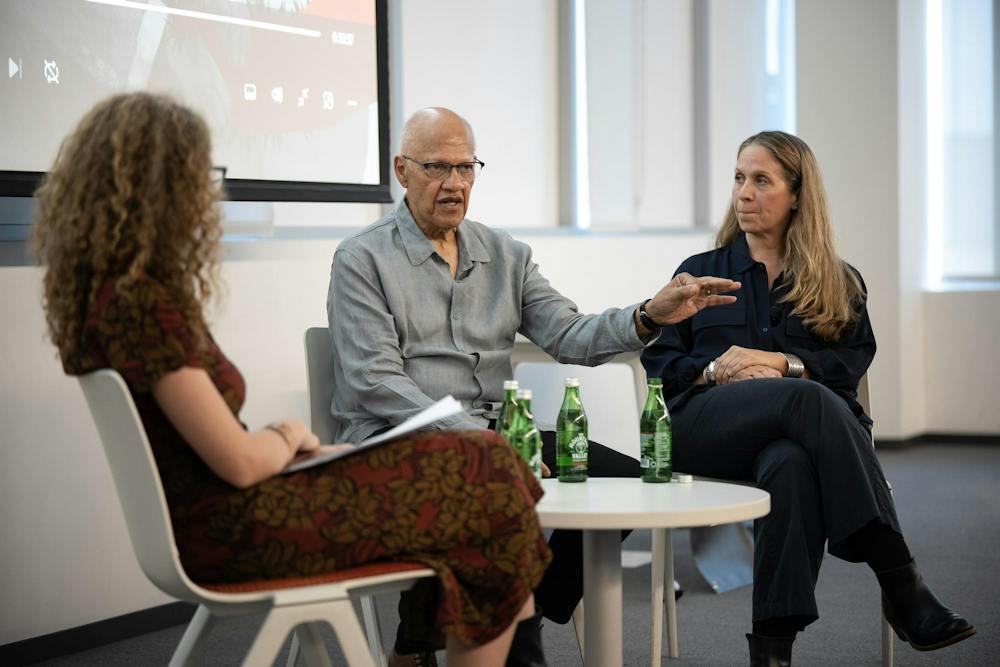
The festival was headlined and closed out by “Listening to Shadows,” a five-part audio series by Jennifer Galvin ’95 — filmmaker in residence at the School of Public Health —and Wilmot James — professor of the practice of health services, policy and practice and director of the Africa Initiative at the Watson School of International and Public Affairs.
James explained that the audio documentary follows his life through apartheid in South Africa, Nelson Mandela’s leadership and South Africa’s response to the HIV/AIDS epidemic, among other topics.
“I think about young people today who grew up in democracies, (and how) they’ve taken it for granted,” James said. By understanding the struggle that South Africa endured to become a democracy, he hopes that people will not take separation of powers, freedom under the law and constitutionalized protection for granted, he added.
PROV/DOC attendee Ben Underwood ’27 thought that “Listening to Shadows” brought a “really unique perspective” by showing “one person’s path through” the monumental historical moment of creating a democracy in South Africa. “I think it makes it feel much more intimate and less abstract and academic.”
Galvin wants “Listening to Shadows” to give people hope. “My hope always with creating stories is that they spark conversation and that they bring people together,” she added.
Many of the festival’s other features were short films, and the first day featured projects that covered a wide range of topics, from the Budongo Forest to rural life in Vermont.
While studying abroad in France, Ellie Wu ’28 learned that many workers in the yachting industry are South African migrants who are working illegally on tourist visas so that they can make a life for themselves. Other workers are attracted to the industry due to its reputation of having a large party culture, she said.
“Yachties: Inside the Industry,” aimed to highlight the negative impact the industry has on its workers, especially women, and the environment.
In her documentary “Rural Living,” Sadie Bell ’28 tells the story of three individuals who spent the majority of their lives in Putney, Vermont. Bell wrote in an email to The Herald that she wondered why some people choose to stay in one place for several decades.
Bell noticed that in many higher education environments, such as Brown, students are “constantly looking for what is to be and what we need to be doing to move toward, not seeing the current now and what is in front of us as enough,” she wrote in an email to The Herald.
To Bell, people who live in the present, such as the three individuals in Vermont, “all seem pretty damn happy,” she wrote.
Elodie Freymann ’18, a postdoctoral fellow at Brown, released the documentary “Waiting for Alstonia” in March 2026. The film explores the role of Alstonia, a plant species vital to both Budongo Forest’s wild chimpanzees and the people living along the forest’s edge.
“I think this story helps demonstrate how complex environmental issues are. There’s never one easy solution,” she wrote.
The film’s second day also saw a variety of documentaries, from films featuring Moroccan artisans to the South African apartheid.
“A Bomb Story” by Andrew Hsieh ’28, a video staffer at The Herald, told a story about the past, present and future of nuclear weapons.
“It’s also a story about living through tragedy and finding community amidst a broken world,” he wrote in an email to The Herald.
Maya Tkachenko ’29, a Herald opinions columnist, spent this past summer in Fez, Morocco where she studied artisanal governance and the evolving role of craft in Moroccan communities. “A New Weave” reflects the everyday lives of Moroccan artisans, as well as how they regained autonomy in the craft market, which is predominantly governed by middlemen, she explained.
“I think it’s really important that people, as consumers, consider the effects (of their actions) when (they’re) buying something,” she said. “Think about who it benefits… and what it might mean to the person who made it.”
Reflecting on PROV/DOC, attendee Ayla Kattler ’27 said that she believes “there needs to be more of a space for visual and audio storytelling at Brown,” adding that “PROV/DOC is an amazing outlet for that kind of creativity.”
“We got so many submissions, which means we’re gonna have to do it all over again next year,” said Gui Sequeira ’28, BPR’s chief of staff. “That’s the really exciting part.”
Tyler Timmers is a senior staff writer covering undergraduate student life.