
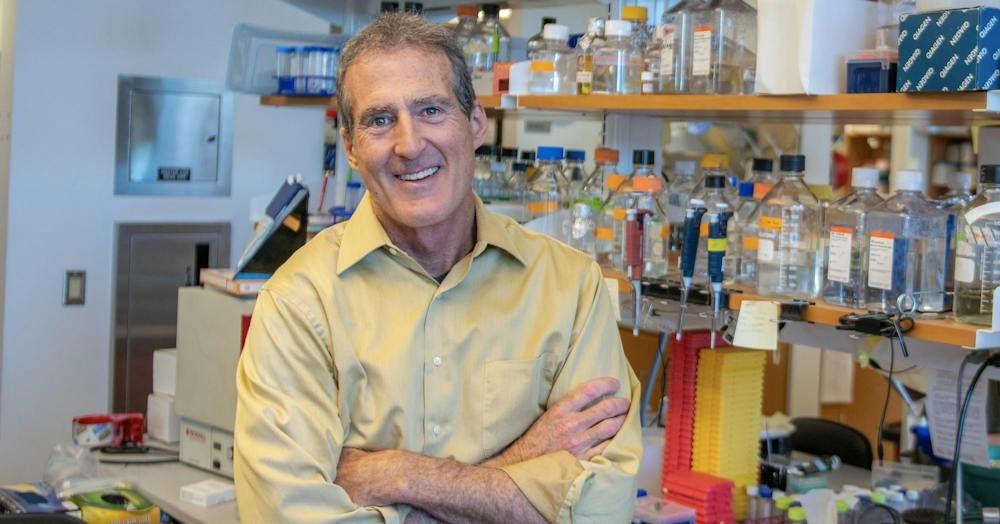
Craig Mello ’82 P’15 P’22 has always wanted to return to Brown. Now, 45 years after graduation and a Nobel Prize later, he will join the faculty of the Department of Molecular Biology, Cell Biology and Biochemistry in summer 2027.
Mello will work in the Giuliani RNA Center, which works to “advance RNA science through fundamental discovery, technology development and translational impact that accelerates life-changing health solutions,” according to their website.
Mello’s role comes after decades of experience working with RNA. In 2006, Mello and Andrew Fire won the Nobel Prize in Physiology or Medicine for discovering RNA interference — a phenomenon where double-stranded RNA interferes with mRNA to regulate protein translation.
“This Nobel-winning discovery gave researchers, for the first time, the ability to silence virtually any gene,” Dean of Medicine and Biology Sciences Mukesh Jain, who is also the senior associate provost for life sciences and senior vice president for health affairs, wrote in an email to The Herald.
The discovery “opened up a whole new class of drugs in which synthetic RNAs can be used to silence disease-causing genes,” Jain added.
In an interview with The Herald, Mello described his Nobel-winning discovery with Fire as a “stunning surprise.”
The two conducted their research on the worm species caenorhabditis elegans: a “self-fertile hermaphrodite,” Mello explained.
They discovered that injecting double-stranded RNA anywhere in the worm’s body can silence genes across generations. The researchers originally injected the specimen in the gonad — the reproductive gland responsible for secreting sex hormones — but found that administering the RNA in other places had the same effect. When the researchers injected the worms with double-stranded RNA, they found that the worms twitched in a way that might indicate gene suppression.
“I always call the worm the real Nobel Prize winner because it’s such a great system,” Mello said.
When Mello received the call in 2006, his wife thought it was a “prank call.” After receiving the news, his next call was to his parents. “My mom says, ‘Craig, you’re so young. Could you win another one?’” he recalled.
According to Walter Atwood — chair of molecular biology, cell biology and biochemistry — the connection between Brown and Mello “runs very deeply.”
“I’ve always wanted to be at Brown,” Mello said, expressing excitement to return to an “interdisciplinary environment.”
Mello, who described science as a “spiritual undertaking,” said it would be “refreshing to be in an environment where it’s okay to be philosophical.”
Jain wrote that alongside his contributions to existing research at Brown, Mello’s experience in biotechnology “will be invaluable for other researchers who are in the process of starting companies or licensing their discoveries so that they can be developed into therapeutics that can help patients.”
Mello said that he is excited to work with undergraduate students, describing them as “fearless.”
“It would be just so much more fun when the undergrads were around,” he said, reflecting on his experiences with summer undergraduate researchers in his lab.
Jain wrote that Mello’s lab “will bring an infusion of new ideas and potential new directions for research.”
“(Mello) fits in perfectly,” said Atwood. “He’s an RNA biologist, a developmental biologist. His coming to Brown is really going to energize a lot of us doing research.”
Mello said it is important for everyone to have a basic “understanding of our genetics” to make informed decisions, such as whether to receive immunizations or what kinds of medicines are safe.
“I would just be thrilled if I inspire some other people and help generate more scientists, more smart public citizens of the world,” he added.
Nishita Malhan is a senior staff writer covering science and research.
Angel Lopez is a senior staff writer covering Science and Research. He’s a sophomore from Tyler, Texas and planning to study neuroscience and literary arts. In his free time, you can find him playing ping pong, listening to music, or reading.


