
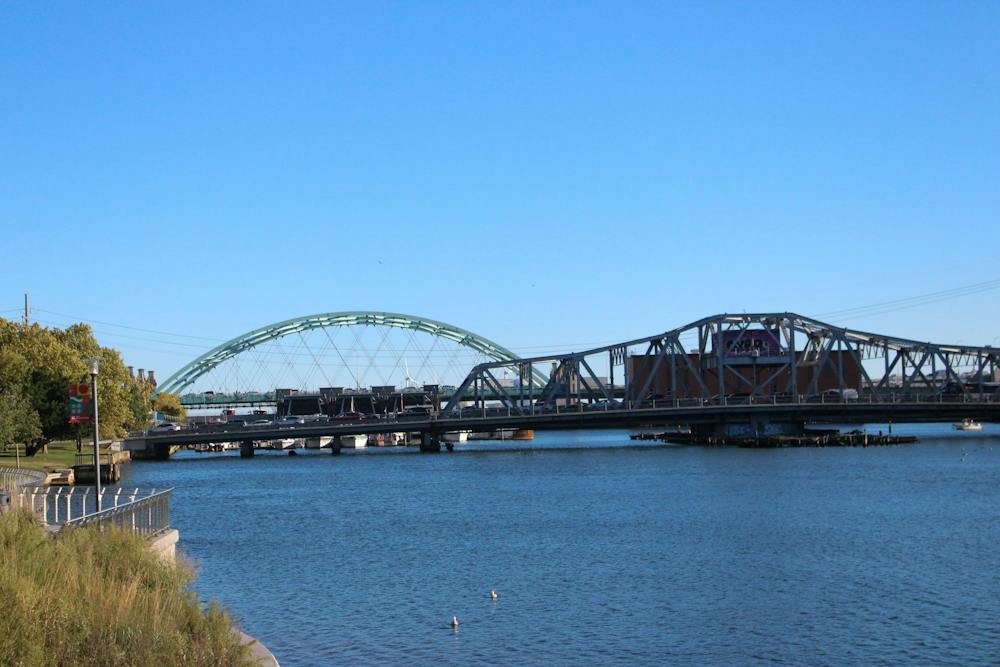
In the last decade, Rhode Island has spent big on improving its bridges — and has seen the payoff. But the state’s roads have not received the same attention, according to a September 2026 report by the Rhode Island Public Expenditure Council.
When the RhodeWorks transportation infrastructure plan was first implemented in 2016, the percentage of Rhode Island’s bridges that were considered in poor condition was around 24% — about three times the national average, according to Jeffrey Hamill, a senior policy analyst at RIPEC and the primary author of the report.
“When 10% or more of a state’s bridges are rated as poor for three consecutive years, the state enters what the Federal Highway Administration terms a ‘penalty phase’ and mandates that a minimum of 50% of federal transportation funds are allocated to bridge work,” Rhode Island Department of Transportation programming services officer Heidi Gudmundson wrote in an email to The Herald.
In the past decade, RIDOT has finished refurbishing 367 bridges and made progress on over 100 more, Gudmundson wrote. These updates came out of a total budget of $5.9 billion, she added.
By 2024, only 15% of the state’s bridges were classified as poor, which Hamill said was the second-largest improvement nationally.
In September, FHWA informed RIDOT that the “penalty phase” mandate was over, Gudmundson wrote. Based on 2026 National Bridge Inventory data, “Rhode Island has dropped to 9.1% of total deck area of (National Highway System) bridges in poor condition, which is below the 10.0% threshold to come out of the penalty,” Shay Burrows, director of the office of bridges and structures at the FHWA, wrote in a letter provided to The Herald by RIDOT.
The decision to invest heavily in bridges “made sense at the time,” Hamill said, because the bridges were in a “perilous state.”
“A road won’t collapse,” he said, but “a bridge will fall down.”
RIDOT’s decision to focus spending on bridge repair was “defensible” given the large number of structurally deficient bridges, said Scott Wolf, executive director of Grow Smart R.I., a sustainable growth and infrastructure organization. “I wouldn’t rake them over the coals too much for a short-term imbalance,” he said, adding that “it’s not the ideal scenario long-term.”
This focus on bridges came with its trade-offs, Hamill said. In 2024, Rhode Island’s state-maintained non-interstate arterial roads were ranked lowest in the country, according to the report.
According to the report, between fiscal years 2020 and 2024, Rhode Island spent $8.40 on investments in new infrastructure for every dollar spent on routine improvements like fixing potholes. That ratio was over two and a half times the national average.
But only 31% of Rhode Island’s spending on new infrastructure was directed toward roads, the lowest percentage of spending on roads nationally, the report states.
Wolf also noted a “revealing pattern” of northeast and mid-Atlantic states having the highest proportion of deficient roads. He attributed this to two main factors: “We have the oldest transportation infrastructure in the country” and “the most pervasive freeze-and-thaw pattern of weather for the most number of months,” which results in potholes and worse road conditions.
Due to these two “fundamental disadvantages,” Wolf said that “it’s unrealistic to expect we’re going to be in the top 10 or even the top 20” states for road conditions.
Gudmundson wrote that Rhode Island “has made considerable investments in both state and municipal road repair and maintenance” in the past several years through initiatives like Gov. Dan McKee’s RhodeRestore municipal road grant program.
“RIPEC’s study relies on lagging indicators and does not represent all the road improvements made in the last two years,” Gudmundson wrote. She added that, from 2024 to 2026, RIDOT carried out 80 pavement projects and the RhodeRestore program completed 860 municipal road projects, with the state directing over $375 million in road investments across both programs.
Hamill confirmed that the RIPEC report only considers data through the 2024 fiscal year.
“We applaud the efforts by RIDOT over the past decade to right the wrongs of years of infrastructure neglect,” Christopher Maxwell, president and CEO of the Rhode Island Trucking Association, wrote in an email to The Herald.
Going forward, the report recommends that Rhode Island balance spending on new and existing infrastructure, focus on improving non-interstate state roads and avoid additional borrowing that could worsen debt.
With Rhode Island now out of the FHWA penalty phase, the state has “more freedom in terms of allocating federal transportation dollars,” Gudmundson wrote, though the current 10-year plan still emphasizes bridge repair and replacement.
Rhode Islanders “want to see roads that are going to do less damage to our cars and that are going to be improved enough so that there’s not unnecessary congestion based on structural deficiencies and based on avoidable accidents,” Wolf said.
“While there is still a long way to go, we are optimistic that … improvements to highways, roads and bridges will continue,” Maxwell wrote.
Wolf also emphasized the need for increased spending on transit, bike and pedestrian infrastructure.
“We are grateful for RIPEC’s analysis,” wrote R.I. House Speaker Christopher Blazejewski (D-Providence) and Senate President Valarie Lawson (D-East Providence) in a joint statement provided to The Herald. “We share their concerns, which, in addition to our committee hearings, is why we passed a requirement for an efficiency and performance audit of RIDOT as part of the state budget.” The findings from this audit are due in March 2027.
“It’s long overdue,” Wolf said.

Pavani Durbhakula is a Metro editor. She is a junior from DC and is studying IAPA and Public Health. In her free time, she enjoys baking, reading and searching for new coffee shops.


