The mysterious lives of serial killers, the stolen paintings from the Isabella Stewart Gardner Museum, the assassination plot of Gianni Versace, conspiracies to rob large banks, and the acquittal of OJ Simpson dominate my Netflix recommendation carousel. As my midterm deadlines march steadily closer, I am nevertheless distracted and consumed by investigations of unresolved questions in violent crimes.
During my late adolescence, I loved to watch true crime media because I participated in high school mock trial. As a totally unqualified but highly enthusiastic prosecution attorney, I pored over the material facts in order to argue in favor of the admission of evidence. During my freshman year, after drafting and memorizing my opening remarks, I remember promptly forgetting the entire speech in front of the entire court room and volunteer judge. While my career as a lawyer began and ended at fourteen, my interest in how legal arguments are constructed based on the facts of the case—and the facts that are missing—remained.
But these days, I need not look further than my New York Times notifications to get a fix. Each day, my home screen offers a waterfall of headlines reporting on violent protests, manslaughter, and war. In a world where suffering and pain run rampant, consuming information about crime as it unfolds no longer feels like entertainment. Even so, I cannot keep my eyes away. I think court cases grab my attention because I love to notice and examine unsolved questions. Why, after decades, haven’t the paintings been recovered? Why might’ve the evidence been scrubbed from the record?
Earlier this week, one of my roommates mentioned that women comprise about eighty percent of true crime audiences—across print, film, and TV (as of 2023). Compared to horror, which often depends on fiction to create gripping storylines, the fact-based nature of true crime made me reconsider my interest in criminal law. A 2010 article published in Nature hypothesizes that women view true crime—consciously and unconsciously—in order to identify possible risks and avoid the possibility of harm. Perhaps, then, I’m just trying to get prepared.
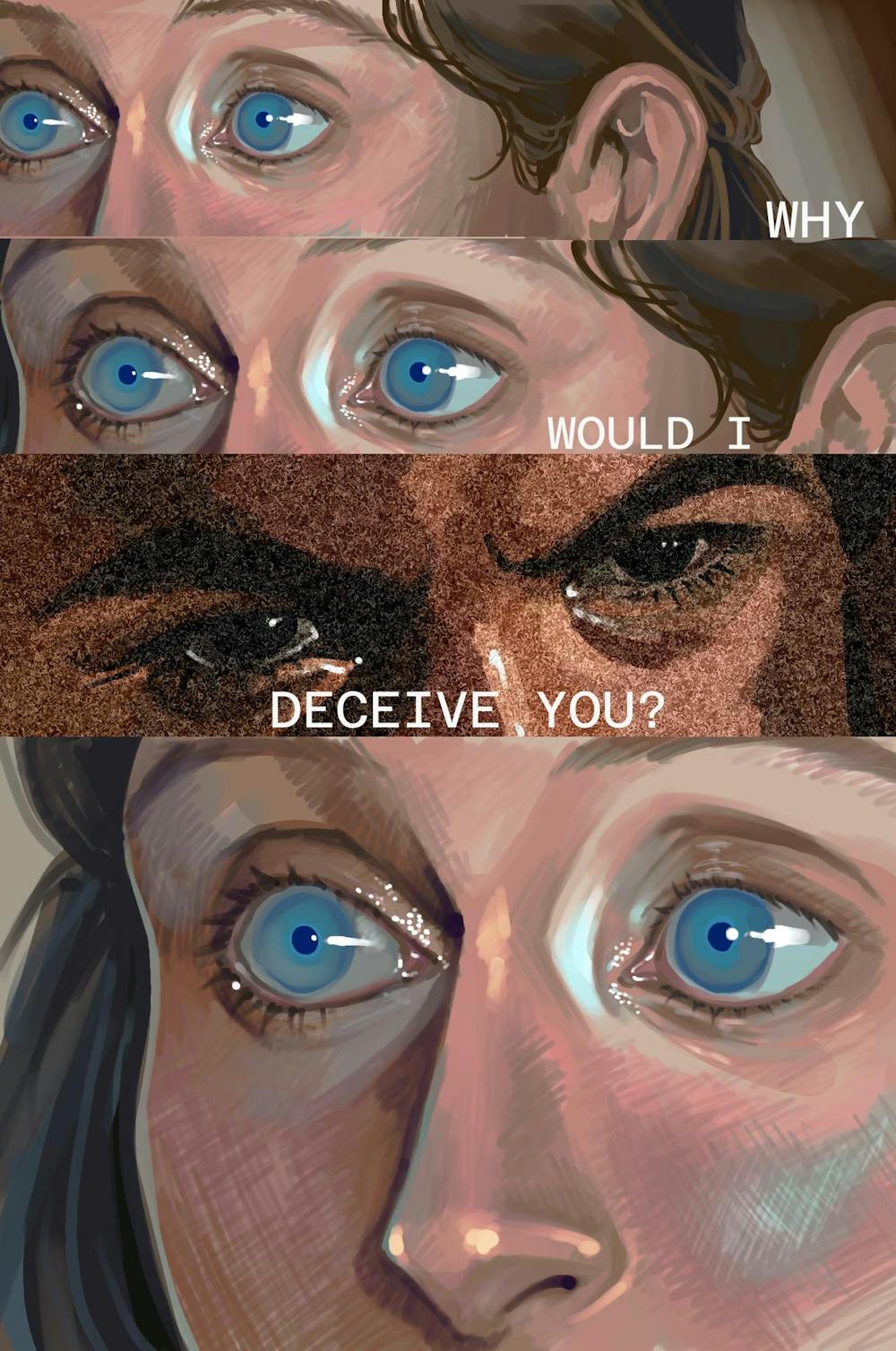
Recently, I realized that an overwhelming majority of the cases and true crime media that I’ve consumed center on male defendants: Ted Bundy, Al Capone, Charles Manson, Donald Trump’s sexual assault allegations, and most recently, the Cornell case. When I heard about Nathan Fielder’s directorial debut You Can See Everything, I was curious about what I could learn from a documentary about a female felon. A victim of sexual violence and male domination herself, the film creates a platform for Holmes to give testimony—without the anxiety of being under oath in a courtroom—about her convictions of a deceptive crime: fraud.
Since Holmes’s conviction in 2022, she largely faded from the spotlight. While I was familiar with the buzz surrounding the movie, I decided to approach the movie with as little background knowledge as possible in order to notice the character that the documentary presented of Holmes. Trading her signature Steve Jobs turtlenecks for jeans and exercise clothes, Elizabeth became “Liz.”
Without her lab coat, I found Holmes’s casual appearance and relaxed demeanor helped to create an environment more apt for truth-telling. She appears comfortable, often sitting by the beach or in her living room during interviews. Even so, without the pressure of being under oath, the documentary poses unique questions of whether telling the truth is possible under the circumstances. During and after her trial, Holmes expresses her innocence relentlessly. Importantly, the documentary filmed hundreds of hours of tape with Holmes before and after she left for prison. Over so many hours, the probability of performance felt highly improbable. In pursuit of the truth, it appeared that Fielder was playing the long game with her.
Fielder’s background in comedy provides him with a unique opportunity to act as a guide and a translator for the audience. He constantly asks follow-up questions to clarify Holmes’s vague and circular claims, and he appeals to Holmes by asking her to explain her feelings about going to prison. Despite my sky-high hopes that the interviews would reveal new details about the case, she only answered about half of Fielder’s questions—oftentimes after long, suspenseful pauses—with “I—I’m sorry, I don’t know,” or “I don’t recall,” or “I don’t remember.”
But why? Or, to be more specific, how couldn’t Holmes remember some of the most consequential details of her life? Beneath her skin, Holmes appears almost robotic, like a failed machine, eerily similar to one that resulted in her prison sentence in the first place. Despite the film’s strenuous attempts to capture “Liz” instead of “Elizabeth,” part of her character still felt missing.
At the end of what became a three-year filming odyssey, I was surprisingly left most with a feeling of empathy for Holmes—an obviously intelligent scientist—after witnessing her being separated from her children, confined to a cell, and left unable to speak for herself. I realized that perhaps beside an overwhelming amount of misleading information, I wanted Holmes to be able to speak and be free anyway. That said, even if Holmes could speak, would she speak the truth?
Sometimes, questions simply lead to more questions. Despite the inclusivity of the film, the documentary feels like a triumph. In conducting such a high volume of interviews with Holmes at her rental home, playing with her children and running on the beach, perhaps the purpose of the documentary was instead to provide a new angle on her character, instead of revolutionary details about the case. That said, to what extent is Holmes’s character a construction? Who built her? And why?