
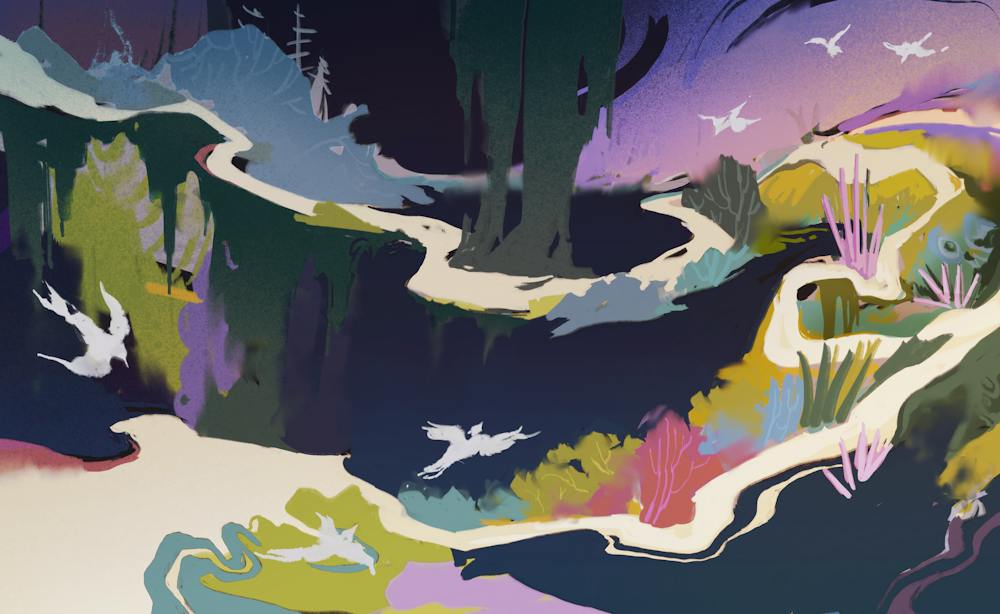
On the opposite side of a fur-coat-filled wardrobe, in the eye of a cyclone, down the rabbit hole, through a looking-glass, a child-sized door, a book, Platform Nine-and-Three-Quarters. The literature and movies we’re raised on abound with portals to other worlds.
Often symbolizing dissatisfaction with one’s ordinary world, being lost brims with promise—gripping adventures, discovery of the unknown, increased independence—tempered by the threat of isolation and uncertainty.
Whereas the state of being found represents security, community, and knowledge, the state of being lost leads to learning, individualism, and feeling yourself as a force against other forces. Getting lost begs the question: When the familiar surroundings and boundaries of your normal life dissipate, who are you?
The first time I remember getting lost, I was very young—a toddler really. What was supposed to be a nice nature walk through a garden devolved into something else entirely when my little brother threw a tantrum. Preoccupied with soothing her son, who sobbed among lavender and black-eyed susans, our mom didn’t notice her other child roaming off. Absorbed in my own world, I trod past the wisteria-covered gazebo, lilies, roses, and purple coneflowers. Eventually, I paused, looked around, and was surprised to find I had long lost sight of my family!
I can well imagine another kid in my situation growing afraid upon realizing the familiar landscape had given way to unknown terrain. I see that kid (one with arguably better survival instincts, if more timidity, than four-year-old Fiona) starting to fret and even cry. In time, they’re found—plopped down on the ground, crumpled expression hidden beneath pudgy hands…
Well. That hypothetical scenario couldn’t have been further from my experience. Quite the contrary, not only was I strangely unbothered but I felt calm. So this must be what it feels like to be an independent adult, a big kid, a deep sea explorer, an astronaut! Or the main character of a story, setting off into the horizon on an adventure. A surge of elation bubbled up through my body. I felt free. Because now I answered to no one. Now, I was responsible for myself. What should I do? What did I want to do or be?
I continued on, encountering elderly women who gathered around me in a gaggle of concern. Thus cozily surrounded, I told them my tale in the hotel lobby—where my mom found me. Happily reunited, waving goodbye to the old ladies, I learned then that getting lost would get me attention.
That being said, my lifelong love affair with getting lost can’t be simply reduced to attention-seeking behavior. There’s real thrill in the spontaneity, anonymity, and unfamiliarity of being lost. People have an escapist urge to leave behind the everyday. If not, why does so much of our art strive to snap us out of our routine stupor, to make the world seem strange again? In his essay “Art as Device,” Russian critic Viktor Shklovsky argues: “Habituation devours work, clothes, furniture, one’s wife, and the fear of war… Art exists that one may recover the sensation of life; it exists to make one feel things, to make the stone stony.” In life, I’ve found this alert, alive feeling comes to me when I’m lost.
Of course, such experiences are only thrilling in so much that you believe you’re ultimately safe and will find your way back. If this was a personal essay about my getting lost and never being found, it’d be a very different story.
One of my family’s inside jokes is that my brother must have been a sheep dog in a past life…which makes me the meandering sheep. Whereas I’m given to dreamy wandering (drawn towards some vibrant tree or alluring window display), he wants us to all stay together. How many times have I seen him swiveling his head, straining his neck, scanning the crowd, and beckoning me back? So, I suppose I can like getting lost, in part, because I know people will go looking for me. After all, Odysseus’s homecoming would have been a purely bitter occasion had the faithful Penelope forgotten him. It’s a simple craving—to hear one’s name called.
Twice, the police have been called on me. Once, in Edinburgh on a ghost tour. Fed up with walking on stubby legs, my brother flung himself into the middle of a cobbled street—from where he refused to get up. I kept up with the tour, not wanting to miss out on any haunted sites or witchy lore. The last I saw before we turned the corner was my mom standing over my brother in the dying light, hands on her hips. The tour ended in Greyfriars Kirkyard Cemetery. Everyone thanked the guide, tipped, and disappeared back into the dark streets. My breath came out in white puffs. The tour guide didn’t know what to do with me. She had a concert to attend. We headed toward it, retracing our steps in the hopes of stumbling upon my family. Meanwhile, my mom was in a police station, giving my description.
Another time police got involved was on a farm in the Catskills. My family stayed in a cabin right by a creek, where me and the other kids would spend sunny afternoons. One day, at my behest, we decided to travel up the creek. Together, we splashed over wet stones and avoided electric wire! (Later, we were disappointed to learn the “electric wire” was just a piece of string demarcating the farm’s territory. Not dangerous at all.) Unbeknownst to us, our parents searched for their missing children in the cabins, barn, henhouse, fields, and hills. But my friends and I had already reached the neighboring farm when someone finally sprinted up the creek and caught sight of us, gabbing away on mossy rocks. Roughly escorted back like a pack of criminals, we couldn’t understand why the adults were so angry. We hadn’t been lost! Far from it, the creek was a watery path winding our way back home.
Now that I’ve shared anecdotes of my getting lost, when was the last time you got lost? Truly lost, not temporarily turned around on Google Maps. All the instances I’ve given are from my (early) childhood. Why is that? Did I suddenly gain a good sense of direction? Or adopt my brother’s sheep dog mentality? Is this a natural part of maturing?
I’d contend that in today’s technologically advanced Information Age, getting lost is an increasingly rare occurrence because it’s basically a “problem” of the past. One solved by apps like Google Maps, Find My, Life360, Messages, WhatsApp, and Instagram—software that enables the user to not only know where they themselves are but also where their family, friends, acquaintances, celebrities, and social media influencers are at (almost) all times.
I’ve become so reliant upon these tools that I feel lost without them. Honestly, I can’t remember the last time I stumbled upon a hidden gem of a cafe, bookstore, or thrift shop. It’s not that they don’t exist anymore; it’s that I don’t let myself “stumble” anymore. Instead, I search places near me, consider the options, read reviews, scroll through photos, and scour menus before making my decision. Stepping foot inside the establishment for the first time, I know what to expect. Spontaneity? Crushed.
But is planning really so bad? I would say it’s like if someone used AI Overview for everything. Sure, it may give you a helpful general idea (assuming its information is correct), but it also skims and skips over a lot. I don’t want to live my life in Overview mode.
Which is why when a friend recently proposed we “hop on a random bus, ride it for like thirty minutes, get off, and try to find our way back. No phones allowed!” I had just one question: “when do we leave?”
Maybe, in the end, I love getting lost (then, found) because it makes for a story to tell: “One day Alice came to a fork in the road and saw a Cheshire cat in a tree. “Which road do I take?” she asked. “Where do you want to go?” was his response. “I don’t know,” Alice answered. “Then,” said the cat, “it doesn’t matter.”


