Every week or two in seventh grade, my friends and I would get together to watch a movie. Without parental supervision, we often ventured into territory we had no business exploring. To this day, Don’t Hug Me I’m Scared still shakes me to the core. On one such movie night, my friend Eli mentioned that his older brother, then in high school, was going to throw a “Project X party” and that we should watch the movie that inspired it. As we sat on the couch, astonished by the sheer insanity of the film, I couldn’t help but shudder at my friends’ enthusiasm. They were looking forward to this, and I was clearly in the minority. Content with riding bikes, playing video games, and running around outside, I wasn’t against alcohol…I was afraid of my friends changing.
Before high school, alcohol felt like a mythical and untouchable thing, the key to a stereotypical high school party experience that I assumed I’d need to be part of within a few years. If you’d have asked thirteen-year-old me to describe what the average high schooler was like, you’d be left with the image of a fratty lacrosse bro holding a Bud Light. Growing up with two brothers—four and six years older than me—I had a front-row seat to that world. Watching their experiences, I came away with the false impression that drinking was a necessary part of enjoying high school. I was paralyzed by the prospect of parties.
To add insult to injury, I was diagnosed with type 1 diabetes just before my tenth birthday, and from that day on, doctors drilled into me that my illness and alcohol do not mix. I felt real discomfort whenever anyone brought up drinking. I remember telling my friends, “Guys, we don’t need to drink to have fun. It’s super bad for your liver anyway.”
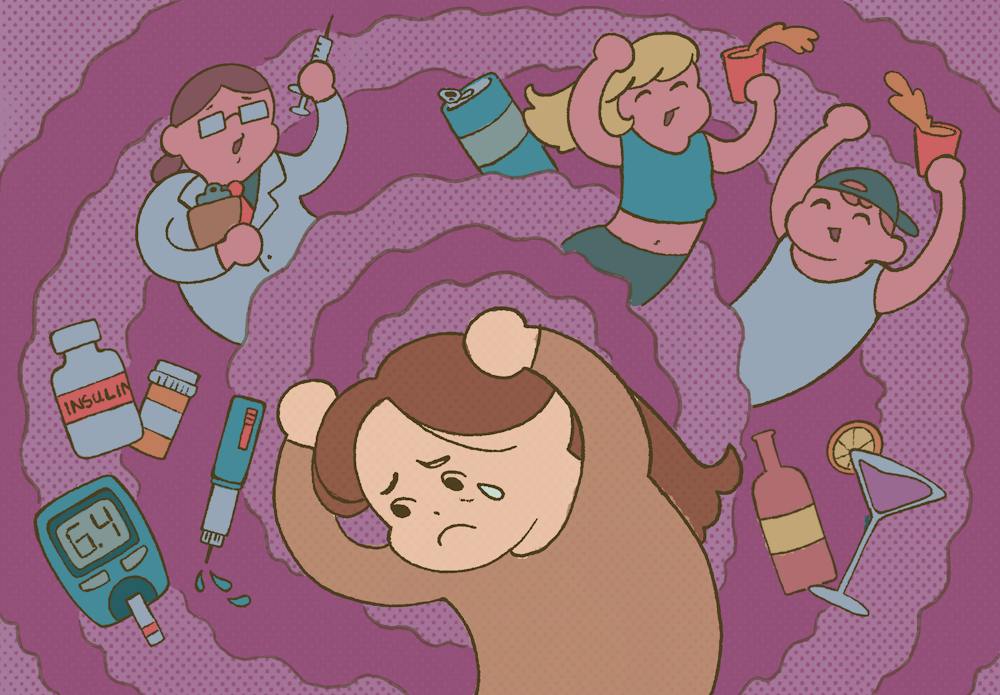
For my body, in which my pancreas doesn’t work like everyone else’s, alcohol is incredibly dangerous and, in certain scenarios, life-threatening. Our bodies treat alcohol as a toxin, so when we drink, the liver stops its normal functions, including releasing small amounts of stored glucose (glycogen) into the bloodstream. For someone with a working pancreas, this isn’t as dangerous a situation. But for me, the insulin I give myself keeps working in the background, with no glucose to balance it, and my blood sugar plummets. Severe hypoglycemia, or low blood sugar, can lead to loss of consciousness, seizures, and even comas. Because being drunk and having low blood sugar look alike, a peer at a party might assume I’m just too drunk and shrug it off. While they believe everything is fine, I might need sugar to keep me from needing a hospital bed.
Since I was naive, I did the only thing that made sense to me at the time: I shoved my fear down and tried to fit in. My resistance to the discomfort was futile. Once we got to high school, parties entered the social equation. More and more, my friends wanted to drink, and as a result, they wanted to hang out with me less and less. They stopped inviting me, and instead of attributing that to them knowing I didn’t want to drink, I felt like something was wrong with me.
Since my diagnosis, I have dealt with intense health-related anxiety. I’m a perfectionist, and perfectionism and diabetes don’t mix well. My CGM (continuous glucose monitor) updates me with a blood sugar reading every five minutes. As a kid, keeping that number as “perfect” as possible was a source of control and self-worth. I would replay the decisions that I had made in my mind over and over again, asking myself what I could have done to prevent the disruption of my blood sugar. I had tied my meaning and importance as a person to an arbitrary number. And every time I went to the doctor and was praised for my stellar control, it motivated me to keep going. For me, my illness felt like an anchor weighing me down, filling me with constant dread.
That anxiety carried over into my social life, and I began to retreat into myself. While I was once an extroverted and loud child, I became a quiet and introverted teenager. Thoughts of my health, school performance, and future constantly swirled in my head. I envied my peers who seemingly, at the snap of their fingers, could drink and party their worries away. Diabetes often felt like a trap. I loathed having to be constantly aware of what I was eating or about to do. To me, alcohol represented everything I was restricted from experiencing. So I spent high school trying to avoid it at all costs.
Fast-forward to this past summer, when my brothers began trying to convince me to start drinking, even just a little. The thought repulsed me, but they believed my sobriety would adversely affect my college experience. I didn’t want what had held me back in high school to hold me back in college. Managing my diabetes had gotten easier over time, so I thought I might be ready. On a night when my family went out to dinner, I decided to order a cocktail. I was prepared: I had researched how to dose insulin for a drink and which cocktails were best for diabetics. After my drink arrived, I took my first sip. I was repulsed. Goosebumps ran over my body, and I knew deep down that I was still afraid. I was afraid of losing control over the illness I had taken so long to master.
As I set down the drink and told my family what I was feeling, a realization began to set in. I had spent so long trying to be like everyone else that I had forgotten who I was and what I wanted. I would hold a beer in my hand at high school parties to fit in, afraid of seeming uptight and boring. In reality, I was too aware and sober to enjoy parties. When approached by peers and asked why I didn’t drink, I could never quite come up with the right reasons or words. Was it my diabetes, or something else all together?
What I valued were small get-togethers and quality time with friends and loved ones. I had an adversarial relationship with alcohol. I saw it as a wild animal—something to be tamed in order to “be like everyone else.” It took me a long time to see that this approach was an obstacle to becoming my own person.
Arriving on College Hill, I again questioned my sobriety. Would I find it hard to make friends if I didn’t drink? If I didn’t want to go to bars or clubs, would I still find things to do? Fear crept back in and made me question my values. I had always associated college with drinking, so would my experience fall short of my expectations if I didn’t? Like many people, my high school social experience wasn’t ideal. In my senior year, I created an idealized version of myself in college. I saw my high school years as a stepping stone to get to the next thing. Over time, however, I’ve recognized that wherever you go, there you are. My insecurities revolving around my sobriety wouldn’t go away solely because I started going to an Ivy League school. What’s meaningful isn’t the change in environment, but the evolution of my sense of self and values.
During my first few weeks on campus, feelings that consumed me during high school began to reemerge. Like most freshmen here at Brown, I attended my first Jounge party on day two of orientation. As I began to feel overwhelmed—and wanted more than anything else to leave the hot, cramped lounge—I panicked. I was afraid of being a social outcast, so I felt the need to be in a place where I didn’t want to be.
This past weekend was the infamous “Halloweekend” that I’ve seen posted on Instagram for ages. However, that same feeling that I had been expecting to arise didn’t emerge. What would usually be a ferocious battle between my fear of missing out and anxiety surrounding alcohol didn’t occupy my thoughts. Being in college, where you’re forced into taking accountability for your own livelihood, I’ve realized that I know how and with whom I want to spend time with. Just because I don’t want Brown EMS to show up on my doorstep doesn’t mean I can’t enjoy myself. For so long, my mindset has been what has held me back from freedom. Every time my friends suggest going out, I already feel like it’s going to suck. That time, I decided to commit to having fun—and I did.
I’m only a few months in, but I am more sure than ever that I don’t need to drink to prove anything. At Brown, I’ve begun to find a community of friends who don’t see my sobriety as “lame” or “stuck up.” It’s going to take a while to be sure of myself, but I’ve now determined that’s for the best. Change isn’t linear—we ebb and we flow. Sometimes I feel extraordinarily confident, and sometimes I curse my diabetes for my decision to not drink. I may not throw a party that leads to a SWAT raid, but my decision not to drink isn’t going to define my four years here. I’m now perfectly happy to tell anyone that I don’t drink and why. I am no longer ashamed, and I know my experience won’t be shaped by what I chose not to do, but instead by what I choose to do.