
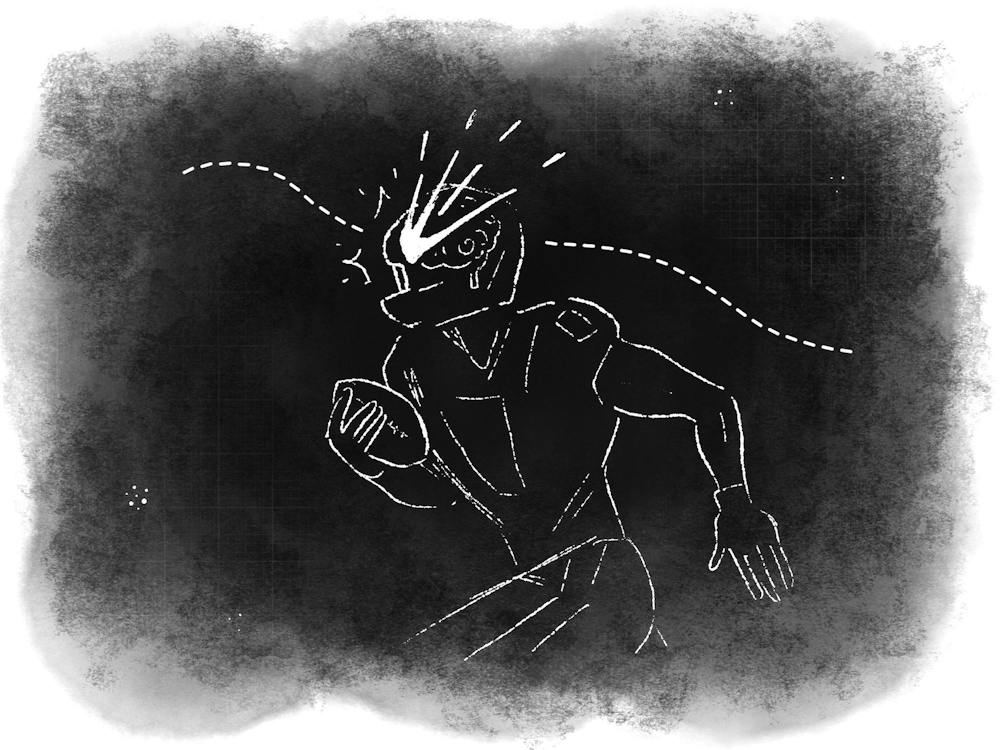
Football is the United States’ favorite sport. Nearly 1.5 million Americans play the game, but the high-contact sport can be very dangerous. With about 1.2 million football-related injuries each year, it begs the question — can the sport ever be safe?
“My answer is yes,” said Associate Professor of Engineering Haneesh Kesari. “But in order to be able to do that, we need to be able to collect the data” on how the sport is being played.
Head injuries are one of the most common types of injuries in football. Nearly 25% of NFL players who passed away between 2016 and 2021 had chronic traumatic encephalopathy, a neurodegenerative disease caused by repeated traumatic brain injuries.
Patients with CTE may experience problems with cognition, memory and behavior, but the disease can only be “definitively diagnosed” after a person’s death, Associate Professor at Harvard Medical School Daniel Daneshvar wrote in an email to The Herald.
In a recent study, Daneshvar — who is also the chair of the department of physical medicine and rehabilitation at Mass General Brigham hospital — and his research group “found measurable differences on MRI in living former football players that were related to the cumulative force of the head impacts they experienced during their careers.”
“Repetitive head impacts over time, including the many impacts that never cause concussion symptoms,” contribute to the development of CTE, Daneshvar wrote. He noted that concussions are not the sole reason for CTE, writing that the average collegiate offensive lineman endures 341 other head impacts “of equal or greater force” for each diagnosed concussion.
Kesari said that a difficulty in addressing CTE is the absence of pain receptors in the brain.
“Evolution did not expect human beings to be hitting their head so hard, so evolution did not give us pain receptors because they did not expect that our organs would be shaken like this,” Kesari explained.
Kesari said that information such as brain strength and events experienced by the brain can help develop a feedback system to help players participate in the sport as safely as they can.
For example, “if you take away the body’s ability to feel pain,” then this can result in more injuries as there is not a feedback system in place to stop the dangerous action, Kesari explained. “If a tennis player could not feel pain, they’ll keep playing until their hand falls off.”
Helmets can also play an important role in preventing major injuries. But despite the benefits that they can bring to a football player’s head safety, “no helmet can eliminate the forces transmitted to the brain when the head is hit,” Daneshvar explained. “Equipment does not address the fundamental problem of accumulating hundreds or thousands of head impacts over time.”
Another way to prevent serious injuries, Daneshvar said, is for collegiate and high school teams to “practice like the pros.”
He explained that head-impact exposure could be cut in half by making the simple change of limiting physical contact during practice, where 70% of head impacts occur. In the NFL, teams have reduced contact practices to once per week on average during the regular season.
“There is no reason that younger athletes need to accumulate more unnecessary head impacts in practice than professional players do,” Daneshvar wrote.
Adding CTE prevention protocols to standard practice could also prevent long-term damage, he noted.
“Players with greater cumulative exposure had more enlargement in specific parts of the ventricular system, the fluid-filled spaces within the brain,” Daneshvar wrote. Although it is not a definite test for CTE, this finding “suggests that we may be able to measure some of the long-term effects of repetitive head impacts while someone is still alive,” he wrote.
According to Brown Football Head Coach James Perry ’00, the Ivy League has implemented some of these practices. In an email to The Herald, he wrote that during practices, players kick off from the 40-yard line instead of the 35-yard line to promote fair catches, in addition to not tackling during practice.
“The Ivy League has been a leader in enacting these rule changes and the data supports its efficacy,” he wrote.
At Brown, Kesari’s group used sensors in helmets to develop computational head models that “can predict what happens inside the brain.”
“People can wear some sensors that will give (players) the feedback of what is and what is not safe,” he said.
For example, if someone were playing football and there were sensors that informed them their brain “did not deform more than it would if you are climbing stairs or … playing tennis, then at least I know that football was as safe as climbing stairs,” said Kesari.
“There is no way to make a contact sport risk-free, but I absolutely think we can make football safer,” Daneshvar wrote. “The goal is not simply to identify risk. It is to give athletes the benefits of sport while doing everything we can to protect their long-term brain health.”

Ivy Huang is a University News and Science & Research editor from New York City. Concentrating in English, she has a passion for literature and American history. Her favorite authors include Marilynne Robinson, Vladimir Nabokov, and Toni Morrison. Outside of writing, she enjoys playing basketball, watching documentaries, and beating her high score on Subway Surfers.
Angel Lopez is a senior staff writer covering Science and Research. He’s a sophomore from Tyler, Texas and planning to study neuroscience and literary arts. In his free time, you can find him playing ping pong, listening to music, or reading.


