
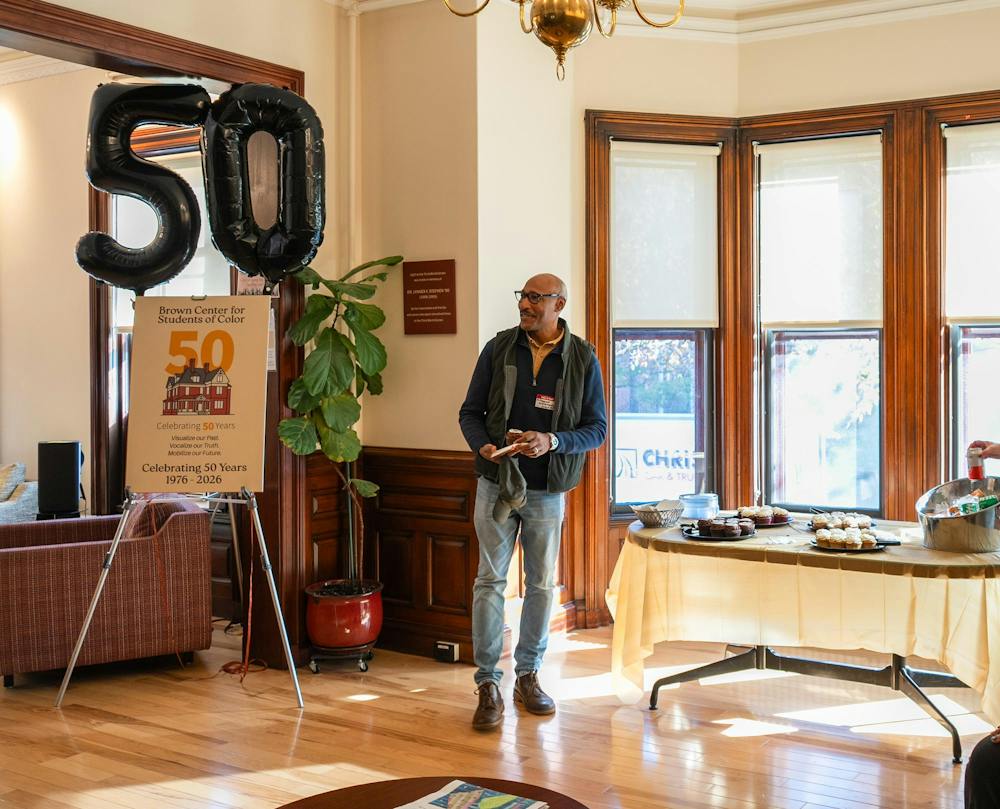
The Brown Center for Students of Color marked its 50th anniversary with a new digital exhibition documenting the center’s past programming and evolution since its founding. The celebration also featured an in-person showcase in Partridge Hall, featuring archival material from the center’s history.
The digital exhibition, titled “Celebrating 50 Years: Visualize Our Past. Vocalize Our Truth. Mobilize Our Future,” contains 14 selected highlights from the center’s digital repository. The center’s broader efforts to digitize its archives have been in progress for over three years and has involved the digitization of nearly 200 items, including VHS tapes, CD-ROMs and cassette tapes.
Among the items, there are recordings of lectures, a 1985 student protest, convocation speeches and a 1999 performance from Shades of Brown, a student a capella group. BCSC’s student board helped select and caption each of the fourteen items.
The exhibition was created in collaboration with Brown University Libraries and the Brown Digital Repository. The archive “honors the legacy of the TWC, founded in 1976 in Churchill House, tracing our evolution to 2026 as the BCSC located in Partridge Hall,” according to the library website.
The physical exhibition, organized by decade, includes a list of demands from the 1968 Walkout, when African-American students from Brown and Pembroke College — the women’s college that merged with the College in 1971 — marched to demand that the University increase its enrollment of Black students and offer them more financial support. The first iteration of the BCSC’s hallmark Third World Transition Program, a pre-orientation program centered on minority experiences, was established as a result of the 1968 protest and student demands.
Today, TWTP leaders share this history with incoming first-years and explain how they can engage with activism currently on campus, according to Ajeé Schaeffer, assistant director of the BCSC.
“It shifted from only focusing on that historical component to using that history as a foundation to learn about what you can do with that information now,” Schaeffer said.
Evelyn Chang ’26 MD’30, a former TWTP co-coordinator who was a student speaker at the reception, emphasized that the legacy of student protest continues to shape the identity of the BCSC.
“Even the creation of the center is rooted in students protesting, students advocating for themselves — I feel like it creates this foundational philosophy of activism and social justice that shapes the community that we build,” Chang said.
According to Vincent Harris, associate dean and director of the BCSC, the center’s leaders want students to “understand that their history and their legacy didn’t start in the 2000s or when they arrived.”
Harris emphasized the importance of celebrating this history “in times where we don’t see this representation across other spaces,” adding that he hopes the BCSC is a space where students can “see themselves here at this campus.”
“The truth about stories is that’s all we are,” Harris said, “The history of our center is where the future begins.”


