
The introduction of every poetry book mentions the poet’s focus on alienation. Are all poets lonely, or are all introduction writers unoriginal? German novelist Erich Maria Remarque, beloved by angsty teenagers, names solitude “the eternal refrain of life.” A topic so universal, aloneness doesn’t require justification when referred to. It insists on confronting our ugly innards and feeling around for the skeleton of our beliefs.
Chapter nine of Ulysses, Stephen Dedalus: “Every life is many days, day after day. We walk through ourselves, meeting robbers, ghosts, giants, old men, young men, wives, widows, brothers-in-love, but always meeting ourselves.” Stephen ends up meeting an even wider variety of creatures throughout the book. But a fictional character is never truly alone; they are accompanied by the author and the reader. Pleasant company, if you ask me. Are humans ever alone, if we have a mother and a past, if we are a byproduct of our experiences and spend our existence bathing in either memories or dreams?
In his work “On Solitude,” Michel de Montaigne, who pioneered the genre of essays—I guess that makes him a godfather of Substack—advocates that social creatures like humans are still in need of being alone. “We must for the most part entertain ourselves with ourselves,” he writes, stating that no external knowledge should interfere with that pastime. What surprised me was how he invites enjoyment into that alienation: “We have lived enough for others; let us at least live out the small remnant of life for ourselves.”
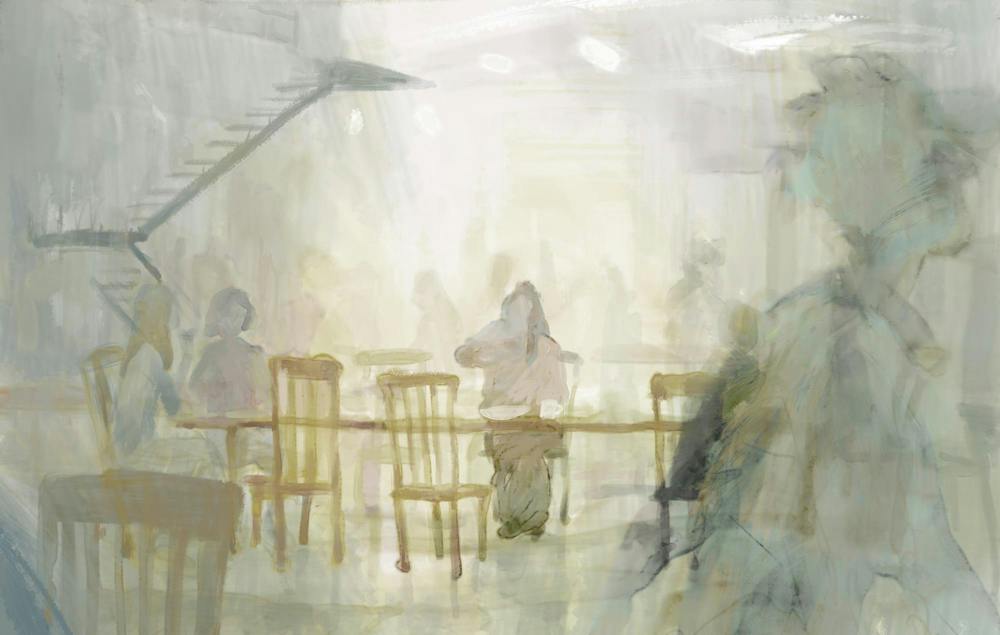
I often perceive loneliness as a punishment, a pathetic confinement—how else does it feel to sit alone at a dining hall?—and forget the exciting part of it, the familiarity of my own company.
The Russian poet Joseph Brodsky said in a 1979 interview: “When you find yourself in a strange place, and the stranger the place it is, to a certain extent, the better—it somehow sharpens your notion of your individuality.” Brodsky claimed that one sees oneself better against a strange background. He was describing places like Venice and England (Old and New), juxtaposing them with New York. He hasn’t written much about this city, because, as he stated in the same interview, “You can’t do much about New York.” I understand what he means. It’s not that New York isn’t strange; instead, the city is so elusive and textured that the emerging clarity about yourself is of a different kind. It’s ergodic—requiring additional effort—much like the eponymous genre of literature. Reading some books offers you a clear reflection of your face on the surface of the paper; reading ergodic literature, where you jump from page to page, intersperse chapters, or deconstruct episodes, challenges and teases you, but it’s a rewarding mischief.
My friends often describe me as someone who has no problem being on my own. I think the reason for that is because of how heterogenous were the places I’ve been alone at. Observing how they made me feel was often a masochistic experience. Those solitary adventures looked less graceful and romantic than Amelie’s antics in Jeunet’s movie. A more accurate comparison would be Soul 22 in the Pixar cartoon: learning how to walk, inhabiting a body, and holding a slice of pizza.
Some places, like Astana, strip you to the bone with their whistling emptiness. Some, like Falmouth, pass you on to the ocean, incapable of curbing your turmoil. And some, temperamental and demanding, refuse to serve as a mere mirror. Care to guess the latter?
New York
I stroll down Park Avenue, unchained, unclaimed, unnamed. The city engulfs me, slurps me like an oyster, poking me with a tiny stick. I’m far from home—from my suitcase in Brooklyn, my college dorm in Providence, my apartment in Moscow. I look up the latter location on the Maps app. 4668 miles away. I don’t miss home, but I picture our bathroom, and it occurs to me that to simply wash my hands in that sink I would need to cross the ocean, take countless Ubers, trains, and, of course, flights. That logistical sequence anchored down the sensation of being in a viscous vacuum. Another uplifting quote by Remarque comes to mind: “Nowhere, no one and nothing awaits you; you only ever carry yourself around.” That’s what I was—a body, a bag, and a watch. A cluster of a physical vessel and several possessions moving down Park Ave, with nowhere to be yet desperate to belong, at least through my presence in the city. As if that would grant me something in common with New Yorkers. They race down the streets, simultaneously drinking their cold brew, reading “A Little Life,” listening to Charli XCX in their Airpods Max, and wearing their suede sneakers (whichever ones are trending). The other ones wake up to the view of Central Park from the windows and know their way around gallery openings and rooftop parties.
It’s getting late, and I need to take the Q, because the thing about being extraneous in a city like this one is that there is no one to control you, but also no one to care.
I am fascinated by the interaction between solitude and anonymity. Does the feeling of not being recognized feel comforting or devastating? The untraceable journey of a guest, whose intrusion could remain unnoticed or cause a disturbance to the microcosm.
Astana
I land in Astana earlier than expected, around 5 a.m., and try to check into my hotel. It’s an unremarkable building next to the U.S. Embassy in Kazakhstan—the primary target of my visit. The hotel resembles an abandoned mall: it’s hollow, with balconies wrapping around the tall lobby. There are several sofas, a closed cafeteria, and palm trees for decor. A disheveled receptionist, who was clearly sleeping in one of the offices, mutters, “Nothing we can do for you right now. Check-in begins in six hours.” I leave my suitcases in her office.
Astana is quiet and hollow, just like the hotel’s lobby. The streets are wide and exposing, no shade to hide in when it gets sunny, and the semi-arid climate makes the heat prickly, suffocating. I ride the cramped bus with people going to work. Little do they know, I am not going to the office. I am here to renew my visa to get back to the US. I’m alone in this country, a complete unknown on a bureaucratic mission.
At sunset, I ride a similarly tight bus without a ticket and almost get caught. I get out next to the Atyrau bridge and pass through the tunnel. This blonde boy is playing guitar, and I realize he is singing a song by Kino, a famous Soviet post-punk band. I pass by and exit the tunnel, but turn around and run down the stairs. I want to meet him and look him in the eyes. I hold on to several coins in my pocket to put in his guitar case, but it’s too late—he’s all packed up and walking towards me. Our conversation is meaningless. I still have my coins, which made my sweaty hands smell all metallic and acidic. Now I have to turn again and walk the tunnel for the third time. The bridge is intricate, but that’s the end of it. If you don’t have to cross the river, there’s only so much to do on a bridge. I walk hallways, then turn around.
In the evening, I curl up on a chair in my hotel room and watch Twin Peaks.
The texture of aloneness depends heavily on the surroundings of the exile. The feeling of marinating in an empty train at night is different from that of looking at the ceiling in your room. I think it might be because of the physics of reflection: our loneliness ricochets differently from the trees during a stroll than from the walls of a hospital room. The angle of that rebound depends on the angle of launch. An intense feeling of estrangement will result in a more unbearable pain when confronted with the social world, while a lack of self-awareness will not lead to any meaningful conclusions. Perchance the value of socialization is to experience the deflection of your solitude when exposed to others of its kind, testing its boundaries and acknowledging its scaling. It feels like palpating the inside of the shell, like a scallop would, yet they can do it simply through existing and being in contact with their exoskeleton, and we have to enroll in silent retreats or journal in the morning.
Falmouth
Of course I got the date of my flight wrong. You can check a hundred times, you can triple-look and still end up confusing the layover with the departure. So he lets me stay in his house. It’s May, and I’m in Maine with my best friend. He has to leave for Vermont, but since I can’t—my flight is a day earlier than we expected—he leaves me at the House without a key.
We have done some preliminary shopping: a cucumber, a tomato, a pack of frozen dumplings, and yet my supplies are gone after the first lunch. The House is huge, it’s intimidating, and I feel pushed out by the buoyant force, as if the House recognizes an intruder. I watch House M.D. and pack my suitcases. I make coffee. Drink water. Wash cups. Call Mom. Walk around the house. Wash hands. It’s been two hours. I have twenty-five more before my departure.
My throat is dragging, and my sinuses feel congested. I palpate my lymph nodes. They are warm and mysterious. The consensus is I’m getting sick, arguably one of the most depressing realizations known to man.
I end up leaving the house and walking down to the ocean. The beach is unsurprisingly empty. The water brings humid, dense fog, and the waves are rocking, a relentless pendulum.
After getting back from the beach, I convince myself that someone has lurked into the house and is waiting for it to get dark to jump out and murder me. I lock the basement and prick up my ears. It’s quite eerie to be stuck in a house that doesn’t belong to you, where objects know their places but not you, where someone else spent their childhood and ran around with their siblings.
If I stay still for a moment, there is nowhere for sound to emerge from, so we’d all be sitting in silence; my body, my thoughts, my friend’s wooden table, his books and his piano. I catch this absence and release it by saying something out loud to myself. Here comes psychosis.
Aloneness: a ruthless mirror. It’s terrifying to experience, to be in an environment where you are in charge of entertaining yourself. People often establish a rigid schedule explaining it with “workaholism” or a desire to escape negative thoughts, but what they are really running away from are the endless paths which they could take during their time alone. Montaigne writes about that too, our tendency to enslave ourselves to various institutions, simply to channel the energy somewhere, without the taxing task of taking ownership. It is much more soothing to ignore your passions when there seems to be no time for them than to question how you would actually want to live your life.
At the end of the day, one could hope to come home to Molly or Penelope or at least a nice bed. But aloneness is not a state to escape from or into. It is a moment of evaluation. To be truly alone is not just reading a book, going on a walk, or meditating. It’s the unwanted moment of boredom when you are pressured to hear your own thoughts: those four seconds in between the shower and the towel, the sound of the door closing after a guest leaves, the forced stillness when you are nauseous in the car and have to keep your head still and look out at the road. And to take pleasure in those moments, one should become good company—first and foremost, for oneself. Only then will those unbearable, exposing nodes in the fishing net of existence feel formative and inspiring.
All that to say—maybe sitting alone at a dining hall isn’t so bad after all.