
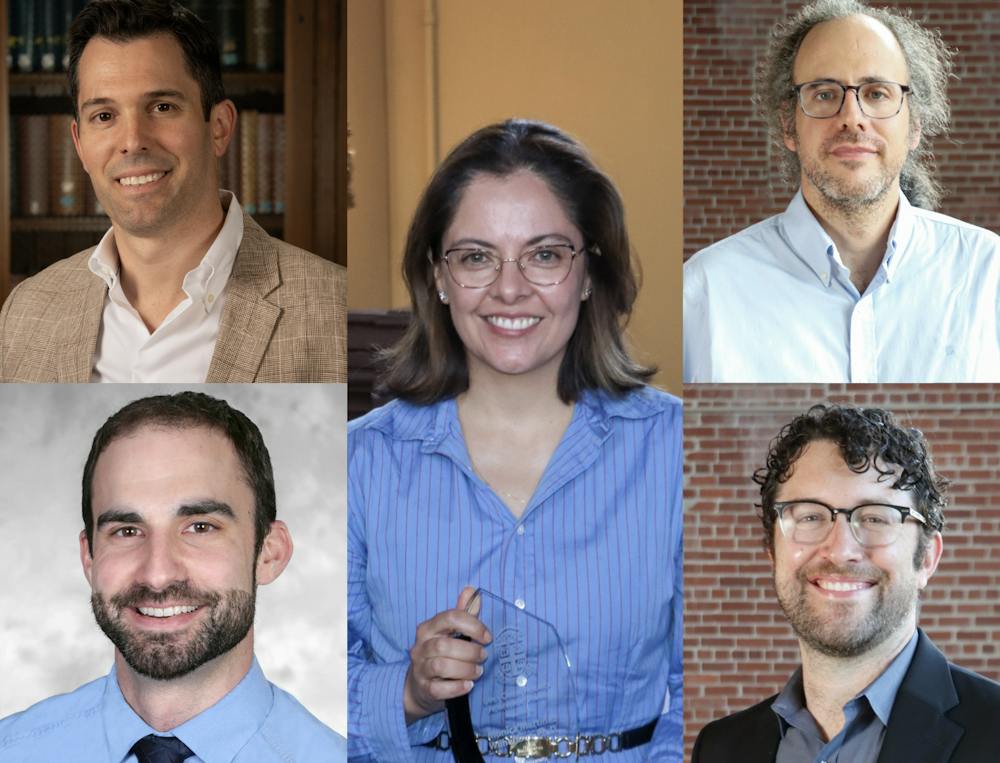
Earlier this month, the 11 faculty recipients of the Research Achievement Award gathered on the Sayles Hall stage to celebrate their exceptional work in subjects ranging from prison-related public health issues to gene editing.
The award recipients represent early and mid-career stage faculty members in four academic categories: the humanities and social sciences, life sciences and public health, physical sciences and hospital-based research.
According to Edel Minogue, senior director of research strategy and development, awardees are determined by their scholarly accomplishments — which can include “publications, professional awards and funded research” — and assessed based on their contributions to their fields of study.
Though all recipients receive the same $5,000 stipend to continue their work, the recognition distinguishes between early career achievement — designated for assistant or new associate professors — and mid-career research achievement awards for associate professors or faculty members who have recently become full professors.
The Herald spoke to five of this year’s awardees about what the award means to them and how they intend to use their stipends to further their work.
Many awardees choose to use their stipends to support members of their research teams.
Early Career Research Achievement awardee Monica Wilhelmus, an assistant professor of engineering who studies sea ice dynamics, believes spending the award money on her research team “reflects what the recognition is really about.”
Wilhelmus explained that expenditures like travel costs or funding for early-stage projects “don’t always fit neatly into larger budgets but can make a real difference in someone’s trajectory.” She intends to use the funds from the award to address the diverse needs of the researchers in her lab.
Justin Berk, an associate professor of pediatrics, medicine and epidemiology, said he intends to use the award money to support a Health Equity Scholar at the School of Public Health. The scholar will join the team in researching addiction and hepatitis C treatment for individuals currently in prison and those who have been released.
Berk, who is also the director of Brown Health’s Center for Health and Justice Transformation, said he was “grateful” for the award because he believes it recognizes the importance of his research focus: healthcare neglect of incarcerated individuals.
With the help of the stipend, Berk and his research team will be able to “train people who care about this work and want to build careers in it,” he added.
Professor of Mathematics Javier Gómez-Serrano, who received the Mid-Career Research Achievement Award, said he wants to use the stipend to support his research group’s current focus on artificial intelligence in mathematics.
Serrano explained that the award money could be used to fund rapidly advancing AI products that are “more difficult to pay with grants,” due to unclear funding terms that are a result of the technology’s ever-changing nature.
David Meyers, an assistant professor of health services, policy and practice at the School of Public Health, examines how private insurance companies in the United States distribute Medicare benefits. He intends to spend the allocated funding to support the students and researchers he works with when examining “payment and delivery reform” for healthcare in the United States.
He explained that the team’s research is generally “quantitatively oriented,” using large data sets from insurance companies and the Medicare program to answer the team’s research questions. Using their findings, the team communicates with policymakers in the federal government to convert their analysis into real-world applications, Meyers added.
George Lisi, an associate professor of molecular biology, cell biology and biochemistry, believes that the award indicates that his team is “doing something well.”
Lisi intends to use the funds for a new project involving AI-driven experiments to identify new small molecule CRISPR gene editing regulators. The team has already compiled initial data and plans to use the award money to fund “the first candidate molecules to be synthesized for experimental studies,” he added.
To find awardees, the Division of Research requests nominations each fall from deans, center directors, department chairs and colleagues, as well as self-nominations, Minogue wrote in an email to The Herald.
The selection process, which occurs in the spring, is spearheaded by the Research Strategy and Development team, which oversees a committee of faculty members and senior leadership who assess each nomination, Minogue said. After combing through the nominees, they send their recommendations to the Vice President of Research, who makes the ultimate decision. To avoid conflicts of interest and “ensure a fair review,” the committee is “reconfigured” every year, Minogue added.
It was “an honor to be recognized alongside such accomplished colleagues,” Wilhelmus wrote.
For Berk, the awards ceremony was “humbling, in part because it brought together so many different fields.”
“A physician doesn’t often get to share a stage with scholars working on problems in quantum physics, building underwater robots and finding new meaning in centuries-old literature,” Berk wrote.

Samah Hamid is a section editor covering faculty and career & alumni. She is from Sharon, Massachusetts is concentrating in Biology and Middle Eastern Studies. In her free time, you can find her taking a nap, reading, or baking a sweet treat.


