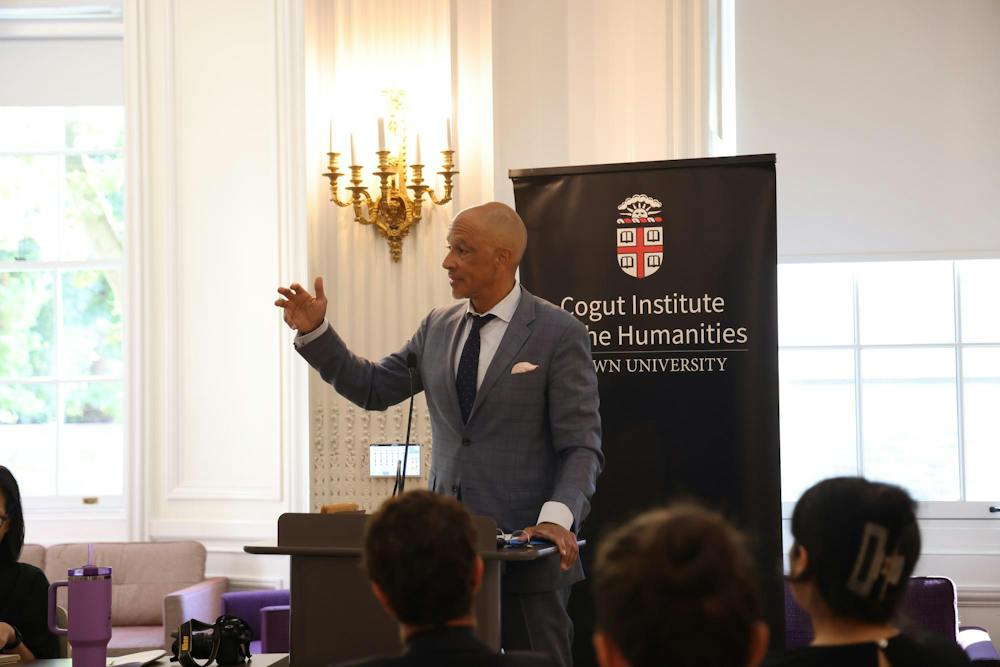
Despite a nationwide pessimism about the value of a humanities education, a Brown event featuring scholars from across the humanities provided an optimistic outlook.
On Friday, the Cogut Institute for the Humanities hosted a conversation called “Humanists on Education,” during which scholars reflected on how their expertise in their respective fields has influenced their views on education. At the event, professors of history, religious studies and education provided cases for why the humanities can persist in the age of artificial intelligence.
The event is the first installment of the institute’s “Humanists on ______” series, Shelley Lee, director of the Cogut Institute, said in her opening remarks.
The “Humanists on” series aims to facilitate informal conversations around topics of interest, Lee said in an interview with The Herald.
In her talk, Assistant Professor of Education Mahasan Chaney advocated for education that protects students’ critical inquiry in the age of AI.
“One of the reasons that AI, I imagine, has been so appealing is because it gives us these quick answers, these very clear answers, so that we appear to know,” Chaney said. “But we should be also instructing students as learners who might build on what they know.”
In fact, this type of curiosity is at the heart of Brown’s ethos with the Open Curriculum, Chaney said in an interview with The Herald.
The “Open Curriculum is so important to continue to learn things that keep us curious and asking questions,” Chaney said in an interview with The Herald.
Studying the humanities teaches us “to not be in a rush to find solutions and answers,” Lee said in an interview with The Herald.
Later in the panel, Professor of History and Chair of History Tara Nummedal said that the current state of the country has forced humanities scholars to return to the fundamental questions of why they are in the humanities.
“We can find the answers to almost anything, or at least we think we can find the answers to anything these days, but I think that the humanities teach us — and what I find my students are less good at — is how to ask a question, how to wonder about things,” Nummedal said.
Ultimately, she still finds history to be evergreen in its value because of the importance of asking meaningful questions, tolerating uncertainty, cultivating curiosity and using empathy as a practice of understanding people and societies on their own terms.
“The past is absolutely full of things that it might be tempting to dismiss as weird or irrelevant or useless,” Nummedal said. “But I think if we study those things and if we really learn how to take the past on its own terms ... we are the better for it.”
At the panel, Dean of the College Ethan Pollock — a professor of history and of Slavic studies — homed in on a common thread of the event: that humanists thrive in their pursuit of further inquiry rather than clear-cut solutions.
For his field of history, for example, this involves a thorough pursuit of understanding the context behind developments.
“You have to understand the history. You have to understand the culture. You have to understand the perspectives,” Pollock said. “All of this is required to be, in a sense, in on the joke.” He added that the work of the humanities involves finding a way to decipher this “joke.”
“We live in a world now…where solutions and clear truths are at our disposal,” Pollock said. “We need people who feel comfortable with ambiguity and relish complexity, people who understand context and recognize the distinction between clear and deep truths.”
During the final talk of the afternoon, Associate Professor of Religious Studies Andre Willis argued that the ultimate value of the humanities lies is the personal growth that comes from their study: “empathy, integrity and inquiry.”
He echoed other speakers’ messages that curiosity about open questions is worthwhile, even without settling on a clear solution.
“The event showcased the importance of the humanities in every facet of life and why we need to insist on its presence in education,” Associate Professor of Africana Studies and of History Françoise Hamlin, who attended the event, wrote in an email to The Herald. “All the panelists agreed that more humanities in education increases empathy and curiosity along with the solid skills of research, interpretation and writing that artificial intelligence could never wholly replicate.”
Elizabeth Rosenbaum is a senior staff writer covering science and research.

Ivy Huang is a University News and Science & Research editor from New York City. Concentrating in English, she has a passion for literature and American history. Her favorite authors include Marilynne Robinson, Vladimir Nabokov, and Toni Morrison. Outside of writing, she enjoys playing basketball, watching documentaries, and beating her high score on Subway Surfers.