
With graceful, choreographed steps, magician Jeanette Andrews, one of two inaugural Prizma Arts and Research Residency artists, took to the stage in the Martinos Auditorium at the Granoff Center for the Creative Arts last Thursday night. Without speaking, she held up a single rose and disintegrated it, letting the petals fall soundlessly to the floor. The next moment, she apparated a new one in its place.
Andrews’s performance opened the Brown Arts Institute’s latest endeavour, “The Logic of Illogic,” a two-day event that brought Brown faculty and outside experts together to explore the relationship between magic, decoys and knowledge formation. The program began with a public performance and discussion panel on Thursday, followed by a closed workshop on Friday in the Fishman Studio.
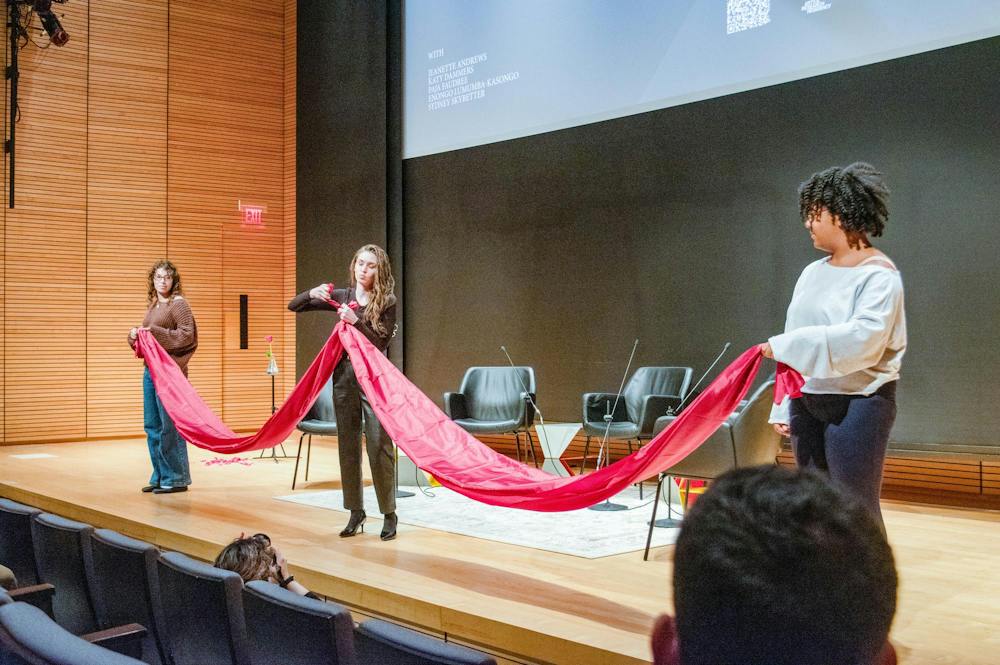
In her second act, Andrews wrapped a large rose-coloured cloth around one of the audience member’s arms before making a pair of scissors appear out of thin air. She cut the fabric into two, before passing one to each volunteer and tying the two ends together. After some manipulation of her hands, she pulled the fabric taut, seamless and undamaged.
Following the performance, Associate Professor of Theatre Arts and Performance Studies Sydney Skybetter opened the public panel discussion, which was joined by REDCAT’s Deputy Director and Chief Curator of Performing Arts Katy Dammers, Associate Professor of Anthropology and Linguistics Paja Faudree and Assistant Professor of Music Enongo Lumumba-Kasongo.
Referring to the volunteers in the second act who helped Andrews onstage and keeping in mind the fact Thursday’s audience came knowing they would be deceived, Faudree said that the performance demonstrated a “collective willingness to participate in the unknown.”
As a linguist, Faudree was particularly interested in how that willingness was achieved despite Andrews’s “suppression of language” during the performance. Andrews explained that her reliance on gestures was designed to emphasise the physical objects in her performance as part of an “object-oriented ontology.”
Andrews said she wanted “The Logic of Illogic” to interrogate the process of “rational belief” at a time when “landing on any form of consensus about what seems reasonable or logical seems increasingly difficult,” she said in an interview with the Herald.
The basis for “The Logic of Illogic” was formed when Andrews came across the work of American philosopher Edmund Gettier, who challenged traditional views of what constitutes knowledge. Under the framework of “justified true belief,” philosophers until the ’60s generally agreed that knowledge is real if it is based on truth and supported by evidence. Gettier argued that a belief does not count as true knowledge if its formation is based on coincidence or epistemic luck.
“Magic is a Gettier case,” Andrews told the Herald. “You have a justification for believing something that — within what is presented to you — is true, but the undergirding thing that is happening is completely different.”
Andrews has been performing magic professionally since she was six years old. In that time, she has developed a “research-heavy” approach that treats magic as a “live thought experiment” to interrogate ontological, epistemic and phenomenological questions, she said in an April interview with the Herald.
The two-day event also interrogated these issues in the context of the internet and artificial intelligence. “Feeds, generative models and deepfakes engineer belief at scale using techniques a working magician would recognize on sight,” Skybetter said on Thursday.
“The Logic of Illogic” is Andrews’s second project at Brown since being announced as an inaugural Prizma Arts and Research Residency Artist earlier this year. In March, Andrews’s “In Plain Listen” performance saw her transcribe one of the earliest recorded magic tricks into a composition for three cellos.
Both “In Plain Listen” and “The Logic of Illogic” were designed to facilitate interdisciplinary engagement, which is one of the central goals of the Prizma program. “For success, I'm measuring whether the work generates new teaching, new research collaborations, new questions that faculty and students didn't have before,” Skybetter wrote in an email to the Herald.
Friday’s closed workshop consisted of Thursday’s panelists as well as six additional Brown faculty members spanning disciplines from English to Visual Art. They were joined by several external experts, including Lionel Popkin, interim dean of the University of California, Los Angeles School of the Arts and Architecture, and Tamar Gendler, the dean of the faculty of arts and sciences at Yale.
For Skybetter, the purpose of Friday’s closed workshop was to “deepen relationships” between departments. “One of the real benefits of Prizma is that we have a number of years, not a single visit, to discern which linkages between an artist and a given professor or department turn out to be meaningful,” he wrote in an email to the Herald.
In an interview with the Herald, Andrews explained that she viewed Friday’s workshop as a brainstorming session between professionals and a stepping stone toward her next project as a Prizma resident.
“I am not technically a student at Brown, (but) I feel so lucky that I am part of this research fellowship whereby I get to learn from the Brown community,” she said.


