
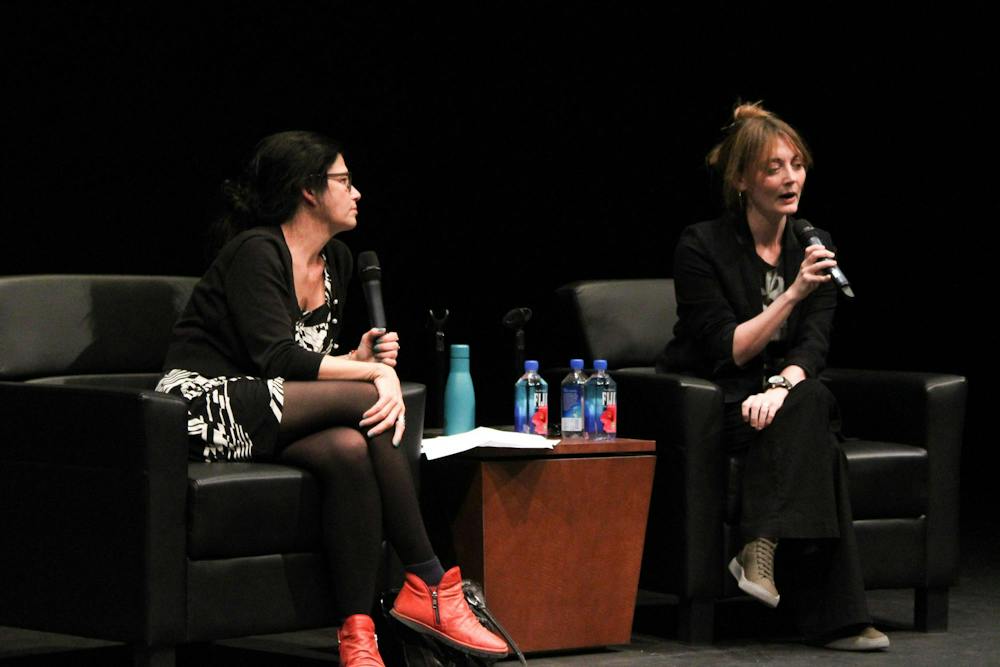
In January, Helen Shaw became the chief theater critic at the New York Times, making her one of only 14 full-time staff theater critics in the country. On Monday, Shaw sat down with Patricia Ybarra, professor of theater arts and performance studies and associate chair of the department, for the 2026 Guarnaschelli Lecture titled “Criticism and the Theatrical Ecology.”
Shaw’s career in criticism began with admiration for her professor at Harvard: Robert Brustein, a critic, theater founder and director. With plans to emulate Brustein’s multi-hyphenate career, Shaw attempted work in set design, before realizing that she “had no gift” in the practice. She returned to Cambridge, Massachusetts to get her master’s in fine arts in dramaturgy, which she defines as “a way of looking at the theater in which you sort of penetrate through to why you are there,” she said at the lecture.
Before joining the New York Times, Shaw worked at Time Out New York, New York Magazine and The New Yorker.
“There’s really only one job where you can go to all of the theater — as long as you don’t sleep — and it’s being a critic,” she said.
Because she sees different shows every night, Shaw has different techniques to position herself for viewing: When she’s working, she has her notebook out.
“I almost think of it as working out with weights… if you work out with or without weights, it changes your form,” she said in an interview with The Herald. “When you pull out your notebook, I feel like it makes you assume the form correctly of being an audience member.”
Her notebook is her “little accountability partner,” she said.
“The other miracle that a notebook does is that it means you don’t start thinking about something else. And theater is always trying to trick you into thinking about something else,” Shaw said.
But Shaw rarely looks at her notes when she writes her reviews. “If your notebook is the discipline, then your memory is kind of like the chaos agent” she said.
Instead, she discusses the show with somebody else or works out her ideas on the page. “The first scene that I start describing turns out to be the scene on which I’m going to base my review,” she said.
Shaw then writes through the night. “I like the way that it kind of deranges your rational function to be up at 2 o’clock in the morning,” she said at the lecture. “Then I will usually sleep for a couple of hours and then wake up and edit it because it’s crazy.”
In her interview with The Herald, she also discussed the difference between writing for audiences who are looking for a specific show to see, versus her ideal, which is that “everyone should see everything, everything, good, bad and ugly.”
Part of being a critic is accepting “that what you are doing is a little bit cruel,” Shaw said at the lecture. “Even when you love a thing, you’re saying it in public. You’re judging people’s work in public. That is very hard.”
In 2015, Shaw wrote a review of Aya Ogawa’s play in which she used the word “failure.” Ogawa was so upset that they banned Shaw from their next production, but they later said that Shaw’s review was the catalyst for their play “The Nosebleed.”
There have also been shifts in theatrical ecology, Shaw said. There used to be so many critics that even new shows would be covered by multiple outlets. That doesn’t happen anymore, she said.
But “if you are in a crisis, the theater is a wonderful place to be,” she said. “No one ever walks out of the theater and is like, ‘you know, there’s really nothing that can be done.’ These lunatics just flew 16 vampires in front of you. Of course, there’s something that can be done.”
Aliza Sapiro Polishook ’29 — who came to the lecture because of her interest in journalism — said that her main takeaway was “how incredibly smart and dedicated you have to be in order to have a kind of dream job like hers,” she wrote in a message to The Herald.
Rebecca Goodman is an arts & culture and university news editor covering career and alumni. She is a senior from Cambridge, MA, studying English. Outside of writing, you can find her at the Avon or in the basement of the Rock.


