
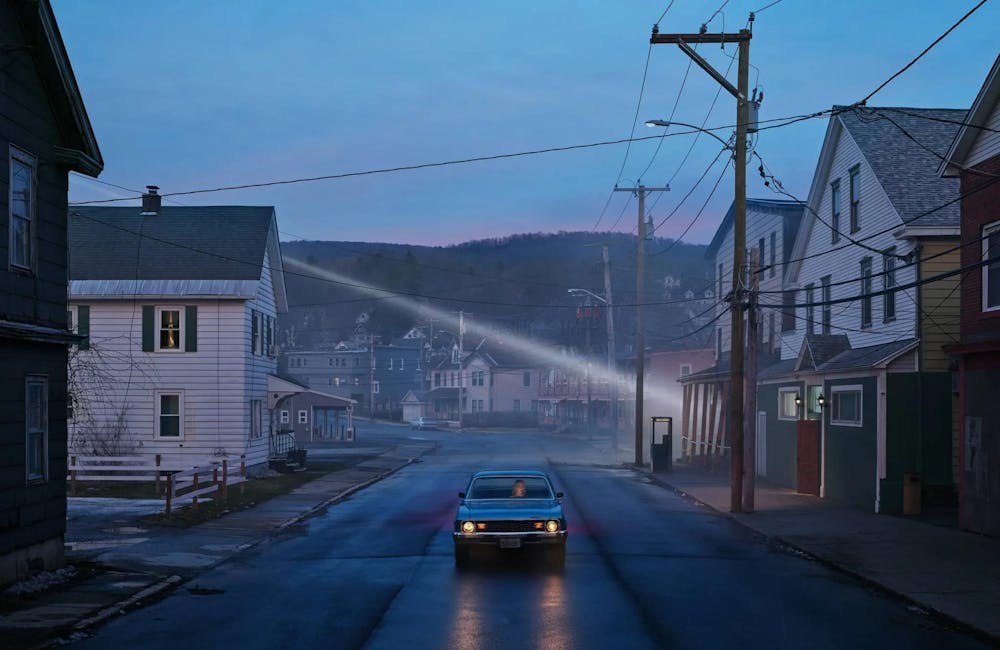
After six years of fans waiting with bated breath, Phoebe Bridgers returned on Aug. 14 with her third studio album, “Lost Weekend” — and somehow, she is better than ever. While it seems like the singer has been facing a lot of personal challenges since the release of her last album in 2020, including a broken-off engagement and the recent loss of her father, the songs she’s produced from the tumult are some of her strongest to date. The album is a staggering testament to her craft as an artist, one who has never shied away from confronting the most devastating of life’s themes in her distinctively cathartic songwriting. Crushingly vulnerable, Bridgers’s cutting lyricism throughout “Lost Weekend” creates an emotionally bulldozing effect, which is only amplified by its overwhelming soundscape.
The four-time Grammy winner, and 2021 Spring Weekend performer, miraculously managed not only to match but exceed long-built-up expectations following the success of her past two albums. Bridgers released “Punisher” in 2020, and “The Record” in 2023 with Lucy Dacus and Julien Baker as boygenius. The swirling excitement surrounding her return to the spotlight was further intensified by what fans are calling an avengers-endgame assemblage of collaborators, from Alex G to Cameron Winter, and her current partner Bo Burnham.
“The Outside” kicks the album off with an intense and unsettling vocoder effect, alien from her signature breathy doubled vocals. The surprisingly robotic production, reminiscent of one of Bridgers’s longtime influences, Imogen Heap, hints that this album will stray far from anything we’ve heard from Bridgers before.
The lead single, “Lost Boys,” released this June, has a repetitive, formal simplicity that, while enjoyable in its own right, served as a misleading preview of the record’s innovative sound. Most of the songs break brazenly away from conventional verse-chorus structures, exemplified on the track “Panorama” which begins with two minutes of otherworldly sounds before any lyrics come in.
The record’s instrumentation is impressively experimental, whirling unpredictably between thick hyper-electronic layered textures and intimate acoustic moments that call back to her earlier indie-folk style. The title track, “Lost Weekend,” masterfully interweaves raw voice memo recordings taken on Bridgers’s iPhone, with complex electroacoustic sound design and phase distortion.
The album’s lyricism is incredibly self-referential and introspective. Repeated callbacks to old songs submerge listeners into a hypnotic Bridgersian cinematic universe. The melody of “Graceland Too,” a fan favorite from “Punisher,” is reworked and sampled throughout the record, including in a transcendent moment in “Liberty Tree” that is sure to induce full-body chills for anyone familiar with the 2020 track. “Graceland Too,” which Bridgers has often described as a “wish,” asks “whether songs can come true?” The futility of this notion, that one might be able to sing a different reality into existence, takes on an even more tragic effect within the context of the recent death of Bridgers’s father. Tracks like “Lost Weekend (reprise)” act as an almost angelic requiem, while songs such as “Still Standing” wrestle head-on with the convoluted feelings of mourning someone with whom you had a tumultuous relationship.
Other standout songs include her collaboration with Cameron Winter, “I Can’t Wait,” which refers to “Jekyll and Hyde finally together” over an infectious beat that finds a sense of liberation and resolution in the acceptance of life’s inevitable pain.
The fluttery “Governor’s Waltz” is another unskippable track. The song’s glittering finger-picked guitar foundation and catchy melody offers a contrasting stripped-down sound that narrates an ironic fairytale of love gained and lost. The song subtly feeds the inevitable pop-culture circus surrounding Bridgers’s called-off engagement to actor Paul Mescal and his subsequent relationship with singer Gracie Abrams, with lines like “she took my place in my bed on that stage.”
While the album is undoubtedly personal, it also grapples with wider themes of societal estrangement and an increasingly technologized world. The jarringly robotic vocal effects threaded throughout the record paired with lyrics like “this machine is killing me” allude to a critique of artificial intelligence in art and the soulless mechanization of the music industry. This sentiment is an echo of the artist’s recent campaign against phones at concerts.
The album’s accompanying tour, which begins this September, will enforce a strict screen-free policy, an attempt to bring audiences back to a more present live-music experience. For those who want a chance to get lost in the “Lost Weekend” experience themselves, Bridgers will be bringing “The Lost Tour” to Boston this October, just an hour away from Brown’s campus.
Rose Farman-Farma is a senior Comparative Literature concentrator from England who loves writing and music.


