
Communication between the right and left sides of the body is mediated by neurons crossing the midline of the spine. But how these neurons “decide” to cross the midline — and how they find paths across long distances — was a mystery until work by Brown researchers offered a possible explanation.
Last month, Associate Professor of Brain Science Alexander Jaworski published a paper about this process, known as axon guidance.
Understanding this process is a “key prerequisite if you want to recreate those conditions to repair a spinal cord injury,” Jane Abolafia PhD’24, the paper’s first author, wrote in an email to The Herald.
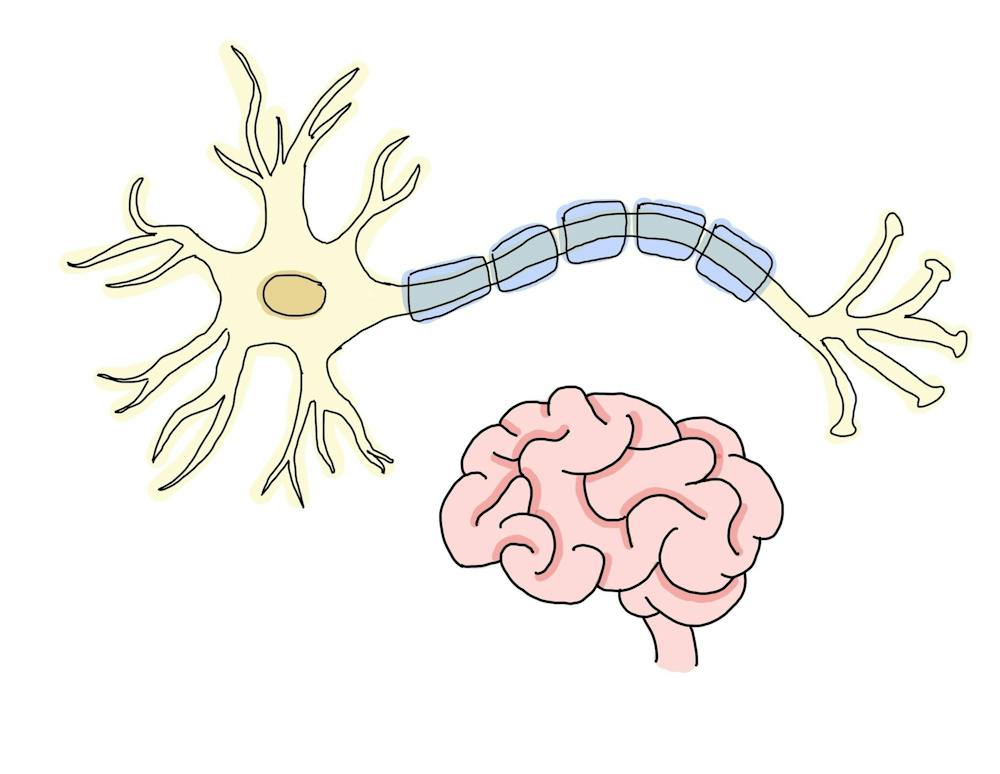
Axons, which are parts of neurons, are responsible for carrying electrical signals from the neuron’s cell body to other cells. During embryonic development, axons grow throughout the body to connect neurons with corresponding target cells, allowing for communication. In axon guidance, a group of neurons called commissural neurons “connect the two halves of the nervous system to each other,” Jaworski said.
“Your brain and your nervous system are obviously really intricately wired, and the connections between neurons are important for your nervous system to function,” Jaworski explained.
Previously, scientists thought that axon guidance was determined locally at the tip of the axon — called the growth cone — when neurons reach the midline, Abolafia wrote.
The new research shows that axon guidance is actually determined at a gene expression level with a “genetic switch,” Abolafia added.
“Most excitingly, we discovered that there is a switch in gene expression that happens in the cell body of these neurons when their axons cross the midline,” Jaworski said. “This gene expression switch seems to control the dynamic behavior of the axons as they approach the midline.”
To investigate the behavior of commissural neurons at the midline, the team used a “novel genetic tool” and single-cell RNA sequencing, Abolafia wrote. This approach allows researchers to see which genes are being expressed “before, during and after this crossing process.”
The team also looked at moments when neurons began to grow during embryonic development. Using “birth-dating” techniques, the researchers can “label cohorts of neurons that are born at different time points during development,” Jaworski said. The team found that at a certain time after each neuron is born, the genetic switch is flipped.
“We were very surprised to find that such a dynamic process at the growth cone can be regulated all the way back at the level of gene expression,” Abolafia wrote.
“What we found is that we basically got an atlas of the diversity of developing commissural neurons,” Jaworski said.
The researchers now understand the “particular subtypes that make up this large population of neurons,” he added.
Next, with the data they collected, the team is going to study how genetic networks, rather than individual genes, affect axon guidance, Abolafia said.
Samantha Butler, a professor of neurobiology at the University of California, Los Angeles who did not work on the paper, told The Herald that Jaworski’s work investigates “a fundamental question of how neural circuits are first established.”
“It’s a beautiful piece of work,” Butler added.
Ivy Huang contributed reporting.
Angel Lopez is a senior staff writer covering Science and Research. He’s a sophomore from Tyler, Texas and planning to study neuroscience and literary arts. In his free time, you can find him playing ping pong, listening to music, or reading.


