
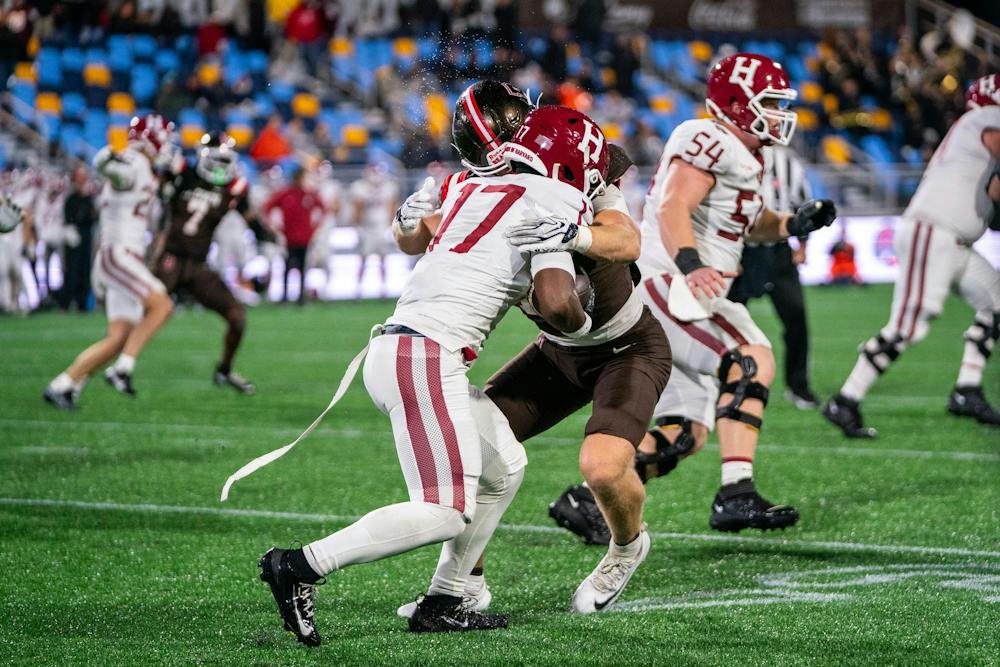
On Sept. 25, Bruno fans packed the stands of Centreville Bank Stadium, and through the wind and cold, rallied behind Brown football, despite the too-little-too-late comeback. It felt like everyone I follow on Instagram was at the game, decked out in brown and white underneath their ponchos and rain jackets. The Herald has conducted data projects highlighting the long-standing tradition of this rivalry over its now 125-matchup history. Rivalries mean a lot in sports. Students are more invested in and more likely to attend rivalry matches — statistics from recent years of Brown football consistently show high attendance when the Bears play the Crimson. Players might feel like they have more at stake, and overall, rivalry games create long-standing traditions, a backbone of sports enthusiasm. While I believe every football game should be as highly anticipated as Brown vs. Harvard, Brown should rethink its primary Ivy League nemesis. Harvard may have the history, but Dartmouth may be a better rival.
Currently, Brown vs. Harvard doesn’t function as a traditional rivalry. There are legitimate reasons for the tradition, including the geographic proximity between the two schools. But Harvard treats our rivalry as more like a stepping stone for their marquee matchup against Yale, which serves as their premier rivalry game. Therefore, Brown vs. Harvard lacks the two-way emotional importance and investment necessary for an arch-rivalry. Furthermore, Brown football’s all-time record against the Crimson is dismal: with only 31 wins, 92 losses and 2 ties, it is our worst record against any Ivy League opponent. Losing more often than not doesn’t invalidate a rivalry, but a compelling rivalry needs meaningful competition and, most importantly, investment from both fan bases.
Brown already knows what real rivalries look like. Ocean State games against the University of Rhode Island, Bryant University and Providence College make great examples. In particular, the Governor’s Cup attracts major media attention and builds tradition, with the winner taking home the signature trophy. The Crosstown Cup, another trophy fought for by Brown and PC’s women’s soccer teams, is a coveted award in Providence sports. Athletes, fans and alums perceive these games as meaningful and worth fighting for, giving both sides an incentive to claim and keep bragging rights. Brown’s Ivy rivalry should give students on both sides of the stands games to circle on their calendars, create traditions around and maintain school spirit for — producing a matchup that feels meaningful and worthwhile. Most importantly, both schools’ athletes and fans should be fully invested. Brown doesn’t need to reinvent a rivalry, as the Ancient Eight have been competing athletically since the 19th century. It simply needs to cultivate and emphasize one with the right ingredients.
A quick glance over the Ivy League shows that Dartmouth would make for the most natural choice. Firstly and most fiercely, especially in football, Harvard and Yale make each other a clear choice by calling their matchup “The Game.” In New York, Cornell and Columbia have an existing rivalry known as the “Empire State Bowl,” making good use of their geographic proximity. South of New York, Penn and Princeton have not only proximity but also the letter “P” to battle over in the mid-Atlantic, in a game I nickname the “Pee Bowl.” This leaves Brown and Dartmouth both without obvious existing rivalries, perhaps because the two schools have forgotten one that already existed.
According to Brown Athletics Archivist and Hall of Fame member Peter Mackie ’59, “Brown and Dartmouth were not big enough or powerful enough to compete with Harvard and Yale, so they created their own rivalry which was really, really intense.” At one time, the Brown-Dartmouth rivalry was the second most important in the Ivy League, just behind Harvard and Yale, according to the University library archives.
Upon closer inspection, this matchup makes a lot of sense. Brown and Dartmouth are similar in many ways, such as their small student bodies, undergraduate focus and similarly sized endowments. Endowments and class sizes have impacts on both the quality of academic and athletic facilities and recruitment efforts, which naturally translate to the quality of players both schools can attract. This past year, Harvard spent over $2 million on athletics recruitment, whereas Brown and Dartmouth both spent closer to $1.3 million. Lastly, Brown and Dartmouth are the only Ivies fighting for the earth-toned colors. Our woodsy mascots could even inspire a fun name for this rivalry.
Brown and Dartmouth also have a long, fierce history of competition, especially on the football field. Brown football has a better record against the Big Green than against the Crimson, and in 2025, the Bears stunned Dartmouth, the 2024 Ivy League football champions. Dartmouth provides a matchup where Brown can plausibly build competitive stakes in the rivalry. Brown has put up a great fight against the Big Green across sports, most notably in our 15-1 record against the Big Green in men’s lacrosse, 24-12 record in men’s basketball and a 47-24 record in women’s volleyball, which just handed Dartmouth another loss on Oct. 2 in five sets. Dartmouth and Brown also currently play each other in the final regular-season football game of the season, which is traditionally when college football rivalry games are played; this timing gives both sides the whole season to prepare and practice.
Brown Athletics should invest in making this rivalry bigger and more meaningful through its marketing, partnerships with student organizations and alumni events. I would also suggest this matchup be given a name and a specific physical prize or trophy that can be traded between the two teams — although hopefully only for short vacations in New Hampshire. Beyond football, as the game will be played in Hanover this year, this rivalry should be pushed in other sports such as soccer, basketball, hockey and lacrosse, so that students can interact with the rivalry multiple times throughout the year.
Brown doesn’t need to manufacture animosity toward Dartmouth or abandon its investment in Harvard. It needs to recognize what actually makes a rivalry meaningful: competition, tradition and, most of all, mutual investment. Harvard already has Yale. Brown should find a proper arch-rival. If Brown students love their rivalry “heated,” then Dartmouth should be the obvious choice.
Clay Edelson ’29 can be reached at clayton_edelson@brown.edu. Please send responses to this column to letters@browndailyherald.com and other opinions to opinions@browndailyherald.com.

Clay Edelson is an Opinions Columnist. He is from St. Louis, Missouri and plans on concentrating in Political Science. In his free time, Clay loves playing with his band, attending Brown Athletics events, and hiking.


