
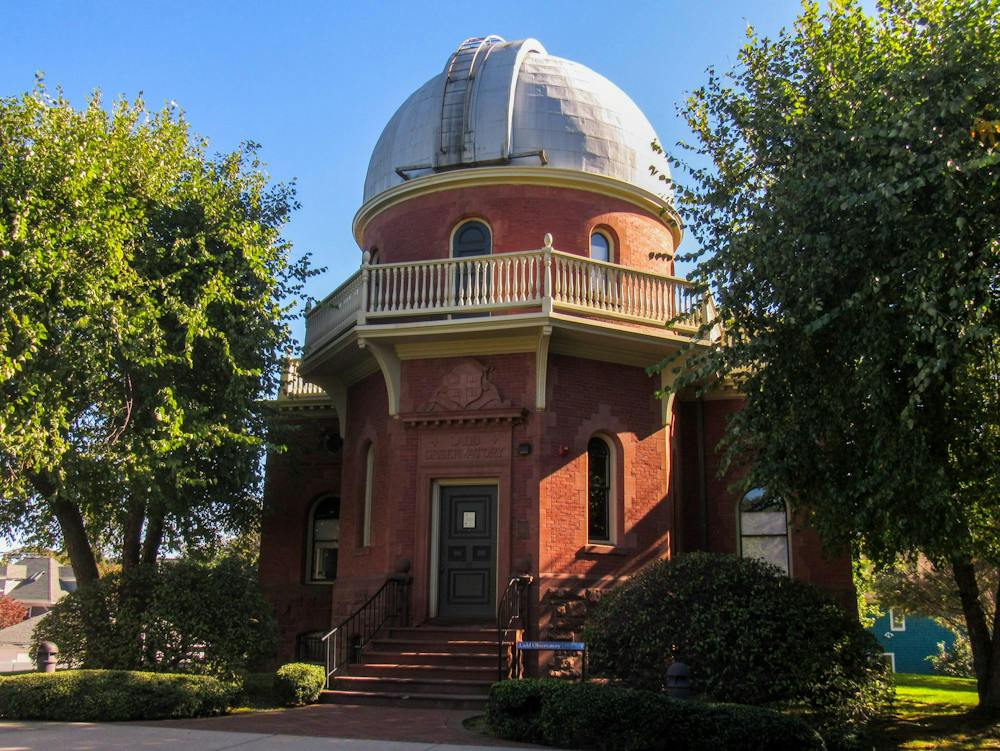
When Robert Horton was 14 years old, he visited the Ladd Observatory for the first time. Standing under the building’s vast domed ceiling, he was awestruck by the 15-foot-long telescope. He never imagined that he would be the observatory’s manager years later.
After 25 years of taking care of the observatory’s refracting telescope, Horton will retire from this position at the end of the fall semester, leaving the telescope to a future generation of caretakers.
The telescope delivers exceptional views of far away objects in space. “You can see divisions within the rings of Saturn, the polar ice caps on Mars, a lot of detail on Jupiter’s storms,” said Horton, who is also the manager of astronomy labs.
In order to keep the historic telescope functional, Horton works alongside Mahmoud Hallak ’25 to clean its gears and lubricate its bearings. But when a part breaks, Hallak and Horton need to dive into the telescope’s patents to understand its engineering and work with Brown’s machine shop to manufacture replacements.
“There are no owners’ manuals,” Horton said.
One of the most stressful repairs is the cleaning of the telescope’s 12-inch lens, which takes place about every three years. “The first few times you do that, you can feel the sweat beading up on your forehead,” Horton said. The lens — which contains two fragile pieces of glass separated by postage stamps to create a thin air gap — is removed from the end of the telescope and brought downstairs, where the dust is cleared.
If not properly handled, the glass can easily be damaged — the lens’s curvature is ground and polished to an accuracy within a millionth of an inch. Before Horton joined the Ladd’s staff 37 years ago, someone chipped the edge of the lens.
“The key thing is to be methodical, to think before you act… you just do everything systematically, step by step,” he told The Herald.
If the lens — crafted by the prominent optician John Brashear — were to break, it would be extremely difficult to replace. “There’s no other one like this, and without the lens, this is just a showpiece,” Hallak said. “This is really the heart of the telescope,” he added.
When looking into space, the telescope’s mount can compensate for the rotation of the Earth, tracking objects as they move across the sky. This mechanism does not involve any electricity. Instead, it is driven by hundreds of pounds of weights, which are reset before each demonstration.
“So many of these old telescopes lost all the (original mechanical) parts,” Horton said. “It’s a shame, and they have electric motors on them now. But this is an original.”
While Brown students and faculty have access to more modern astronomical equipment at the observatory on the roof of Barus and Holley, Ladd remains an opportunity to step back in time.
Currently, students are designing new exhibits to display Ladd’s extensive collection of antique astronomical instruments. Horton explained that he tries to “use their energy and their creativity” to create “more of a museum experience.”
“If you ignore the history of how these early scientists figured things out, you can’t fully appreciate what we know today,” Horton said. When the stories behind scientific facts fade into obscurity, people are not encouraged to “to look forward and continue asking questions.”
Beyond protecting the past, Ladd tries to keep the observatory as accessible as possible. Most Tuesday evenings during the academic year, student workers roll open Ladd’s shutters for viewings open to students and community members alike.
Ryan Seeb ’27, a student worker at Ladd and a coordinator for the Brown Astronomy Club, said that the group hosts events at the observatory several times per semester, giving tours of the facility and using the telescope for demonstrations.
When Horton retires, Hallak — who became involved in the operation and maintenance of the observatory as an undergraduate worker — will step into his role. But Horton plans to stay involved in a part-time capacity.
“I look at us as temporary custodians. We have this awesome responsibility to make sure the next generation can continue on enjoying this,” Horton said. “These craftsmen built something that would last many, many generations,” he added.


