
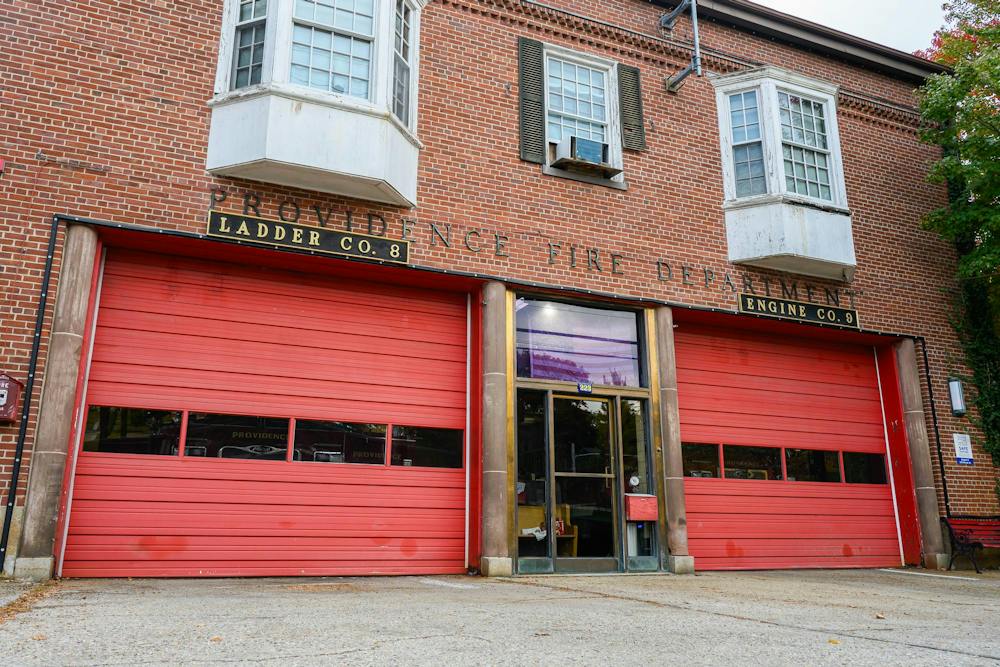
Housing affordability is a crisis in Rhode Island. According to The Herald, the median salary in Rhode Island is 41% less than what is needed to afford rent. These high prices are primarily driven by a supply shortage: The National Low Income Housing Coalition estimates that the state lacks 23,222 rental homes that are affordable and available to its lowest-income renters. An affordable housing shortage is a primary impetus of homelessness, which has doubled in our state since 2020.
To solve this problem, policymakers must clear regulatory barriers to building affordable, multifamily housing. Many of these barriers, such as restrictive zoning laws, are well-understood by housing advocates. However, a lesser-discussed barrier to affordable housing development, and one that is especially pressing in the Ocean State, is overly strict fire safety rules in the state’s building and fire codes. They increase the cost of constructing new housing significantly and are disproportionately strict for small multifamily homes — the type that is most needed. Fires are a serious safety concern, but so is housing unaffordability. It’s time for Rhode Island to reform its fire safety codes.
Currently, Rhode Island’s building code treats any buildings with three units or more as commercial construction, not residential. Triple-decker homes were once a staple of affordable housing in Rhode Island, but today developers are often barred from building them by compliance costs. The difference between commercial and residential building codes is immense: Under the more stringent commercial codes, developers are often required to hire fire safety experts with rare credentials, often across multiple firms. For example, a licensed fire protection engineer might be needed to perform egress calculations and produce stamped drawings. Becoming a fire safety expert is difficult, meaning that developers may face challenges in finding the support they need — there is a documented shortage of well-trained fire inspectors. In Rhode Island, earning a license to be a commercial fire sprinkler installer takes a whopping 8,000 hours of apprenticeship. Further, the commercial building code requires developers to use more fire-resistant materials, meet higher accessibility standards, install higher-capacity fire sprinklers that often require a dedicated water service line and provide more documentation to authorities.
Comparatively, projects with one or two units are governed by a simpler and more flexible residential building code. According to an analysis from Massachusetts — which has an identical law governing the difference between residential and commercial buildings — reclassifying three-unit projects as residential could decrease construction costs by 25%. Dallas, Texas, and the state of North Carolina have both recently made this change.
Another fire rule that increases housing costs is the requirement to build two staircases. This rule applies to buildings taller than three stories — supposedly, dual stairways allow for faster exit during a fire. However, single-stairway buildings are cheaper, because stairs are expensive to build and take up valuable space on small plots. According to the Pew Charitable Trusts, a second staircase adds roughly 6-13% to the cost of a four-to-six-story building on a small lot. Pew also analyzed fire records and found that sprinklered single-staircase buildings as tall as six stories are no less safe than buildings with two. As of fall 2024, at least 11 states had passed laws or rules to study or allow single-stair apartment buildings.
Though some of its rules align with other states, the Rhode Island fire code is considered the strictest in the country, due to a sweeping policy response following the 2003 Station Nightclub Fire in West Warwick, which took 100 lives and injured 230 others. The Station Nightclub Fire was a true tragedy, but the policy response was an overcorrection. R.I. lawmakers, reeling from loss to of life, passed the Comprehensive Fire Safety Act of 2003. The act’s provisions were steep, applying sweeping requirements to properties that bore no similarity to a nightclub. Arguably, the act was unnecessary, since the Station Nightclub Fire was caused not by insufficient codes but by a failure to enforce existing ones.
In the 23 years since the overhaul, there have been zero mass-casualty fires in the state, and Rhode Island currently has the lowest casualty rates per residential fire in the country. This is likely because Rhode Island’s public spending on fire safety is also the highest in the country. Rhode Island has twice as many firefighters per capita as the national average, and spends 1.8 times the national average on fire safety. There is no evidence that Rhode Island’s fire activity is higher compared to other states — high fire protection in Rhode Island has no connection to higher fire activity. Plus, 70% of fire department calls in 2023 were for medical emergencies. Only 4.2% were for fires, explosions or hazards. Seen one way, we’re getting what we’re paying for — but seen another way, we’re overspending on a problem that doesn’t exist.
State Rep. June Speakman (D-Bristol, Warren) has introduced bills to loosen both rules: one in 2024 that would have moved buildings with four or fewer units under the residential code, which passed the House 70-1 before dying in the Senate, and another in 2026 that would have allowed single-stair buildings up to four stories. These bills have been praised by housing advocates and builders, but vociferously opposed by firefighters: “I’ve never seen such an anti-safety piece of legislation,” said a lobbyist for the Rhode Island State Association of Fire Fighters. “People are going to die if this happens.”
We understand the concerns of first responders, and acknowledge that loosening building codes could increase safety risks. However, Rhode Island’s housing crisis is also a safety problem. Homelessness, primarily driven by a lack of affordable housing, is an urgent public safety crisis. In 2024, Rhode Island had the second-highest rate of chronic homelessness — 54 people died while experiencing homelessness. Firefighters across the country are increasingly forced to address the harms of homelessness. Fires sometimes break out at street encampments, and homeless people disproportionately rely on emergency medical services — which most Rhode Island fire departments provide. Providence Fire Department records show that between March 2022 and April 2023, there were 550 ambulance calls at Crossroads, a homeless shelter in South Providence.
Preserving strict fire safety codes is in the interest of firefighters, but so is reducing homelessness. The best way to do that is to build more housing — common-sense reforms to fire safety codes are where we should start. We urge the Rhode Island legislature to continue its efforts to reform building codes, and Rhode Island firefighters to use their expertise to guide reforms rather than block them.
Anya Kleinman ’30 and Evan Tao ’27 can be reached at anya_kleinman@brown.edu and evan_tao@brown.edu. Please send responses to this column to letters@browndailyherald.com and other opinions to opinions@browndailyherald.com.


