
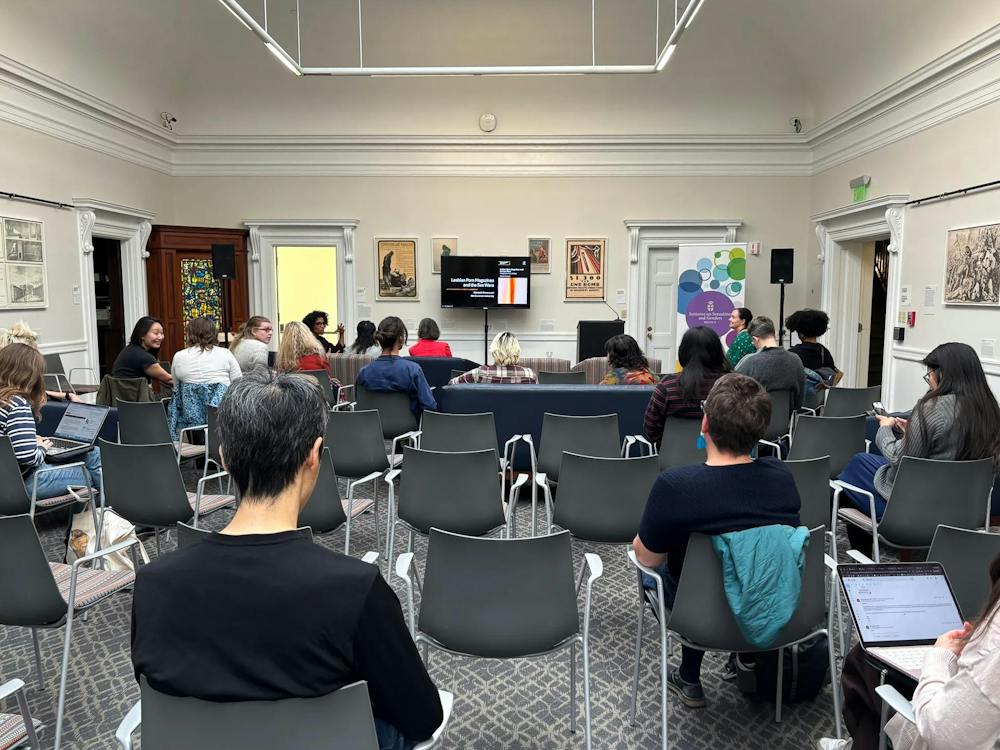
In the ’80s and ’90s, lesbian sex magazines were some of the first fruitful publishing grounds for many people who became celebrated queer, trans and feminist theorists. “Porn, like all media texts, is complex and multifaceted,” Old Dominion Professor and Chair of Women’s and Gender Studies Elizabeth Groeneveld said at the inaugural event of the “Gay at the Hay” series.
At the Thursday talk hosted by the Initiative on Sexualities and Genders, Groeneveld discussed her 2023 book, “Lesbian Porn Magazines and the Sex Wars: Reimagining Sex, Power, and Identity.” While discussing her research, she reframed lesbian sex magazines from the ’80s as texts that helped generate conversation about sex, power and lesbian identity.
“While porn is often perceived as a genre with little in the way of redeeming cultural value, this book makes a case for valuing porn for what it teaches us about ourselves, the world we live in, and the world we might wish to create,” she said at the event hosted at the John Hay Library.
Groeneveld explained how she provided a history of the Sex Wars — a series of intense debates about sex and sexuality during the late ’70s to early ’80s — in the first chapter of her book. When writing this chapter, she looked at archival magazines, as well as the Hay’s digitized “On Our Backs” collection, which holds copies of the eponymous sex magazine that she called a “cultural touchstone of lesbian life.”
Groeneveld said she argued that the “letters-to-the-editor section of magazines like On Our Backs comprises a frictional space,” a term that describes “how ideas of different editors, staff, contributors and readers rub up against each other” and generate new ideas about lesbian sex and lesbianism over time, Groeneveld said.
“Frictional space isn’t specific to lesbian sex magazines, but there’s something a bit lesbian and a bit sexy about the frictional spaces of magazines,” she added. “The tactile holiness of magazines produce an embodied reading experience that arguably has its own erotics of touch.”
At the talk, Groeneveld pointed to a short story published in a lesbian sex magazine called Bad Attitude. The story examines a “sexual encounter between strangers from the perspective of each participant, structured in side-by-side columns.” The space between the columns becomes a frictional space for the debate between the two participants, she said.
Along with On Our Backs and Bad Attitude, Groeneveld also examined three BDSM magazines started between 1983 and 1984, as well as Black Lace, a Black lesbian magazine established in the early ’90s.
Groeneveld said that in the book, she contrasts the conversations happening in Black Lace to those in magazines that were mostly led by white lesbians. Although many of the lesbian porn magazines during this era were led by white women, Black contributors used these magazines “as places to articulate their own stories, fantasies and desires,” she said.
Readers of On Our Backs in particular demanded a more diverse magazine in letters to the editor. This speaks to how “fantasies of greater sexual freedom may have also been intimately linked to desires for racial integration,” Groeneveld added.
Groeneveld also pointed to the role lesbian sex magazines played in creating and circulating educational HIV materials during the ’80s and ’90s as another form of activism.
“In circulating information relating to lesbian health, particularly safer sex, lesbian sex magazines imagined and helped create networks of care based on understanding, acceptance and mutual pleasure and fulfillment,” she said.
At the talk, Groeneveld said she chose to use the term “lesbian porn magazines” instead of “lesbian sex magazines” to emphasize these publications; reworking of a genre to create something that did not previously exist.
“I’m also trying to signal that these magazines have value as porn,” she said. “These magazines were primarily for sexual excitement and hopefully gratification, and that alone has value for academic study.”
“I actually found the talk really engaging,” said Sarah Leister ’28, who attended the event. “I feel like my mind opened on some of the topics that (were) talked about, like queer history and porn.”
Mia Newell ’30 said she had heard of the “Sex Wars” prior to the talk, but was not very knowledgeable on the topic. “It was fun to see first-hand the kind of debates that people are having, and especially the racialized debates.”
“There is comfort to be gained in learning these histories and reading the stories of how others have not only survived but carved out spaces for both pleasure and mischief,” Groeneveld said.
Miriam Davison contributed reporting.

Ivy Huang is a University News and Science & Research editor from New York City. Concentrating in English, she has a passion for literature and American history. Her favorite authors include Marilynne Robinson, Vladimir Nabokov, and Toni Morrison. Outside of writing, she enjoys playing basketball, watching documentaries, and beating her high score on Subway Surfers.


