
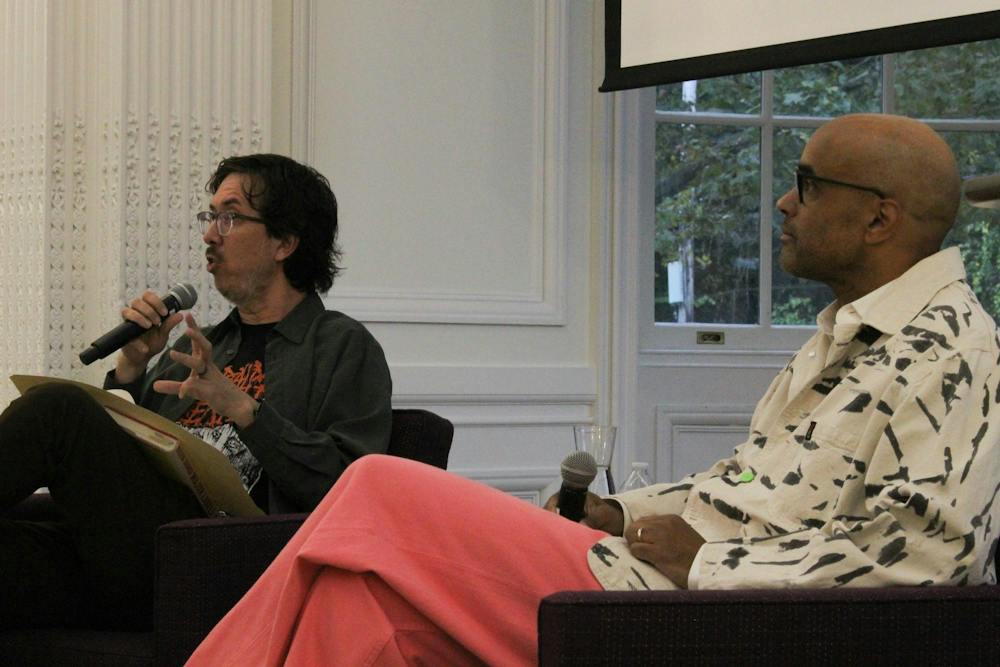
On Tuesday, Kelefa Sanneh — a staff writer for The New Yorker — visited Andrews House to deliver a lecture entitled “FIGHT SONGS: A Brief History of Controversial Pop Music.” The talk — which was part of the Greg and Julie Flynn Cogut Institute Speaker Series — examined discourse in mainstream music as a reflection of social organization.
Sanneh opened the lecture by discussing the extent to which genres are used as a framework to understand music. “Why can’t it just be music?” Sanneh asked the audience. Even, “just good music,” has become a playlist on Spotify, he said.
He played a snippet of Aretha Franklin’s collaboration with George Michael — “I Knew You Were Waiting (For Me)” — to illustrate how some Black R&B singers drew on elements of pop music to attempt to achieve “crossover success” and further appeal to white audiences. While the song wasn’t necessarily controversial, it represented a controversial trend, Sanneh said.
“Is assimilation the goal or the problem?” Sanneh asked the audience. “What kind of freedom is most important: the freedom to stay in your own community or the freedom to leave it?”
He then pivoted to “Dirt Road Anthem” by country singer Jason Aldean, which received backlash from critics for its inclusion of rap-style verses. Sanneh suggested that because genres are rooted in tradition, songs like Aldean’s have stood out due to their bending of a genre’s mainstream characteristics.
Throughout the talk, Sanneh questioned the simplicity of placing music in genres. For example, he mentioned that while country is “the most self-consciously white genre,” it also bears clear influences from Black hip-hop artists.
While modern listeners have grown more accustomed to genre-mixing in mainstream music over time, some still maintain a certain value system that dictates their music taste, he said. Sanneh played a clip of Fenix Flexin’s artificial intelligence-generated song “RUBBERZ” to illustrate a category of music where many listeners “draw the line.”
Yet he said that because “RUBBERZ” adopted its own cultural significance by spurring online discourse, the song — despite its non-human qualities — still has a history and an identity.
“It may be slop, but it’s authentic slop,” Sanneh said. He added that other music with autotune and AI elements can still be “intensely personal,” such as Charlixcx’s work. “Maybe new technologies allow new forms of intimacy.”
According to Sanneh, listeners are “impossible to satisfy” because of their desire for music to possess elements that are “incompatible, mutually exclusive.”
“We want our favorite songs to feel like intimate secrets, but we also want to watch them conquer the world,” Sanneh said. “We want to hear what we like, but we also want something new. We want things to be faster, cheaper, better — but also slower, more valuable and just like they always were.”
The lecture concluded with a Q&A facilitated by Rick Baldoz, an associate professor of American studies.
Zoe Yu ’27.5 — who attended Baldoz’s class AMST 1611S: “U.S. Pop Culture” two years ago — remembered reading Sanneh’s book “Major Labels: A History of Popular Music in Seven Genres” as part of the course syllabus.
“I really enjoyed Kelefa Sanneh’s writing style,” she told The Herald. “In-person, (he is) just as intriguing as he is in the book.”
Darcy Chang GS — a fourth-year Ph.D. student studying ecology, evolution and organismal biology — said she attended the event after hearing about it through Today@Brown. After recognizing Sanneh’s name from The New Yorker, Chang “thought it would be interesting to see what he had to say.”
“I totally enjoyed it,” she said after the lecture. “It was exactly what I thought it would be based on my previous readings of his columns.”

Kendra Eastep is an illustration chief and a Senior Staff Writer for Arts & Culture. She is from New York City and concentrates in English and History. While she draws, she likes to drink peach tea and watch video essays.


