
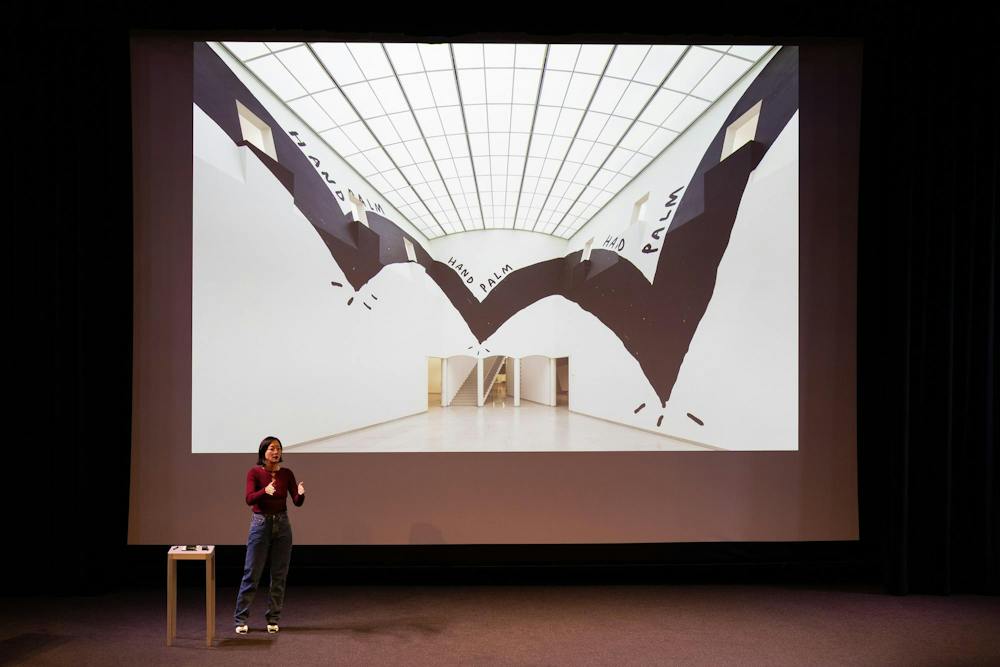
When Christine Sun Kim was asked to create a mural for the Queens Museum in 2022, she turned to the American Sign Language books she read growing up as a source of inspiration. Like comic strips, ASL books use motion lines to illustrate movement, translating a three-dimensional language onto a two-dimensional plane. The resulting mural, roughly 35 feet tall and 100 feet wide, is composed of four drawings, which together represent a poem in ASL: “Time Owes Me Rest Again.”
Kim, who is based in Berlin, delivered remarks at RISD’s 48th Gail Silver Memorial Lecture at the Rhode Island School of Design Auditorium last Wednesday. Kim, who was born deaf, gave her talk in ASL with interpretation by two interpreters. Over the hour-long lecture, she provided background on her methodology and artworks, many of which examine issues around accessibility barriers for the Deaf community.
Throughout 2025, Kim’s mid-career retrospective, “Christine Sun Kim: All Day All Night,” was on display at the Whitney Museum of American Art in New York City, New York and the Walker Art Center in Minneapolis, Minnesota. In September, she was announced as one of this year’s MacArthur Fellows.
Rest and fatigue are recurring themes in Kim’s work. A major part of one of her most recent exhibitions is “Community Sigh,” a sound installation composed of a set of vinyl records, which continuously replay recordings of over sixty Deaf people sighing. The result is a chorus of sighs — a fugue of fatigue. Kim played a video of the installation on Wednesday and explained that sighing, which demonstrates labour and resilience, is a political act that signals hope.
“If you’re encountering barrier over barrier, again and again, it helps to pause,” Kim explained. “Breathe in. Make space in your lungs. Exhale it to build yourself up to try again.”
Kim often imagines emotions and ASL signs as characters who move and interact with each other. In 2017, Kim created a billboard for the Whitney Museum based on the sign for “future,” which is composed of two arching movements. “I got obsessed with the movement of the hand forming the sign, and I started to look at it so much that the sign for ‘future’ became a person with its own personality,” she noted at the lecture.
The resulting work, “Too Much Future,” depicts two thick semicircles that bounce across the canvas. Kim wanted the thickness of the black line to hold emotions such as “fear, anxiety, joy (and) anger,” she said.
“I love to think of anxiety as a person, anxiety as a deaf person, anxiety as a mom,” Kim added. She said a lot of her anxiety is related to making requests for accessibility — a frustrating and laborious experience that often leads to Kim feeling “ghosted.” Her “FOMO Scores” project plays on the idea of musical scores as systems that provide strict instructions for a performance. It consists of a series of canvases shaped into the ASL sign for “score,” onto which Kim has pasted several of her unanswered email requests for accessibility measures. The white text, imposed on a stark white background, represents how her messages often fall into the “abyss.”
“Society is very much entrenched and fixed in its ideas of what society should be, how people should be (and) how information should be communicated,” Kim said. “In the Deaf community, we are a marginalized group with horizontal oppression, with a lot of baggage (and) a lot of trauma that has been passed through generations.”
One of Kim’s requirements when working with an art gallery is that they commit to providing sign language access as part of the “institution’s practice from then on.” When she creates a sound installation, Kim ensures that she provides materials for deaf viewers to understand her work.
Kim, who studied painting at the School of Visual Arts before completing a Master of Fine Arts in sound and music at Bard College, recalled that when she first started working with sound art, she was worried that her work was inaccessible to the Deaf community and that it made her “less Deaf.” But she realized that the focus of her work is not about the audience, rather about how she can best express her ideas — for her, that happens to be through sound.
“My hot take on the Deaf community is that I don’t see the Deaf community as something that will be around forever,” she said, pointing to the advent of new technologies like gene therapy that could eradicate deafness. In her mind, the Deaf community is “running out of forever.”
“I feel like sign language is forever, but the deaf community is not,” she added during the question-and-answer session. “People love sign language. They just don’t love deaf people as much.”
As Kim closed her lecture, she emphasized that she not only has to do “twice as much work to get something across,” but that she often experiences a lag in communications when interacting with hearing people. “I have to wait for the interpreter to then interpret it for me to finally get the information. So I’m never in the now, I’m always behind,” she explained.
“Except for tonight. Forever is behind us now,” Kim said.


