
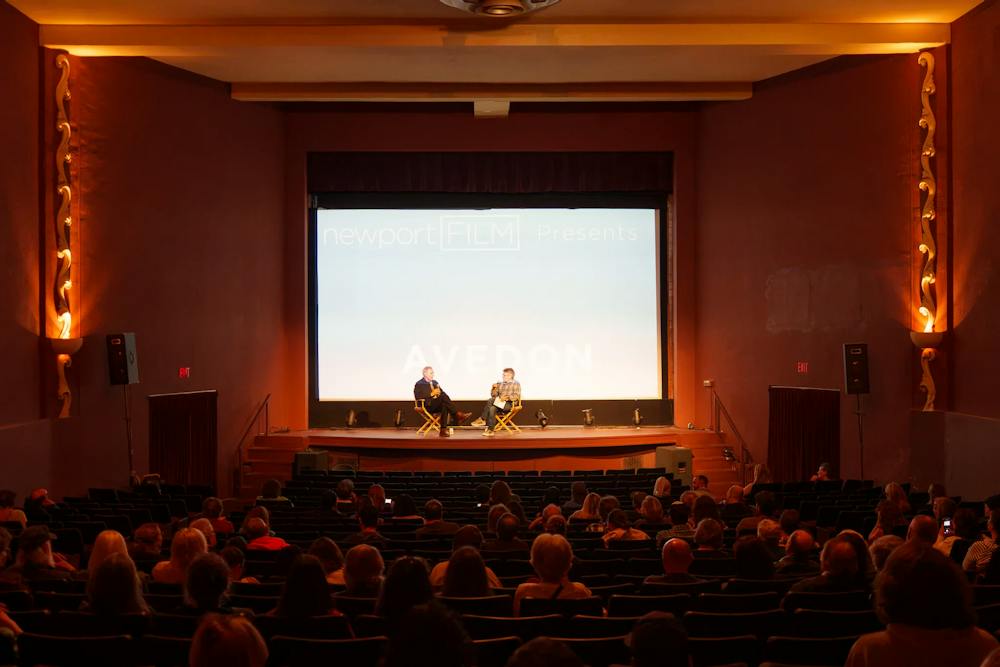
At the Avon Cinema on Thursday, cinematographer Robert Chappell recalled that when he first met with filmmaker Ron Howard virtually, he was concerned about what his Zoom background should be: “Should it be a blank wall? Should it be art directed?”
Hosted by newportFILM, the Thayer Street theater housed an early screening of “Avedon” — Howard’s new documentary about the prolific 20th-century photographer Richard Avedon — ahead of its release on Netflix later this year. The screening was followed by a conversation between Chappell, the film’s director of photography, and Thaddeus Russell, senior critic of photography at the Rhode Island School of Design.
Avedon was famous for his confrontational portraits shot against stark white backgrounds. By decontextualizing his subjects, he aimed to create a greater sense of intimacy — and question where meaning lies in a portrait.
“We were so excited because newportFILM always does try and have film talent, however they’re associated with the film,” Cathleen Carr, executive director of newportFILM, said in an interview with the Herald. “It was a delightful layer to learn that (Chappell) hadn’t seen the film yet.”
Chappell said that selecting a cinematographer is not unlike casting an actor. As the director of photography, he hoped he was able to provide something to Howard that the director would not otherwise have been able to “anticipate or articulate.”
Howard was interested in Chappell’s work as a cinematographer in the 2003 documentary “The Fog of War,” which won the Academy Award for Best Documentary Feature. Directed by Errol Morris, the film utilized the Interrotron, a two-way mirror system invented by Morris that allowed the subject to make direct eye contact with the camera while speaking to an off-screen interviewer.
Twenty years later, Howard enlisted Chappell for “Avedon” because he was interested in creating a similar effect.
Chappell recalled how Howard “came in sweatpants every day, wanted to hang out (and) wanted to have lunch with the small crew.”
“Avedon is a consummate artist. Ron Howard is a consummate artist… and I think that there’s an affinity between them,” Chappell said. “He’s looking for subjects and characters who he feels identifi(ed) with.”
One challenge for Chappell was creating a visual style that would pay homage to Avedon’s work without “competing” with it. He explained that he initially considered shooting the film entirely in black and white, but he decided against it because he did not want to “mimic” Avedon.
“If my lighting and backgrounds were totally forgettable, I’ve accomplished what I should have,” Chappell said.
“(“Avedon”) inspires me to keep going,” Chappell added. “I’m sure he went through periods where he felt like he’s never going to work again. And he kept going and he kept making beautiful things.”
“It was a real delight to see two deep image-centered professionals talking about craft and being so thoughtful about Avedon,” Carr said. She hopes that the documentary will introduce a new generation to Avedon’s work and his “painstaking” approach to image creation, in “contrast to the proliferation of images today.”
“It was just a wonderful evening to bring people together who love photography, love images, but also love the weight of Avedon’s cultural impact in this country,” she added.


