
I remember a time when it was easy to forget about politics. Still an elementary student in St. Louis, Missouri, I was oblivious to Michael Brown’s death and the Black Lives Matter movement that followed, and I paid no mind to Donald Trump’s asinine musings on running for president when former President Barack Obama was still holding down the fort. I do not believe many would blame an eight-year old for being oblivious, but I find myself reflecting on that ignorance over a decade later.
As I have grown older, and hopefully wiser, I have become aware of the monumental, pervasive issues that face America today. I have attended a protest or two myself, and I am proud to say I voted for the first time this midterm cycle, but I see a deepening chasm between the politically engaged and the apathetic, at Brown and in America.
Only 32.1% of Brunonians voted in the 2022 midterms, and less than 40% of the Class of 2030 plans to attend a protest while at Brown. This apparent apathy draws me to join the long line of opinion writers that promote civic engagement within the Brown student body. Much ado has been made over how to jumpstart civic awareness within our student body, but to bridge the gap between the politically conscious and the tapped out students at Brown, I have a proposition: We need to ground our conversations about politics in personal, local issues that speak to the day-to-day concerns of individuals.
Brown and its students have a prolific history of activism that carries through to the present day. The Open Curriculum’s founding myth is based in students’ calls for reform, and Brown protesters played a role in Citizens’ Bank’s partial divestment from ICE contractors last spring. Suffice it to say, Brown has a vibrant political scene, but this scene is composed of a relatively small chunk of the student body. And beyond campus, the share of American society that is civilly engaged is even smaller than it is on College Hill.
There are several reasons for this lack of engagement. For one, activism at Brown has recently focused primarily on U.S. federal actions which limits the ability of our international peers to speak on political issues. International students constitute a significant portion of our student body, yet protesting or even speaking critically of the current U.S. administration means risking their entire livelihoods in America. Our fellow Brunonians are in need of political outlets other than engaging in forms of civil disobedience that could endanger them personally.
Just moving those national policy-focused protests into interpersonal conversations may not prove our answer either. The solution to political disengagement requires more than just changing our methods of discourse, it’s also about changing what we are focusing our discussions on. National partisan policy is divisive, and often disconnected from Americans’ day-to-day realities.
State policy on pressing issues such as reproductive rights and the legality of marijuana is widely varied, thus the realities Americans are living under are diverse. Even the primary way Americans can engage in politics — voting — differs from state to state. Policies such as citizen initiatives and referendums are only instituted in about half of American states, despite the incredible agency they give to voters; in Missouri, my home state, a referendum resolutely halted a gerrymandering effort by our elected officials.
In contrast to polarizing and sometimes esoteric talking points, speaking from personal experience would allow students to give valuable input on pressing political issues in America and abroad; for example, an Australian student can speak to the efficacy of the country’s under-16 social media ban at a time of imminent reckoning for America’s tech giants.
To throw my own hat in the ring, as a citizen of Missouri, I have seen firsthand the devastating effects of legalizing sports betting. Opening our political dialogue to personal experience would allow me to provide a perspective to those from Nebraska as they mull over that same measure these midterms. When issues as fundamental as income and property taxes are on several ballot measures this cycle, it is paramount to consider the voices of those that have lived through such laws in other places.
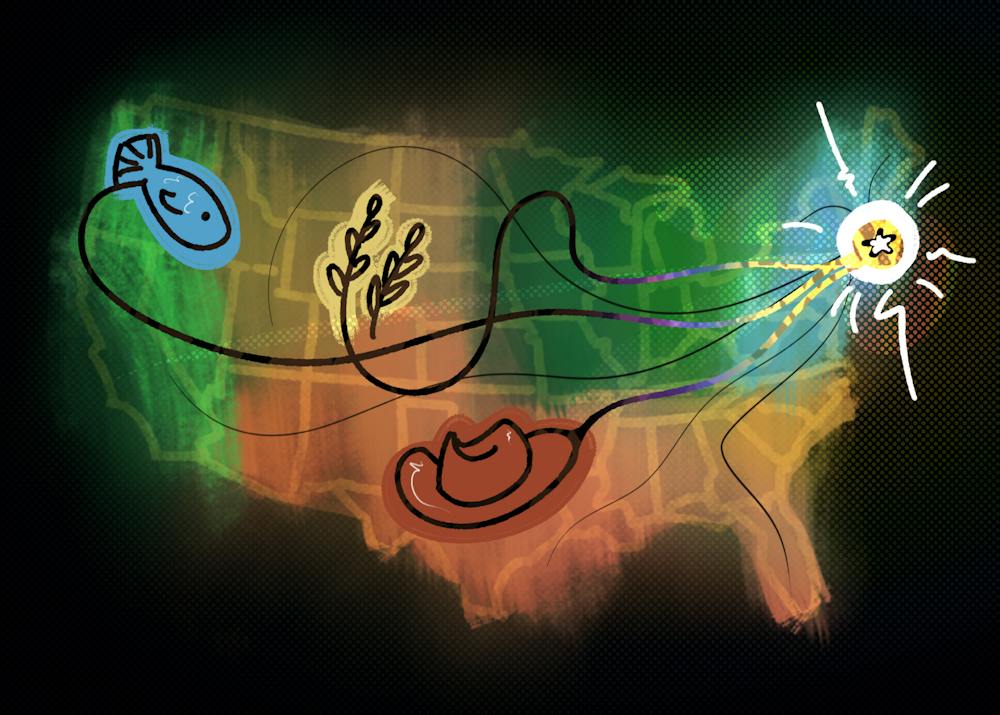
Making our political discussions personal — which often means grounding our talking points in local, rather than national policy — may also prove the key to unlocking the silent majority, at Brown and at large. More reserved Brunonians may be hesitant to voice their opinions on foreign policy and the like, but you would be hard pressed to find an American or Brunonian who has not felt the impact of American politics on their own wallet. Collective action is strongest when addressing issues people experience daily, as opposed to the binary that colors much of American debate.
The late great Rev. Jesse Jackson said it best: “America is more like a quilt… held together by a common thread.” In the present age, we must find our common thread. I will not pretend to have the ultimate answer, a quick and simple panacea for our political ailments. Still, there are modern precedents for unity, and we have a meaningful opportunity at Brown to find our next great movement.
Finding that common thread can start by understanding the similarities between the issues impacting all of us. This can start as simply as by opening up a copy of the Brown Political Review, a nonpartisan student publication, that consists of articles about local and quotidian issues across the globe. Even if you don’t become an expert on every issue, you can gain a broad brushstroke sense for the local news that might be most directly important to individuals of diverse backgrounds.
Bringing personal experience into academic conversations has been and should be advocated for by Brown, but it does not need to stay within classroom walls. Bringing this practice into political discourse, and teaching each other about the issues close to our hearts, can also aid us in finding the common ground necessary to inspire action. The road to change may not only start with policy, committee or even protest. This midterm season, it may start as simply as asking your neighbor what is on their ballot.
Izuchukwu Obialo '29 can be reached at izuchukwu_obialo@brown.edu. Please send responses to this column to letters@browndailyherald.com and other opinions to opinions@browndailyherald.com.


