
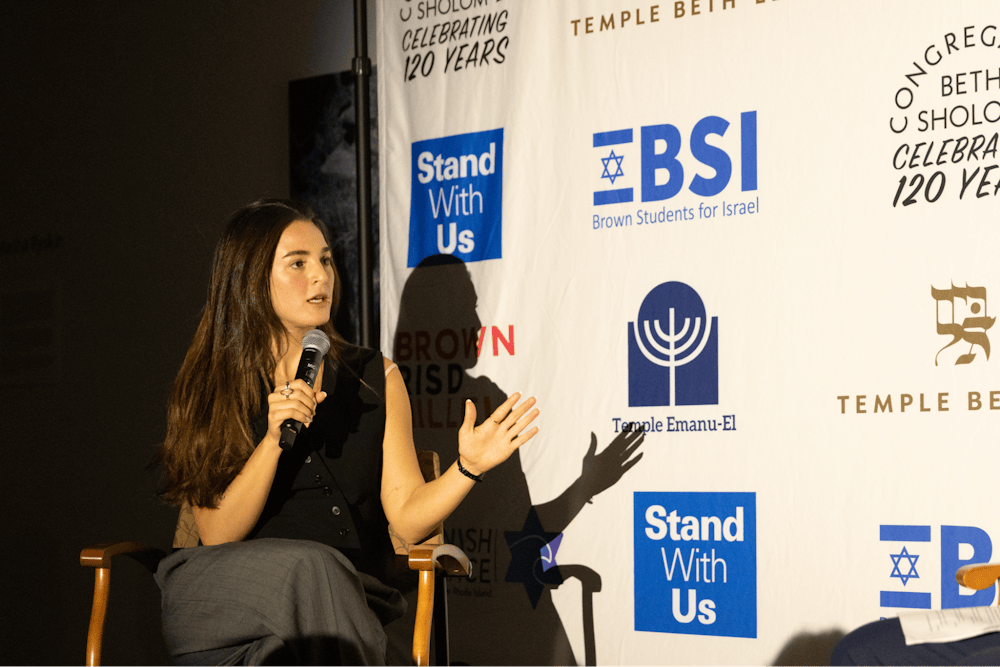
On Oct. 7, 2023, then-21-year-old Maya Regev was kidnapped from the Nova Music Festival and held hostage in Gaza for 50 days. Three years and one day later, Regev shared her experience at a Thursday event organized by Brown Students for Israel in partnership with Brown-RISD Hillel and several Jewish community organizations.
Co-presidents of BSI Lev Kotler-Berkowitz ’27 and Leah Koritz ’27, who are both former senior staff writers for The Brown Daily Herald, said the talk was the biggest event BSI has held in remembrance of the Oct. 7 attacks.
Oct. 7 “was this horrible event that I think shocked a lot of people in the Jewish community and in the Israeli community,” Koritz said. “It kind of felt like a lot of people maybe didn’t understand the gravity and how many people were affected and impacted.”
This Oct. 7 marks the first anniversary since all the Israeli hostages returned home. The last 20 surviving hostages were released by Hamas on Oct. 13, 2025. “That’s a change now where there’s not really like this call to action as much, and it’s more about remembrance,” Kotler-Berkowitz said.
On Oct. 7, Regev arrived at the Nova Music Festival with her brother, Itay, and several of her friends. She told the audience that before the attack, she was having “the best time of (her) life.”
“It was a party that was all about love, all about freedom, all about celebrating life,” she said.
But just before 6:30 a.m., the DJ shut off the music and announced red alerts signaling that rockets were being launched toward Israel. At first, “we thought, it’s just a matter of time before everything will get calmed down and we can keep on partying,” she said. Time passed, and Regev said that she and her friends realized the threat was serious. They were waiting outside by their cars when they suddenly heard gunshots all around.
“I remember people falling right next to me because they got hit, and I really want to help them, but I can’t because I might be next. I have to save myself,” she recalled.
After running from the shots for over an hour, she received a call from her friend Ori Danino, who had left the festival. But hearing his friends in danger, Danino returned with his car to help the rest of the group escape.
Regev and her brother called their dad from Danino’s car, and almost immediately encountered a pickup truck blocking the road. Nine gunmen exited that truck and began shooting, hitting Regev and her brother in their legs.
“The whole time, my father is on the phone with me,” she said. “He hears everything.” Regev then played a recording of the phone call for the audience, where she could be heard screaming in Hebrew.
“I’m saying, ‘Dad, I got shot. I got shot. They are coming to us. We can’t escape. We’re in the car, they are coming to kill us. I love you. I’m sorry,’” she said.
Danino managed to escape but was later caught by a different group of attackers. He was one of six hostages executed by Hamas after being held hostage for 11 months. Ori “saved our lives, and it cost him his,” Regev reflected.
Eventually Regev was taken to a hospital, where she met another Israeli captive in a shared room named Guy Illouz, who had been shot by Hamas attackers multiple times. A day and a half later, Illouz died from his wounds.
“I remember saying to myself, ‘Okay, no, you’re not surviving only for you and for your family. You’re surviving for Guy and for Guy’s family because they deserve to know what happened to him, and I’m the only one who knows,’” Regev said.
Throughout her time as a hostage, Regev said she received inadequate medical treatment and was frequently tortured by her captors. “I was in hell. I was in a place where I was again hated simply for being Jewish,” she said. But she said that this “was the place (she) felt God the most.”
Fifty days after her capture, Regev was released and reunited with her mother, father and youngest brother. “The moment I touched them was the moment I started crying like a baby, was the moment I felt like (I was) safe again,” she said. Four days later, her brother Itay also returned home.
“But returning home was only the beginning of another journey,” she said. Regev underwent 10 surgeries on her left leg and was hospitalized for almost a year. Throughout this time, she and her brother talked to many radio stations and TV channels. She also traveled and met with government officials to spread awareness about their experience and the hostages who had not returned home.
“We fought for all the remaining hostages,” she said. Only when the last one came home could they “really breathe properly.”
The event then transitioned into a Q&A, moderated by Kotler-Berkowitz and Koritz with questions submitted by audience members upon registration. When asked about the best ways to support Israelis and former hostages, Regev said to “keep defending Jews’ names and Israel’s name wherever you go.”
After returning home, Regev said she cried when seeing the support Jewish communities around the world showed for her and other hostages.
Regev was also asked what gives her hope today. “I really believed after I was released that there’s no good in this world,” she said. But traveling and sharing her story brought that hope back. “Me sitting here in front of you, this is what gives me hope,” she said.
Maya Levy, a first-year at the University of Rhode Island, said she felt “empowered” by hearing “how she was able to have hope” throughout her experience.
Maisy Roos, a junior at URI, said that she attended the event in order to “show up for other Jewish people and show our support towards Maya.” She added that it is “important that Jews stick together, and no matter where we are, we’re always supporting each other.”
Alyza Feiler, a master’s student at Johnson and Wales University, said she was “so grateful that Maya took the time out of her busy schedule to come see us. It means more than she’ll ever know.”
BSI partnered with several community organizations to host the event, including the Jewish Alliance of Greater Rhode Island. Steven Baker, president and CEO of the alliance, said the event was important “in the climate that we’re living in right now, to get the truth out there of what these victims went through on Oct. 7 and being held in captivity in Gaza after.”
Baker said this message has generally “sadly been overshadowed.” He added that commemorating the lives lost and affected on that day is necessary.
“It makes us never forget. (It) reminds us that being Jewish is a blessing,” Baker said.
Rachel Wicker is a senior staff writer covering affinity and identity. She is from Athens, Georgia and plans on concentrating in English on the nonfiction track and International and Public Affairs. Outside of writing, she enjoys reading books of any genre and doing yoga.


