
“Wicker” begins with a fable of a fish catching a glimpse of its reflection in an ice cap, after which it rams into its mirrored self and dies. “Safer not to see your fishy self at all,” a voiceover by Peter Dinklage says.
In a society built on shame and repression, it is easier to hide than face the risk of uncovering who you really are and what you truly desire. In “Wicker,” the protagonist (Olivia Coleman) finds value in taking the harder path.
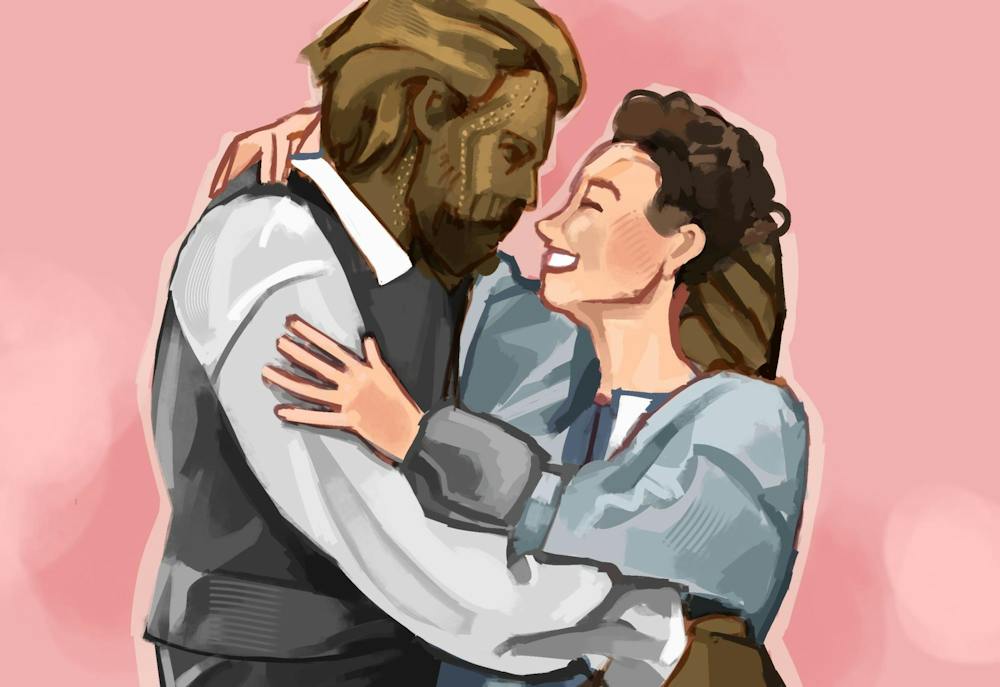
Directed by Alex Huston Fischer and Eleanor Wilson and based on the short story “The Wicker Husband” by Ursula Wills, “Wicker” stars Coleman as a recluse fisherwoman in an isolated, patriarchal village and Alexander Skarsgård as “the wicker husband” who brings love to her life and turmoil to the town.
Caught between scorn for the village’s obsession with marriage and an aching loneliness, the fisherwoman implores the village basketmaker (Dinklage) to make her a husband. His response? A look of appraisal and a succinct order to be ready in a month. True to his promise, one full moon later a man made entirely out of wicker meets the fisherwoman at the chapel.
While marketing for the film took off its eccentric raunchiness — with posters of hands wrapped around a wicker chest and slogans such as “big wick energy” taking the internet by storm — the film leans more into the genuine affection between the couple than their physical relationship. Its eroticism is still undeniable, especially when coupled with the film’s humor: The wicker husband’s body creaks as he moves, a choice creatively employed during the film’s intimate scenes.
“Wicker” shines the brightest in its satirical depiction of social traditions and constructs. One of the film’s first scenes involves a wedding ceremony where the groom fastens a metal collar to the bride’s neck, who chokes out a smile as she completes this celebrated rite of passage. Scenes like this are easy to laugh at, yet prompt the viewer to reconsider the traditions so easily accepted in our own society and the absurdity we may have just become accustomed to.
Much of the film centers around the village’s response to the wicker husband’s arrival, which disrupts the steady acceptance of contractual and convenient relationships. Village women look longingly at the wicker husband, drawn not just to his tall stature and woven muscles, but also his plain, unguarded devotion to the fisherwoman. Once satisfied with — or at least accepting — their lackluster marriages, the wicker husband shows the women of the village the desire and affection they could be both receiving and giving.
Not everyone is happy with this disruption. The film’s primary antagonist, the tailor’s wife (Elizabeth Debicki) maliciously disapproves of the fisherwoman and her husband, despite her own dissatisfactions with the constraints of her role as a woman. In one scene, the husbands gather in the village bar to gripe about their wives’ new, ostensibly unfeasible expectations, like clear communication of their affection.
But “Wicker” manages to avoid a cliche portrayal of a patriarchal society, instead revealing how both husbands and wives can be hurt by its restrictions and denials. One young husband attempts to learn from the wicker husband to better please his wife. His spectacular failure, while darkly humorous, questions the extent to which both men and women can unlearn the values that have formed their very existence in pursuit of purer connection.
There are moments when the film’s adaptation from a short story falters, and the dialogue and themes seem inadequately translated from the written word. The romance itself between the fisherwoman and the wicker husband also falls flat in its execution and development, more touching in what it represents than what it is.
But the film's stunning set design and natural imagery — setting suns, a tree changing through the seasons, fish squirming in a clear stream — create a dreamy setting both visually appealing and thematically constructive, as the utopic setting juxtaposes with the bleak village traditions.
The isolated, claustrophobic village setting contrasts with the wilderness of the outside world, with the wicker husband symbolizing a connection between nature and humanity that allows a transcendent love free from society’s corruption. As a complete outsider to society, the wicker husband brings a vulnerable and uninhibited approach to love and intimacy that our modern world could learn from.
Ultimately, the film questions the feasibility of this kind of love if one remains trapped in a society that rewards shame and punishes desire and vulnerability.
Its answer? The film’s ending suggests that once you are bound to the values of a society, it is nearly impossible to break away. When men are taught to demand and women are taught to accept, there are stark limits not just to reality, but to imagination. And even in a world touched by fantasy, magic is only there if you ask for it.
Rachel Wicker is a senior staff writer covering affinity and identity. She is from Athens, Georgia and plans on concentrating in English on the nonfiction track and International and Public Affairs. Outside of writing, she enjoys reading books of any genre and doing yoga.


