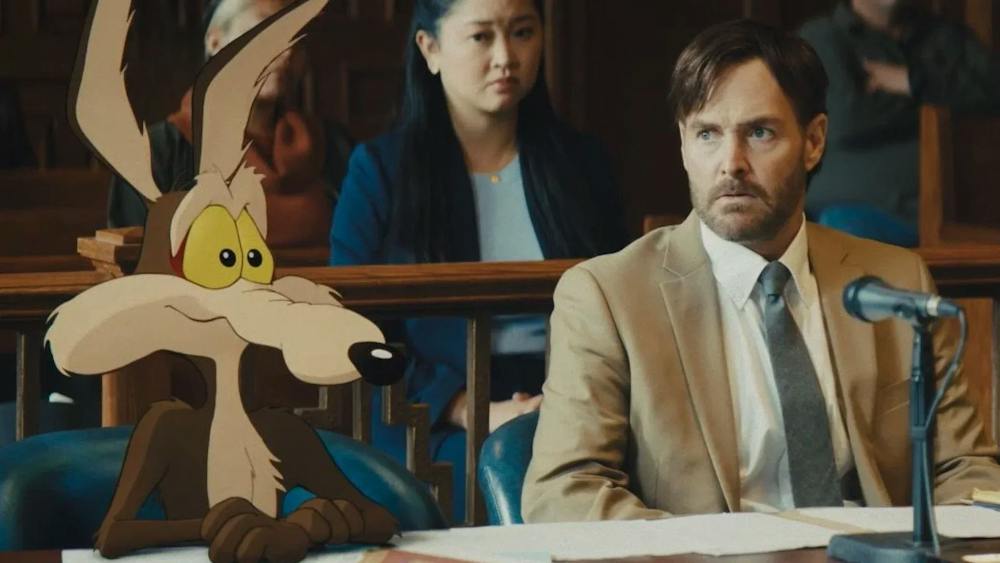
With many “beep-beeps” and “meep-meeps,” “Coyote vs. Acme” is a fun watch for most audiences. But for devoted Looney Tunes fans, the movie may be a bit of a let-down.
The film, inspired by a satirical 1990 New Yorker article, offers a fresh take on Wile E. Coyote’s desperate attempts to catch his on-screen nemesis Road Runner. After using one too many defective Acme products in his futile pursuits, Coyote sees a TV ad for Avery, Jones & Maltese — a cartoon violence law firm — and decides to take things into his own hands and sue the Acme corporation.
Lawyer Kevin Avery (Will Forte) has fallen into a lethargic routine of settling lawsuits for menial sums, but his legal intern and niece Paige (Lana Condor) has big dreams of seeking justice for injured cartoon characters.
Kevin quickly brushes Coyote’s lawsuit aside when it is initially presented to him. But to Kevin’s chagrin and Paige’s delight, a zany series of events results in the firm filing a huge lawsuit against Acme. Newly neighbors with Coyote in the motel where he lives, Kevin is forced to deal with the lawsuit and the canine next door as they try to subpoena the Road Runner.
The film stays very aware — sometimes painfully so — of its position as a connection between live-action films and classic cartoons. But unlike other Looney Tunes movies, such as Space Jam, its cartoonish violence feels forced in some places, especially as some “flashback” sequences show original, fully animated scenes from Road Runner cartoons. Running away from a painted train in live action translates well, while a deflating Road Runner dummy in Coyote’s arms does not.
In an interesting twist for a man-vs-the-corporation movie like “Acme,” the completed film faced a bumpy path to release after it was shelved by Warner Bros. Discovery in 2023 for a $30 million tax write-off. Filmmakers and Looney Tunes fans were upset — one fan even dressed as Road Runner to advocate for the movie’s release outside of the Warner Bros. studio lot. But the movie was given new life in 2025 after the rights were bought for $50 million by Ketchup Entertainment. In August, the movie finally made it to the silver screen.
For fans of Looney Tunes, the movie includes cameos and references to well-known characters, including Speedy Gonzales, Porky Pig and Yosemite Sam. But the representation of the speaking cartoon characters is disappointing, as lovable characters in the original series now come across as irritating (cough cough, Tweety Bird), and characters that are meant to be bothersome hit it right on the nose, like Acme CEO Foghorn Leghorn.
John Cena hit it out of the park with his representation of overconfident Acme lawyer Buddy Crane. The actor nails the overconfidence and inflated personality that one looks for in a live-action cartoon character, but successfully shows his embarrassment as he cracks jokes about cracking eggs to Foghorn Leghorn, one of many characters voiced by Eric Bauza. While the film spirals out of control as deeper Acme secrets — such as the mysterious Project Sisyphus — come to light, Cena’s delivery does not become trite.
The movie does come to a satisfying conclusion, achieving a fun watch for young and old alike without making any significant social commentary. And for diehard members of the “beep-beep” vs. “meep-meep” debate, many will leave frustrated that the film chose “beep-beep” for Road Runner’s signature sound.

Ian Ritter is a university news and science & research editor, covering graduate schools and students. He is a senior concentrating in chemistry. When he isn’t at The Herald or exploding lab experiments, you can find him playing the clarinet or watching the Mets.