
This past spring, Professor of Economics Roberto Serrano decided to give his students a take-home midterm for the first time since he started teaching ECON 1170: “Welfare Economics and Social Choice Theory” nearly 20 years ago. The results were startling: The median grade was 98%, and nearly half of students earned a perfect score. “Historically, the average grade in the midterm exams ranged from 65 to 85,” Serrano told The Herald. The professor’s suspicions that students were using artificial intelligence to cheat were confirmed when the average on the in-person final was 48%.
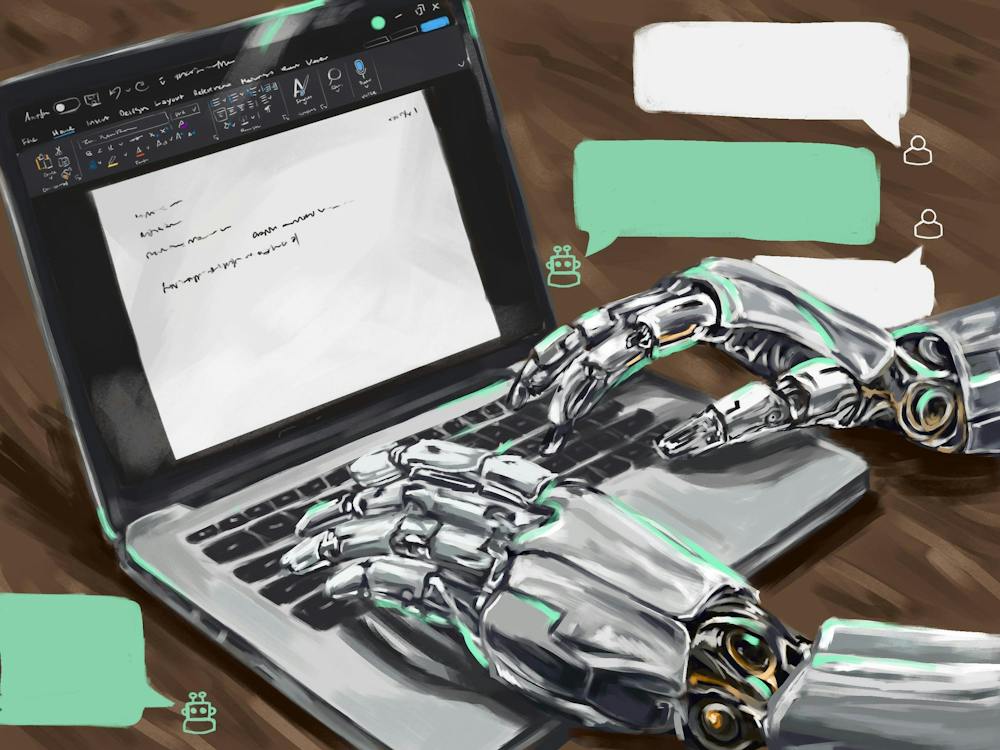
Following the incident in Serrano’s course, The Herald reported that professors in the Department of Economics were shying away from offering take-home exams. This is not unique to Brown or economics. In the age of AI, educators across the country are abandoning the take-home academic paper in favor of in-person blue book exams. I agree that in-person exams seem to be an inevitable solution to widespread access to AI. Especially for STEM courses and subjects like economics, which are often content-based rather than analysis-focused, this solution may prove effective as they can test students’ ability to accurately recall information without the help of external resources. But the push away from take-home essays, which are often more process-based, makes less sense than the push away from take-home tests. As professors reckon with the role of AI in the classroom, the academic essay should not be completely abandoned. Instead, in writing-focused humanities courses, its value should be recognized as a tool for advancing critical thinking and intellectual development, despite concerns over AI use.
Following the national trend, some professors at Brown have changed their assessment policies to offer in-person, timed exams in place of take-home essays. For example, of the undergraduate courses in the Department of History at Brown offered this semester for which I was able to access the syllabi, I found at least four courses where students were not tasked with completing any writing outside of class. Of history courses offered in fall 2022, the year ChatGPT was released, every single class syllabus I found required students to complete some form of out-of-class writing.
I believe the purpose of the take-home essay was never the final product, but the process. Learning through essay writing occurs in the false starts, the brainstorming of ideas and in the rearranging of paragraphs and sentences. Research on college students found that well-designed, multi-step writing assignments are important tools in pushing students to build critical thinking skills and make substantive revisions to their work. Revision is self-criticism, and its value lies in its ability to force students to reflect and narrow the disconnect between what they were trying to say and what they actually wrote. It rewards thoughtfulness and slow thinking, two skills that are lost when students are under a time crunch. With in-class writing, there is little opportunity to build these skills. Rather, students are forced to pick an argument and get it onto the page as quickly as they can. A take-home essay can teach students that getting to the answer quickly isn’t always the point.
Writing an essay has been said to require the mental equivalence of the physical energy required to dig a ditch, so it should come with no surprise that many students are turning to AI to shortcut that process. A 2026 Gallup poll found that over one-third of college students reported using AI to help them write their papers. Although The Herald’s Spring 2026 Poll found that just 14% of students thought it was appropriate to use AI on writing assignments, I find this statistic hard to believe given the widespread popularity and affordability of platforms like ChatGPT and Gemini, and the fact that, nationwide, over 50% of middle, high school and college students report using AI to help with homework. Additionally, 48 students from Serrano’s class have confessed to AI use — which is more than half of the 86 students in the class at the time of the take-home midterm.
Concerns about students using AI to write their essays are real, but there are strategies professors could employ to minimize that risk. Professors could assign a mix of in-class writing alongside take-home essays, simultaneously testing students’ ability to write in a timed setting and allowing the freedom and creativity to explore their thoughts without the pressure of a time constraint. Or professors could assign papers and have students explain their argument to one of the TAs, enabling students to develop oral argumentation skills and also offering a way to gauge whether the work they turn in is their own. There are also new technologies that make checking whether a text was generated by AI increasingly feasible. In August, Claude introduced a machine-readable watermark for free use which marks all content generated by the chatbot. Many professors at Brown already use TurnItIn, a platform that can check student’s work for AI and reports high levels of accuracy, and there are other programs that can analyze student’s Google Docs activity for signs of AI use. All of this is to say that there are many tools educators can use to discourage AI use in take home writing. These should be taken into consideration as professors decide what their future AI policy will look like.
On top of the intellectual downsides, no longer assigning papers also has consequences for students’ careers and ambitions. Many students at Brown write senior theses. They are often over 40 pages long and require a year’s worth of work. Without the preparation of writing shorter papers throughout a student’s undergraduate years, they will be ill-prepared to tackle a challenge such as this. There is little doubt that AI use in the workplace will continue to grow — more than half of American employees already report using AI to help with writing in office settings. In order to responsibly and efficiently use these tools, a strong writing foundation is necessary which is learned from paper writing.
There is no doubt that the world is changing very rapidly and that skills we think are important today may very well become irrelevant with the release of the next, more advanced generative AI model. But the ability to think carefully, construct an argument and revise one’s own work will never lose its value. Professors should adapt the take-home essay to reflect these advances, while simultaneously recognizing its value as an academically pervasive skill.
Max Mooney ’29 can be reached at max_mooney@brown.edu. Please send responses to this column to letters@browndailyherald.com and other opinions to opinions@browndailyherald.com.


