
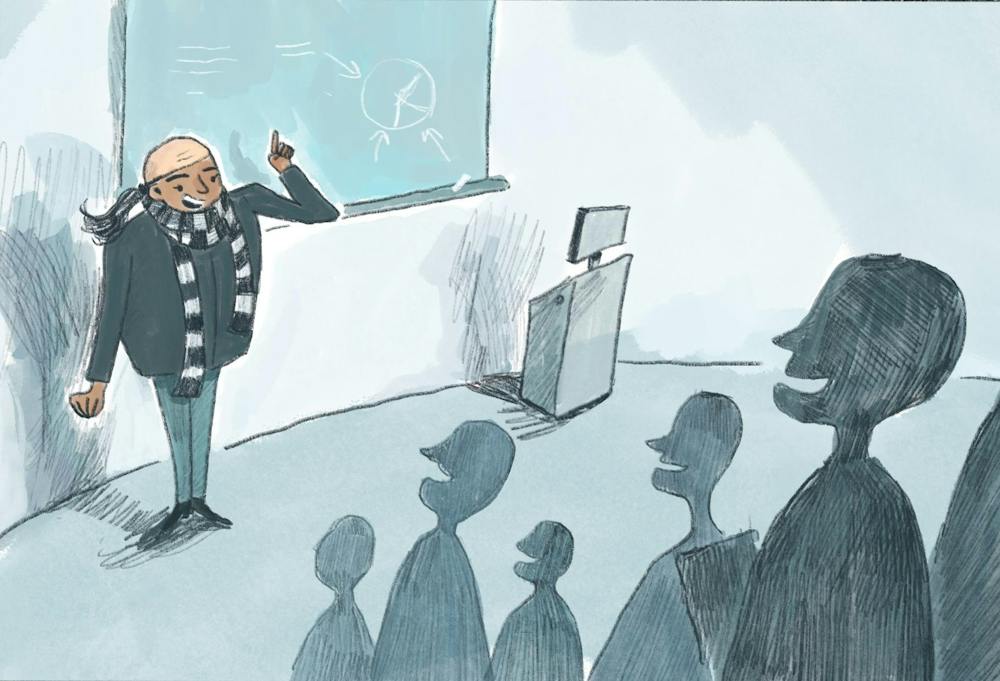
A few weeks ago, I was stage-punched and dragged into the wings of the Salomon 101 auditorium in front of 248 students. I was a lonely local variable who was no longer being referenced in the program — and hence had to be garbage collected by the computer. This is just one of the many roles I’ve played in the semi-educational skits my colleagues and I produce for CSCI 0150: “Introduction to Object-Oriented Programming,” affectionately known as CS15. Every lecture, the other humor teaching assistants and I get onstage to coax students into standing up and hitting the Macarena, the Quan or Cotton-Eye Joe.
As a humor TA for CS15, I make a fool of myself on a routine basis. While this may not be the educational purpose of the class, it shapes much of the students’ learning experience. More classes at Brown should borrow CS15’s habit of making its TAs a little ridiculous — it gets students to ask for help sooner and to be honest about what they don’t understand.
Ideally, all Brown courses should encourage students to approach their TAs, but few classes put in meaningful effort to playfully humanize TAs in the way that CS15 does. The hope is that once you, most likely a first-year who just moved into Brown, dance the Macarena with your TAs during lecture or watch them lick peanut butter off of each other onstage, you’ll be less intimidated by going to the Thomas J. Watson Center for Information Technology to ask them questions about your code. And beyond just showing up, the craziness of CS15 skits means that when it’s your turn in the debugging queue, you might even be more honest about your understanding of the course’s content. After all, you’ve seen your TA in, trust me, a vulnerable state, which makes it easier for you to be vulnerable in return.
This feature of CS15 has proven especially valuable in our current age of artificial intelligence. As illicit use of AI in students’ coursework becomes more and more widespread, Professors have resorted to all kinds of coping mechanisms. Some embrace the technology while others stopped grading problem sets all together. In CS15, students are held to a strict no AI-use policy — besides a CS15-specific model named Kevin who won’t just give you the answer — making TAs the first contact point for questions. Since the course focuses on program design, students need to learn how to create programs which other humans — not just machines — can understand and adapt. This gives TAs and students much more to discuss than basic Java syntax. In fact, being able to explain your design decisions to others is the most transferable skill you might take out of CS15 — and it’s something you can practice more efficiently with a TA than with ChatGPT. Since TAs have been made accessible to students via their constant degradation in skits, the course’s human-centered approach continues to stand out as uniquely successful.
CS15’s outlandish flair builds more than strong relationships between students and their instructors. By pushing students to think outside of the box, skits and playful assignments train students in the kind of creative thinking that helps one succeed in any field. For instance, our recent skit “Slush Grey and the Seven Vertically Challenged TAs” explains the dangers of making private methods public by showing how, if that happened, the Wicked Witch could coerce a vegan Snow White into eating eye of newt.
The value of creating something which impresses an audience is mirrored in the extra-credit scheme of the course itself: As the semester progresses, students are invited to join in on the TA’s fun through grading schemes which incentivize going above and beyond. “Bells and Whistles” opportunities reward students for putting a new spin on old computer games like Doodle Jump and Tetris. The project “Cartoon” has an explicit extra credit point for having a “personal connection” with the animation one creates — the best one wins a lunch with Professor van Dam and the Head Teaching Assistants.
Learning how to carve out your own version of a classic topic, whether it’s a joke in a skit or a new kind of game feature, is about more than fun for fun’s sake. I think that the silliness of CS15 becomes an act of creation, enabling students to take agency over the course material. By reaffirming that choosing to have fun and choosing to learn more deeply are often connected, more classes at Brown could embrace this aspect of a liberal arts education. This could mean open-ended assignments, a meme displayed on the first slide of each lecture, or, if you’re lucky, dedicated skits. In any case, CS15’s lesson for us is that the satisfaction of learning a concept well enough to create art with it is as important as the content itself. It only takes a little peanut butter and a spotlight to make the magic happen.
Arya Vishwakarma ’29 can be reached at arya_vishwakarma@brown.edu. Please send responses to this column to letters@browndailyherald.com and other opinions to opinions@browndailyherald.com.

Arya Vishwakarma is an Opinions editor and member of the Editorial Page Board. She is from Belle Mead, New Jersey and studies pure math. She likes playing in the orchestra, taking the RIPTA and enjoying dry noodle bowls.


