
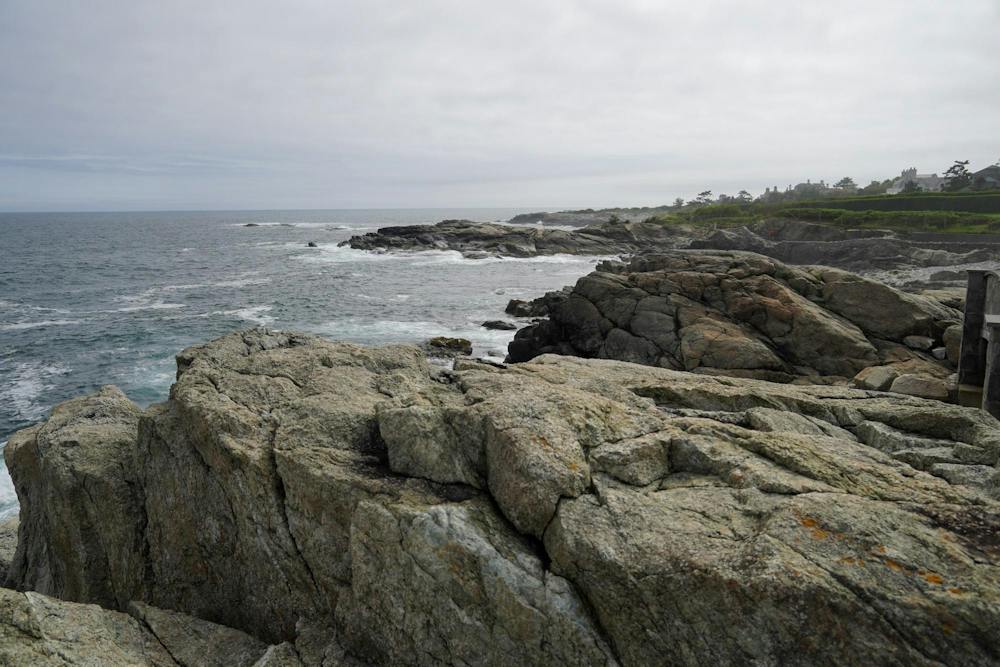
Earlier this month, Newport’s effort to restore a collapsed portion of the historic Cliff Walk cleared a major regulatory hurdle when the Rhode Island Coastal Resources Management Council approved a revised repair plan.
With the new plan, the Cliff Walk may be restored as early as 2028. Some sections of the Cliff Walk — the historic public pathway along Newport’s coastline — have been closed for more than four years after severe weather caused the path’s erosion in 2022.
The trail, which takes walkers past Gilded Age era mansions, draws more than one million visitors every year.
The city is now awaiting final approval of the plan from the U.S. Army Corps of Engineers, wrote Thomas Shevlin, the City of Newport’s director of communications, in an email to The Herald.
“Our biggest hurdles appear to be behind us,” Shevlin wrote.
The restoration project has received over $23 million in funding. This includes an around $13.8 million federal grant, a $6.25 million congressional appropriation and $3 million in bond funds from the Rhode Island Department of Environmental Management, according to Charles St. Martin, the acting chief of communications for the Rhode Island Department of Transportation.
Homeowners own the portions of the Cliff Walk that cross their properties, but the city holds an easement guaranteeing that the public maintains recreational access.
Private property was a point of discussion during the repair plan’s development.
“There are instances where a public project will have private benefits, and that’s fine,” wrote R.I. CRMC spokesperson Laura Dwyer. The original plan proposed extending stone reinforcements, but “it was stated that (the repairs’) purpose was to protect a private structure,” which would require a Special Exception. The “staff did not think this met the requirements,” Dwyer wrote.
Attorneys and engineers representing the affected property — Ochre Point, also known as “Southside” — initially resisted the decision. Turner Scott, who works as the attorney for the property owners of Southside, has stated that his clients would not cover future maintenance costs.
Scott did not respond to The Herald’s request for comment.
The revised plan proposes a technique known as rock doweling, where steel bars are used to anchor the bedrock.
“We try to have a collaborative relationship with private property owners all along the Cliff Walk,” Shevlin said. “However, ultimately our primary concern and responsibility is to ensure that the walkway remains safe and passable for the public.”
Dwyer said that while the repairs should protect the walkway, they cannot ensure its long-term stability. “Weather and waves will continue to be a factor,” she said, adding that the structure is over 100 years old.
“Our staff routinely inspects the walk for maintenance issues,” Shevlin said. “We’re currently working to conduct a more comprehensive report that will serve as a baseline for measuring existing conditions and to help us plan for future maintenance.”
Michaela Hanson is a senior staff writer covering community and culture.


