
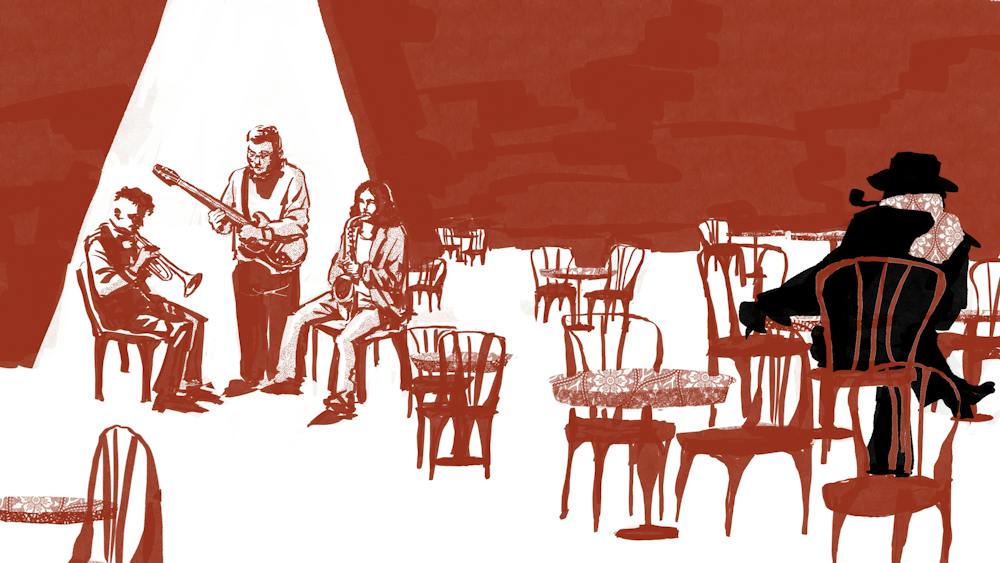
I’ve been thinking quite a lot about chairs recently—at least much more than the average person does day-to-day. I think about people too. People and chairs. People in chairs. Chairs that once held people and now sit empty. It does not seem to matter much, not even to me. And even if it did matter, it is only a chair.
. . .
Fact: My mom never let us take off the plastic wrapping of our new dining table chairs.
I suppose this comes with the scrimp-and-scrounge mentality shared amongst those who leave their countries with nothing in their pockets. Those same people who are given the Sisyphean task of making something from nothing at all. I understand this better now—empathize with it even—but back then, watching it unfold filled me with a strange kind of resentment.
My mom leans over the grease-and-Pepsi-sticky counter of the McDonald’s line, and I listen to foreign words tripping and stumbling over a foreign tongue as she points to the cheapest thing she can find on the menu. (She insists this is the only thing she likes.) I watch, silent, my perfect-English words locking on my perfect-English tongue. The teen at the cash register who looks just bored enough to be there and not bored enough to unravel the incoherency of my mother’s Mandarin-tinged order turns to me instead.
– What can I get for you?
– Two McChickens please
The teen in front of us, the woman behind me, her two boys whose collars she keeps trying and failing to grab at as they run concentric circles around her thighs, and me—we all belong here. My mom stands at five-foot-nothing, and there is no space for her at all.
I can’t claim to possess such superiority as I have just implied. I can’t claim that I am not also one of the disdainful, dismissive, just learn to speak English, it’s not that hard Americans, standing behind the counter looking down at my mother. I listen to my parents’ faltering sentences to the cashier, the gas attendant, and the customer service line, and the urge to apologize crawls up the back of my throat—nausea. My mind, the traitor that it is, screams at me: Say sorry they can’t speak (and not that you can’t understand), laugh like it’s some big joke, run run run away and act like you’re not related.
I don’t do any of those things. Instead I just stand there, numb and dumb. I gorge myself on anger, and in secret, I starve anyway.
The anger crashes over me in waves. Once, I took a pair of kitchen scissors and stabbed right through the plastic wrapping on one of those stupid, preserved dining table chairs. I overestimated, and now, if you look closely, you will see white stuffing peek out from the flowery brown cushion like a snowdrop blossom. My mom has never looked closely. But my luck is merely owed to the fact that we do not use those dining chairs much.
Fact: For meals, we sit in the kitchen, on plain wooden seats.
If you google the image of a “plain wooden chair,” you will have a pretty accurate idea of what they look like. These chairs are nothing special, perhaps even less so than most. No craftsmaker spent years honing their talents, learning to shape their legs or mold their seats for comfort. You can probably still buy a set of four at Ikea, or, like we did, pick them up off the street of a nice, rich neighborhood where they were tossed out for recycling. Here is a kind of craftsmanship and skill that goes unappreciated and unseen.
One man’s trash is another’s treasure?
These chairs are not special in the least, but I cried when my father tried to throw them away. It was as if he told me, that after all these years, he was going to toss a beloved old dog—not that I ever had a dog, but I did have blue parakeets once—to the streets. I blame myself for this incident however, because I am known for being the most sentimental one of us bunch.
Fact: My own chair was passed down to me from a boy sent to the psychiatric ward.
It is a gaming chair, though I have never gamed. This must raise some sort of Grecian dilemma, like Euthyphro who wrestled with: Is the pious loved by the gods because it is pious, or is it pious because it is loved by the gods? So tell me, can I still rightfully call it a gaming chair if I have never gamed? This line of thought almost certainly led to Socrates’s death by execution—for impiety and corruption of the youth—so perhaps it is better not to dwell on it.
I also try not to dwell on the idea of sitting in a dead man’s chair. (Please, allow me some leeway for the dramatic flair.) He was a family friend and fresh out of a year in college, where Aunt Guo—his mom—is certain that those absurd and unnatural ideas were first planted. The last time I saw him, he had been ranting and raving about aliens and leaving for Arkansas. He pulled a knife out from the kitchen drawer, and that’s when I decided to go back to my room and lock the door.
I’m not sure what’s become of him; he may be alive and quite well in Arkansas. All I know is that I got his old black and white AndaSeat gaming chair and it sits back at home, gathering dust.
Fact: We no longer have a red leather armchair.
My dad is a fixer, a bit of a tools and mechanics whiz. He deconstructs our Toyota Sienna every half a year or so and performs all the oil changes, tire adjustments, fluid checks, and such. I can picture him, stubborn and sunburnt on the hot asphalt of our driveway (that he personally resurfaced, and then sealcoated with a SikaQuick and a blowtorch), fiddling with the suspension on the underside of the car. As he works, he likes to warn us: Don’t let the car dealership scam you into paying for more than you need. Call me and I’ll do it better. For free too. He adds as an afterthought.
My mom is many things, but she is definitively not a fixer. In the master bedroom was a leather armchair. I call it leather because the seller had advertised it as such, and my mom bought into it immediately.
Within months, the so-called leather fell off in little flakes. Chips of red would cling to the seams of your jeans and be almost impossible to wash off. It was like a scab that you couldn’t help but pick at, leaking blood and clear lymph fluid right when you thought it had closed.
My mom’s brilliant idea was to paint over the bald white patches with a glittery red nail polish, an attempt at fixing the unfixable. Needless to say, the bottoms of our jeans were thereafter stained with more than just fake-leather flakes.
. . .
I can’t help but think of these chairs. And among my thoughts I have picked out two:
(1) Not all objects have beauty imbued into them from birth. I think that it often seeps its way in through the cracks and crevices and swirling wood grain by time and use. To be a forgotten thing or to sit cold on a museum shelf, I believe, must be to subject an object to a dismal fate.
(2) Beauty does not end when an object is made. Perhaps it never ends as long as it is used and reused, either loved or hated. Perhaps it continues to live as long as we live: in the bodies that wear it down and in the hands that try—however clumsily—to repair it, in the ones that will keep a broken chair years after it should have been thrown away.
But I am no crafter, at least not in the way I see it. So where exactly does the bulk of beauty in an object exist? In the slow, methodical creation of it, or in the way it is used and lived with? Which one of us can say for sure?


