“Everyone is female, and everyone hates it.”
– Andrea Long Chu, Females
I have the highest praise for authors who can write about being a woman without starting to hate themselves. Perhaps that’s why Valerie Solanas—in spite of her androcidal tendencies—could unapologetically seduce me into her world.
As a child, Valerie projected her naïve anger onto the world. She wrote and sold insults to other kids. She beat up a girl for talking to a boy. She tried to attack a nun who crossed her.
Valerie’s vigilante dreams persisted in her adult years. She found Andy Warhol at his studio and gave him a copy of her original play, Up Your Ass, which Andy promptly “lost” (it was too pornographic and repulsive, even for him). Furious, Valerie threatened him with blackmail. She got back twenty-five dollars and some exposure in a second-rate movie.
Following that, Valerie wrote the SCUM Manifesto. In SCUM, men were the source of every pestilence in society: war, marriage, disease, famine, murder. They were inferior to women in every way. The only way to fix this abominable world, Valerie argued in all seriousness, was to eliminate the male sex altogether. It was the duty of women to undo the workings of incompetent men, overthrow capitalism, instate complete automation, collapse the government, and restore matriarchal order to society. Perhaps it was her schizophrenia, or maybe she finally had enough of the world’s bullshit, but Valerie became convinced that her good ol’ benefactor Andy was scheming to ruin SCUM! So, she bought a gun, walked to the Factory, and…
SHOT ANDY WARHOL THROUGH HIS FUCKING SPLEEN.
With the help of luck and a skilled surgeon, Andy survived, and Valerie went to jail, thus concluding her public career. Although, had Valerie never shot Andy, the movement SCUM created probably would’ve died then and there. But because she did, SCUM survived as one of America’s most infamous pieces of radical feminist literature—isn’t it paradoxical that a woman’s success depends on her self-destruction?
As extreme as SCUM was, Valerie seemed to peer directly into my soul and strip bare the part of my identity I thought I was ready to subdue forever: my femaleness. I cringe when I see my stunted, feminine bones reflected in the mirror. I hate the fact that I cannot muster up the courage to correct my friends when they say “she,” because I suffer far too many uncertainties and doubts about my hopelessly gendered existence to consider myself a girl. The rawness of girlhood! How can I even begin to explain this brutal, delicate force that I have tried to reject all these years, yet still can’t let go of?
((endurance))
I wonder if the rage that drove Valerie to shoot Andy was the same as my mother’s when she threatened to divorce my dad. Time distorts my memories: I remember cowering on the floor, unable to move. I remember crying at the notion of my family breaking. Mostly, I remember the mad look in her eyes as she told me to “never entrust your life to Chinese men.”
China loves to cower in the folds of its history and pretend like its thousand-year war against women never existed. When Mao Zedong’s iron fist descended upon the People’s Republic, it buried China’s traditions—alongside the millions of concubines, harems, and raped daughters. Yet, as the rest of China was industrializing, rebuilding itself from the aftermath of its civil war into a global tech superpower, young girls were still enduring the pain of having their feet turned into a jarring mass of flesh.
Until the 1940s, the archaic Chinese practice of foot binding methodically afflicted girls in rural areas. By breaking bones and tightly wrapping them in gauze, their feet’s growth would be stunted. The motivations behind bound feet exceeded beauty standards: Like all things gendered, feet were political. Class determined labor. The richer a girl was, the less she needed to work, so the less she walked. In trying to imitate a status they did not have, fathers and mothers crushed their daughters’ feet, transferring down to her a generational superstition—a hope that the pain she would endure at every waking moment of her life might somehow bring them fortune.
My waipo had her feet bound when she was a child; the Cultural Revolution hit her when she was a teen. She fled with her family into the mountains of Chongqing, settling down in a humble, decrepit little town called Tongjing. Granted, amidst this upheaval, my grandmother no longer had to keep her feet bound. Still, the existing damage compounded over time. The aftermath of the war, the struggles of becoming a young mother, and my waigong’s abusive fist encumbered her already malnourished body until her crippled feet could no longer hold their weight. By the time I began to visit her in my mother’s childhood home, she could barely stand.
I admit—I was insensitive. While my father and uncle filled the slummy apartment with boisterous laughter and my mother whispered secrets to her siblings, I confined myself to the couch, peeling grapes and attempting to entertain my half-senile grandmother. Her ineptitude infected my ten-year-old self. She dragged me into the depths of traditional Chinese society every time I visited, and every time I would find myself sitting beside her motionless body on the couch, my feet stuck to the ground as if they were broken too. Back then, I didn’t know that the next time I would visit, I would be going to her grave.
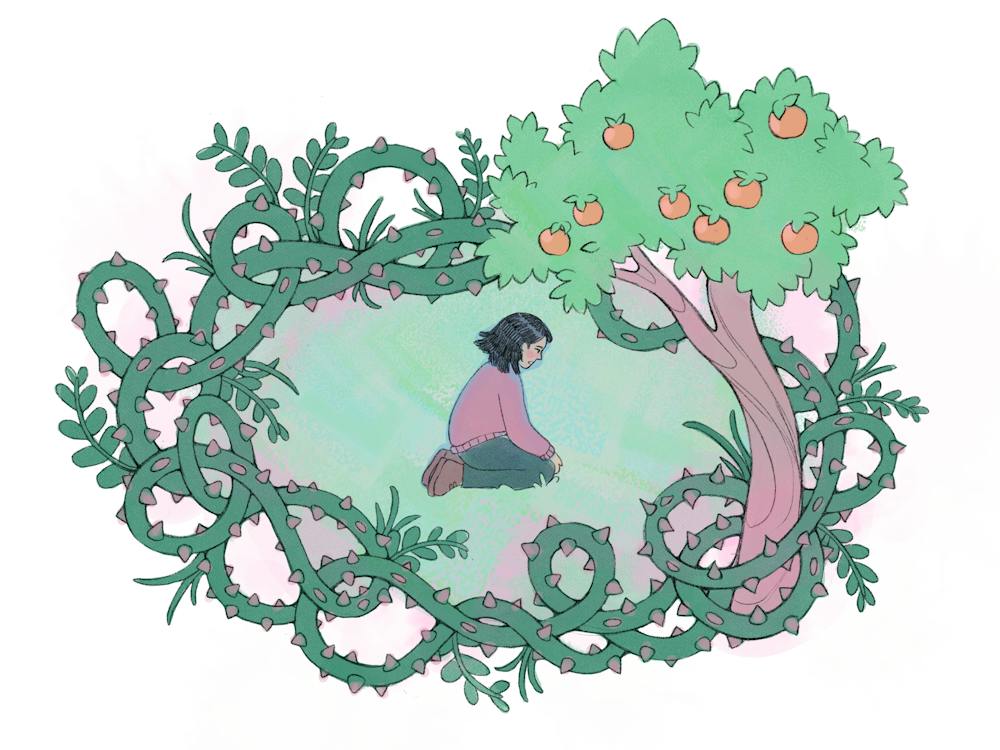
The trek to her grave wasn’t easy. Thorns and weeds infested the vacant trail. After an hour, I was breathless and woozy when we found ourselves in a small clearing graced only by a tangerine tree and a run-down cabin—my waipo’s home. Her grave lay a few steps below them, next to my waigong.
Instead of just spelling out the name of the deceased, Chinese graves etch their entire heritage onto it. My waipo, 樊德珍, situated herself comfortably in the middle of the slab, following all the mothers and daughters who came before her. I traced the lines downwards until I reached the bottom line: granddaughters.
As my mother knelt down before the burning offerings, I thought of the countless women buried beside their sadistic husbands. I thought about the cycle of trauma that had been passed down with the simple etching of a stone. I thought of my waipo’s mutilated feet. I wondered if death might make her more comfortable.
My waipo never did consent to the way her life turned out. She did not subject herself to her biological femaleness nor its physical and political consequences.
No one gets to consent to girlhood.
((escape))
ACT 2, SCENE 1. The DAUGHTER greets herself in the begrudging mirror. The white blouse imprinted with the crest of the Sacred Heart lies awkwardly on her shoulders, which are ever so slightly too wide. She sticks a bobby pin in her hair. On social media, haircutting has become a ritual amongst heartbroken women. Experiencing a bad breakup? Get a bob cut. Leave behind that toxic relationship with a few snips. She’s still scrutinizing her appearance when MA walks in with a comb.
DAUGHTER: Ma, you pull on my hair again.
MA: Endure it for a second. Your hair is as tangled as a sparrow’s nest.
DAUGHTER: It hurts!
Time flies.
ACT 2, SCENE 2. The daughter is in the bathroom again, but older. Her hair is now a shoulder-length bob. It appears more mature and vintage. Sleep has escaped her, so she paces around the enclosed space until she finds a pair of craft scissors. Almost impulsively, she raises it to a strand of hair and snips it in half. Then another, then another. It’s thrilling. She wonders how many of its smooth hairs she can destroy until it turns savage and unrecognizable. We let the montage go on for a minute, then the door is slammed open by MA, whose face is frozen in rage and fear.
MA: Why are you up? Go to bed. God, what did you do to your beautiful hair?
DAUGHTER attempts to speak, but all her spirit of rebellion had melted away the moment she saw MA’s conflicted face. Her heart has dropped into the pit of her stomach as she prepares for the onslaught to come.
MA: You…you mutilated yourself! Now, you’re…
MA chokes on her rage, then continues, voice shaking.
You’ll start looking like a boy soon, like one of those f*gs selling their bodies on the streets. Think of the girl your waipo would have loved. You’re my daughter, so act like one.
ACT 2, SCENE 3.
DAUGHTER (if she could tell the truth): ((Ma. You gave me the gift of life. You taught me what it’s like to be a woman. Yet, all that I have learned from you is how to suffer. I’m sick of being the victim of our generational trauma and I’m sick of everything this misogynist household has forced me to become. And—don’t shake your head—you run away from your femaleness too. Think about the grown man who needs his aged mother to wash his feet, or the CEO who’s having an affair with his secretary while his wife and daughters observe helplessly from the background. We both want to eat the power and the privilege that society serves to men on a platter. We hate on pink and praise boyish behavior. We hate ourselves because femininity means vulnerability and weakness. Unhappiness is an inescapable consequence of our biological sex. Men, relatively speaking, are perfectly happy where they are.))
But she does not say this. She cries and apologizes until her knees become weak and her throat burns with a million sorry’s she doesn’t know why she says. She wishes to have been born a boy. She wishes to feel nothing at all.
ACT 2, END.
((interlude: redness))
Womanhood is a cycle of self-hatred. I have learned to hate myself in the same way my mother was taught by her mother, her mother by her mother. Why is it that we can’t help but detest the self we are assigned?
Sigmund Freud had an idea back in the twenties. He called it “penis envy.” Essentially, women wanted to be men. The daughter’s realization that she lacks a penis causes her to develop an intense anxiety about her femininity which she projects onto her mother for not giving birth to her as a man. The mother thus becomes the object of the daughter’s resentment, and her envy for the patriarchy intensifies—
—Since when did red become a symbol for women? Was it when girls discovered menstruation for the first time, helplessly watching as a congealed, foreign force invaded their bodies? Was it when the Romans raped and stole the Sabine women from their motherland, staining Rome with their blood? Was it when the Church burned hundreds of innocent women in Salem, lighting up the sky with fire?
Yet, despite all odds, they fought back. Women emerged from the depths of the hell that is society, covered in blood and rejuvenated by a kind of carnal, womanly solidarity that could only be forged in collective suffering. Out of the SCUM Manifesto’s blazing ashes came W.I.T.C.H, the Women’s International Terrorist Conspiracy from Hell. Dressed from head to toe in black robes, they screamed and shouted the evils of war and capitalism, illuminating 1960s New York City with a violent blaze of passion. Women did not stop shouting when the Nazis told them that cosmetics were sinful, stifling their mouths with the red muffles of fascism. Instead, red lipstick became women’s war masks, their symbol of transgression. Hollywood stars flaunted its sensuality, making American men shudder at the sight of their faces. In rural China, young girls graffitied over the sex-trafficking advertisements plastered over their back alley walls with lipstick to protect other girls. Girls who were strangers to them but girls whom they understood nonetheless—by the very nature of girlhood.
So, Valerie rebukes Freud. She writes that the woman does not envy the man. Rather, the man envies the woman…because his Y chromosome is really an incomplete X. So, the man—the incomplete woman—yearns to parallel her “emotional strength,” her “forcefulness,” her “resilience,” and her unstoppable “vitality.” He longs to be part of that unbreakable, undefeated sisterhood. Instead, spurred by his own insecurity, he turns to misogyny, war, and disease. It was never penis envy to begin with. It’s pussy envy.
((authority))
In line for the women’s bathroom at the New Hope pride parade, I tried to cover my bloody nose from the hordes of people waiting to pee. The smoldering heat that pervaded the air of New Hope brought out more than just sweat. Though I tried to act nonchalant, I realized it’s hard to ignore someone actively bleeding out in the bathroom. Still, I did not expect such overt kindness to come in the form of a tampon.
“Um, do you want to stick my tampon up your nose? It’s bleeding a lot,” asked a stranger with a Pepto-Bismol-colored buzzcut. Not wanting to stick the cotton behemoth in my nose, I awkwardly rejected the offer while trying to stop my nose from staining the sink red.
Yet, that small gesture remained in my head. After my little bloody episode finally subsided, I rejoined my friends at the lunch table, where my very cis-het friend greeted me with a concerned offering of pizza. I looked at my other friend, a rainbow tattoo situated in the center of her cheek. Drag queens blew kisses to the homophobic protesters. The children on the sidewalk waved rainbow flags at us. An old gay couple held hands. A stranger with a buzzcut had offered to soak up my nosebleed.
In spite of all the shit the world has to offer, here they were. Here we were, parading for life, against all odds.
Male, female, nonbinary, transgender, genderqueer—in my giddy post-nosebleed clarity, I believed wholeheartedly for a minute that no other community has better exemplified the spirit of youth and of girlhood.
***
To my girlhood,
Hi there. I’m still a little apprehensive about writing this. Truthfully, I hate my nakedness. My hips are too round. My skin is too soft for my liking. I wish I could toggle my boobs off when I want to, but unlike cutting off your dead ends, you can’t escape the body you’re given. Likewise, I can’t escape your memories of my adolescence, but I can reinterpret history.
Yes, you are a fatal condition of existence, but at the same time, a paradox. Girlhood is enduring generational trauma as though it were a mother’s brutal yet caring reprimand. Girlhood is swallowing your own rage while knowing that it is something to rise above. Girlhood is hating and loving, destruction and restoration, inner turmoil and peace. Girlhood transcends gender as a universal experience that everyone experiences at least once in their lifetime. So, be a little kinder towards your femininity.
It came a long way.


