Unfortunately, I am a person who scares easily.
The triggers are everywhere—a bug in my semi-private bathroom, whose locked door is a comfort until it traps me alone with the evil creature; the face of a ghost on my screen after being forced by my friends to play Roblox horror games at 2 a.m.; the screams of motorcycle engines on Thayer as I rush home after a late-night study session.
In all of these moments, I react in the same way. I flinch instinctively, like I’ve been burned by a hot stove, and yelp the age-old, inadvertent interjection of surprise.
“엄마야!”
Umma—the Korean word for mother. Eighteen years and three thousand miles from home, I still call out for my mother, my umma, in my mother tongue. It is a fitting label.
***
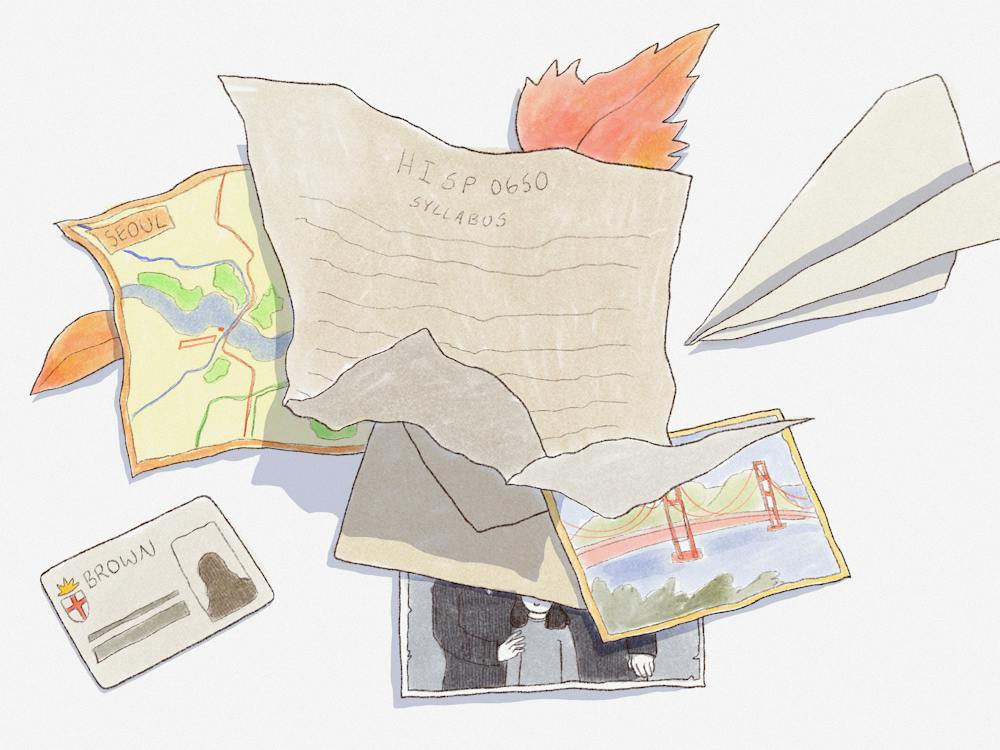
Last week in my HISP0650 class, we discussed Yasnaya Aguilar’s essay “Hábitos al Hablar,” in which she explores language as a form of resistance and one of the many constructors of cultural identity. In the final paragraph, she raises the following questions: ¿Qué sucederá con las personas que aprenden en la infancia y al mismo tiempo hasta tres lenguas? ¿Qué papel juega cada una de sus lenguas en la construcción de su identidad? (What happens with those who learn up to three languages simultaneously during their childhood? What role does each language play in the construction of their identity?)
As I turned my eyes forward, eagerly awaiting her response to this situation that pertained exactly to me, my hopes were crushed with the following, matter-of-fact line: “No lo sé.” She isn’t sure of the answer, either.
Still, listening to my professor speak of the diverse associations that every individual makes with different languages got me thinking about my relationship with the three that I speak: Korean, the language of my first words; Spanish, my third and thus youngest language; and English, the not-so-neglected middle child. Each one evokes different memories, different emotions from various eras of my life, and wildly different versions of myself. And yet, in the end, they are equally mine.
***
- 한국어
I love my mother tongue. There’s something endlessly comforting and homey about it, as though it’ll take you into its arms, embracing all your flaws after the weeks of disuse have left you rusty. I love playing back decade-old videos from my childhood and listening to my babbling, twangy voice utter the Korean syllables with such ease; I love watching the wrinkles on my grandmother’s beautifully aged face rise and fall in time with the sentences that leave my mouth, a sure sign that she understands my every word.
This is, of course, not to say that I enjoyed attending Korean language school growing up. In fact, I hated it with a passion—for twelve years of my life, it meant that I had to wake up at the crack of dawn (a crisp 7:30 a.m.), trek across entire mountains and valleys (cross the East Bay southward into Cupertino), and sit through four hours of hell (pure grammar, SAT-style Korean reading comprehension questions, and the occasional disruption by my rowdy male classmates who passed the time by chucking paper airplanes at the whiteboard). I attended only for the paper cups of tteokbokki they served during field days and on Korean holidays, and because my parents would rouse me out of bed each Saturday and send me on my way, groaning, “I hate 한글학교!”
Sometimes, when I speak in Korean, I’ll emerge like a figure hidden behind a veil. I can still picture the look of relief worn by the boy in my fifth-grade class as I translated his words to the teacher. I recall, clear as day, the surprise of an elderly woman on a subway in Seoul when she spotted me reading from a thick English novel. In that memory, I respond to her question, smiling, in unaccented Korean. My veil slips away.
- Español
My Spanish journey began from sheer perfectionism—one missed accent mark on my first Spanish 1 vocabulary quiz. For the next five years, I memorized every grammar rule, pored over the picky conditions for the subjunctive and indicative moods, and engraved every possible scenario for the two Spanish verbs meaning “to be” into the surface of my brain. And yet, by the time I reached AP Spanish Language and Culture my senior year, I had come to a shocking realization: I couldn’t hold a single conversation in Spanish without my brain scrubbing itself clean, my heart flailing around in my chest, my palms perspiring tremendously.
I panicked. I threw myself into one-on-one calls with virtual instructors from Colombia, Spain, and Argentina, just to nudge my tongue in the direction of comfort, if not fluency, in this language I wanted so badly to excel at.
I still get asked why Spanish interests me so, why I’m pursuing it even now, constrained by neither obligation nor requirement. It’s true that I love Spanish for its adherence to its rigid, yet nonetheless logical, grammar rules. I love the warmth, the musicality of the native speaker’s rhythm. I love that it’s a language that consistently pronounces the two fickle syllables of my first name correctly.
Still, part of me wonders if it’s all because Spanish is a language that’s not spoken by any of my closest friends or blood-related family members. It’s a language that I hear solely in my own voice; it is, therefore, perhaps the closest thing I have to an audible echo of my thoughts.
- English
As counterintuitive as it might sound, English is, without a doubt, the strangest out of all of my languages.
It’s the only language that I can draft an essay in, knowing I didn’t insult or disappoint an entire nation of people. It’s the only language I’ll use to write poetry.
But there will come times when its syllables, smoothed over from years of use like the edges of sea glass, will glide over my tongue, and I’ll think of the ocean-sized distance between the Korean peninsula and the coast of California, of the even greater gap between “home” and a land unknown. They are the lengths my parents went to sixteen years ago to bestow upon me the gift of fluency, which is to say, the promise of comfort and convenience over shame.
So when I say “girl,” “squirrel,” and “February,” I hear my parents struggling to form the curl of the “r” consonant. When I ask a stranger on the street for directions, I think about how my late grandfather once wandered the streets of a strange city for hours after getting lost on his walk around our neighborhood.
English gives me confidence; it’s a language that makes me feel like the world is my oyster, like I can communicate with whoever I want, accomplish anything I put my mind to. And yet, speaking it with such perfection also fills me with overwhelming guilt. I’m not sure it’s a feeling I can accurately put into words in any language.
***
No entiendo de identidad sin contrastes, Yasnaya Aguilar writes in Hábitos al Hablar. A Korean-American, chattering away in the best Spanish she can muster—I am an individual made up of contrasts. A mama’s girl, jumping and startling at every passing shadow; a hopeful, newly independent college freshman; a still foreign, distant almost-stranger. I’m not sure what to make of her just yet.
But I am excited to see where she takes me.


