
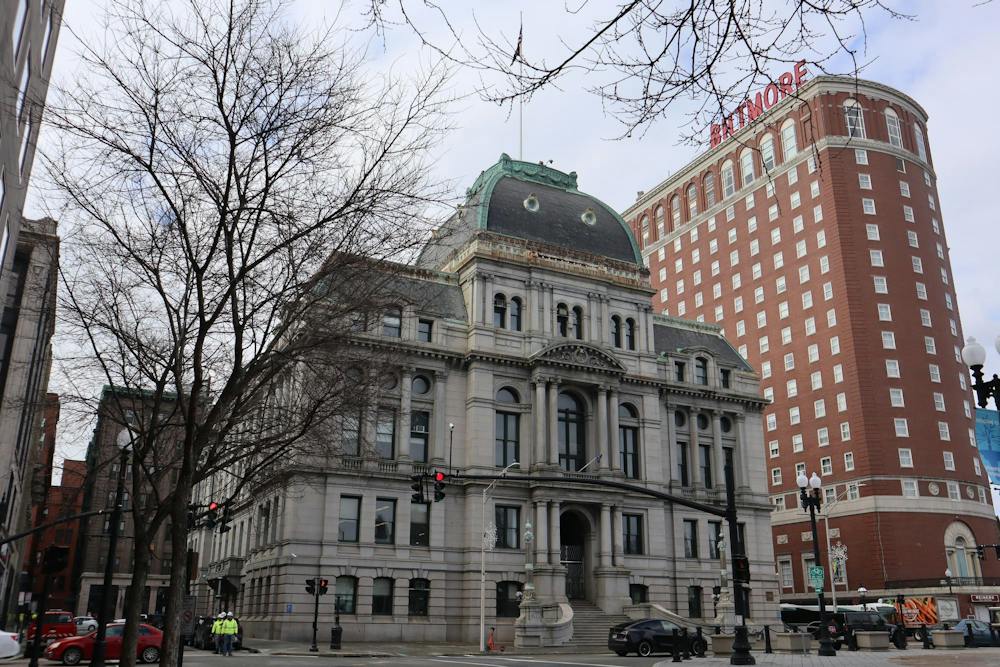
On Nov. 3, Providence will vote on Question 7, a proposed ordinance that would divest city funds from countries found to be committing severe human rights violations. Question 7 is the first citizen-initiated measure to make the city’s ballot, and the first time voters of any city in the country will directly vote on a binding divestment ordinance.
If passed, the ordinance would bar the city from buying the sovereign debt of “foreign countries conducting ethnic cleansing, apartheid, illegal military occupation or genocide” and from investing in “complicit entities,” which it defines as “corporations which directly and knowingly enable and contribute to severe violations of international humanitarian law.”
A citywide campaign, spearheaded by the Providence for Palestine coalition, pushed for the ordinance to appear on the Nov. 3 ballot. Members of the coalition include Jewish Voice for Peace Rhode Island, Reclaim Rhode Island, the Rhode Island Democratic Socialists of America and AFT Local 6516 — the parent union of Brown’s Graduate Labor Organization.
“Over 100 volunteers worked across the city of Providence from February through July to collect around 10,000 signatures,” Zack Kligler ’20.5, an organizer with Jewish Voice for Peace R.I. and Providence for Palestine, said in an interview with The Herald.
Though organizers surpassed the number of signatures required by the city charter for an ordinance petition in April, the City Council did not enact the proposal upon receiving the petition. After the coalition obtained signatures from an additional 5% of Providence voters, the council set into motion the proposal’s enactment on July 30.
“We’ve seen people come together across religion, across ethnicity, across cultural background to support this measure,” Kligler said.
Kligler said that state Rep. David Morales MPA’19, Democratic nominee for Providence mayor, “has been a supporter of the campaign from the beginning.”
“He’s been very clear about his dedication to making sure that this is enforced,” Kligler said.
Morales’ former opponent Mayor Brett Smiley has decided not to back the proposed ordinance. “Antisemitism is a real threat in Providence,” Carl Austin Miller Grondin MPA’24, Smiley’s press secretary, wrote in an email to The Herald. “Many members of our Jewish community feel targeted and less safe due to symbolic gestures like this.”
“The Mayor will continue to advocate for people to vote no on Question 7,” Grondin wrote.
Maria Friedman, executive director of the Rhode Island Coalition for Israel, expressed a similar sentiment.
“We are firmly against the proposed divestment ordinance,” Friedman told The Herald.
“Although Israel isn’t explicitly named in the ordinance language, the organizers of this ordinance have made it clear that it targets Israel,” she continued. “It is antisemitic to single out and try to destroy economically the only Jewish state in the world.”
“It doesn’t end with the Jews,” she said. “They’ll start chipping away at other groups, at other freedoms if we’re not careful.”
In response to Friedman’s claim, Providence for Palestine organizer Adit Sabnis GS wrote that “criticizing Israel’s illegal military occupation, apartheid and genocide” is not antisemitic, “but trying to equate all Jews with the actions of Israel certainly is.”
Kligler said that the campaign “has been led disproportionately by Jewish organizers, for whom organizing for justice and human rights for all is part of our Jewish values.”
He said that Israel “definitely” falls under the ordinance’s jurisdiction, noting that the exact list of other affected companies and countries will be determined through “the process of enforcement.”
Friedman expressed concerns about the enforceability of the ordinance and argued that the consequences of passing this ordinance would extend beyond Providence’s Jewish community.
The city would have to spend “hundreds of thousands of dollars in litigation fees” to fight challenges to the ordinance, she said, adding that its passage “risks damaging the pensions and retirement investments of current and retired Providence city employees.”
Sabnis wrote that divestment would not adversely impact the city’s finances. “The ordinance specifies that the city must continue to hold its financial duty to pensioners and residents as paramount in making investment decisions, safeguarding the city’s financial future,” he added.
Several other cities throughout the United States have already passed divestment measures, including Medford, Massachusetts, Richmond, California and Belfast, Maine. “But this will be the first instance in which it is happening by popular vote directly,” Kligler added.
“Given that Providence has a proud history of ethical investments,” Sabnis wrote, “the idea that divestment is harmful or would not be enforceable is disproven by the fact that Providence has done this successfully before.”
In 2006, Providence became the first U.S. city to pull municipal funding from companies conducting business in Sudan during the genocide of civilians in the Darfur region. Additionally, a 2013 City Council resolution approved Providence’s divestment from fossil fuels.
In 2024, months before the Brown Corporation voted to reject a resolution to divest from companies that backed Israel and its military, the City Council proposed and heard a divestment ordinance which obtained the sponsorship of Council President Rachel Miller. The measure never made it out of committee.
Friedman and Kligler are also split on the democratic implications of Question 7.
Friedman claimed that, if passed, the ordinance would “raise everyone’s taxes,” and that litigation expenses would slow down city services such as trash pickup and snow removal.
“It’s delegating our independence to unelected foreign bodies that are named in the ordinance,” Friedman said, adding that taking financial autonomy away from the city is “something that should alarm every Rhode Islander.”
“We wholeheartedly believe in the value of human life and the right of every individual to live a life of dignity and safety,” Sabnis wrote in response to Friedman’s claims. “Those are human values, not values that belong exclusively to the ‘West.’”
“Ultimately, this ordinance reflects a simple principle: Providence should not financially support governments or companies engaged in grave violations of human rights, regardless of which government is responsible,” Sabnis added.
Meanwhile, Kligler expressed excitement about putting this choice “directly in the hands of the voters.”
Annika Melwani is a metro senior staff writer covering state politics and justice. She is from New York City and plans on concentrating in English and International and Public Affairs. In her free time, she can be found reading or drinking an iced vanilla latte.


