
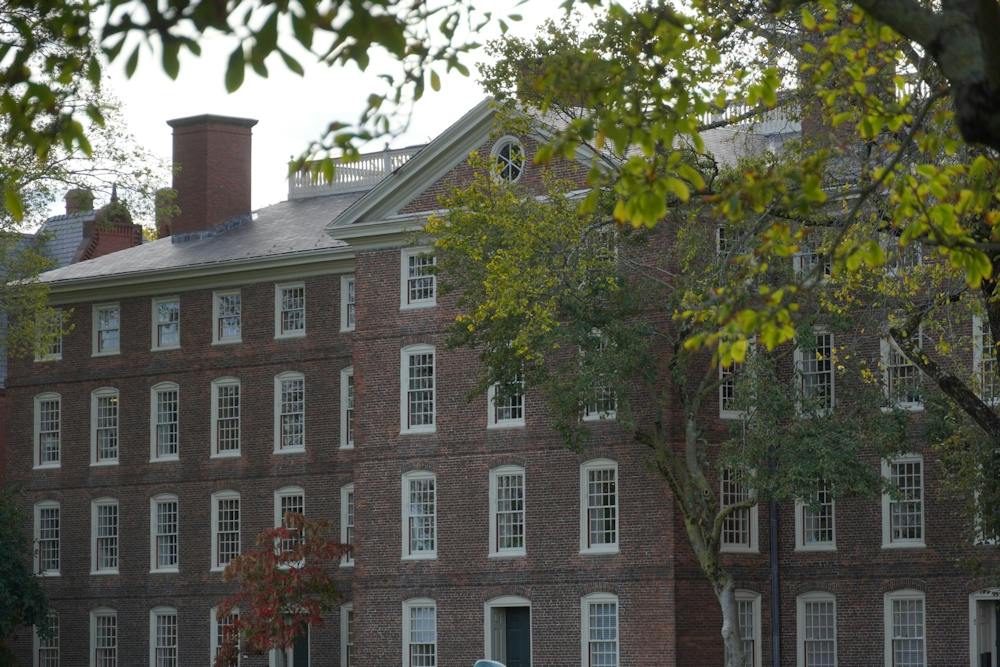
My first experience with Providence politics was at a City Hall hearing in Sept. 2023, where I joined dozens of my classmates to push Brown to pay a fairer share of taxes to the city. Mayor Brett Smiley’s administration had just finalized a new Payment In Lieu of Taxes, or PILOT, agreement with Brown (and Providence College, Johnson and Wales University and the Rhode Island School of Design) that arranged for the schools — as a non-profit educational institutions that don’t pay property taxes — to make voluntary contributions to the city. We believed it was woefully insufficient. Nonetheless, it was approved, and for a long time seemed to me that the policy was immovable. But that feeling changed on Sept. 9. State Rep. David Morales MPA’19 won the Democratic primary nomination for Providence mayor — and will likely win the general election in November — with part of his campaign platform centered on returning to the negotiating table with Brown.
In Brown’s PILOT agreement, the school supplements its unpaid property taxes by making “voluntary payments” directly to the city and “community contributions” — which can look like anything from scholarships for residents to fraternity fundraisers. In fiscal year 2024, Brown contributed a total of $5.08 million in voluntary payments and $11.9 million in community contributions. (Under a side deal separate from the PILOTs, Brown agreed to pay Providence $46 million over 10 years in exchange for several properties and concessions.) While this might seem like a generous sum, the numbers are deceiving. Under the first PILOT agreement, voluntary payments represent only about 11% of what Brown would otherwise owe in property taxes. And little of what Brown counts as community contributions (things like student club volunteering and financial aid) actually benefits the community. If elected mayor, David Morales and Brown’s next president must negotiate a more generous payment plan and rebuild trust between towns and gowns.
There’s a good argument to be made that the laws that grant tax-exempt status to wealthy nonprofits, like hospitals and universities, are in need of reform. But until that happens, PILOTs are a good stopgap measure at the municipal level. Like most municipal governments, Providence’s City Hall is dependent on property taxes, a tax paid by real estate owners relative to the value of their property. In fiscal year 2026, $401 million of the city’s $624 million total budget came from property taxes. But in Providence, 44% of real estate is tax exempt because it is owned by the state government, federal government or 501(c)(3) organizations like hospitals or universities. According to the City Council, this necessitates property tax hikes on homeowners and businesses.
Brown looms large over the PILOT issue: The University owns an estimated $1.3 billion in property within city limits, which would generate roughly $55 million in annual property taxes. This could substantially increase City Hall’s budget, but is a drop in the bucket compared to Brown’s annual budget: About $1.9 billion in fiscal year 2026 — almost triple Providence’s. Brown’s growth is costly for the city: When the university purchases property, it is immediately removed from the tax base. Rhode Island state law attempts to mitigate the imbalance by having the state partially reimburse cities for property taxes that would otherwise have been paid by tax-exempt institutions, but this isn’t a fair solution either: It effectively forces Rhode Island taxpayers to subsidize Brown’s real estate.
PILOTs reentered public debate during the recent mayoral campaign. Smiley’s administration was responsible for the most recent deal, acknowledging “they still don’t give enough… but it’s the best deal we could negotiate.” Morales, the newly victorious challenger, campaigned on renegotiating a more generous arrangement earmarked for public school staffing at a time when the Providence Public School District is direly underfunded.
A key problem with the current PILOT agreement is that it dishonestly exaggerates its actual fiscal impact. Brown claimed in its 2023 press release that “the combined financial impact of voluntary payments and community contributions from Brown will total $303.3 million in benefits to the city between 2024 and 2043.” But will it? There are two types of PILOTs, voluntary cash contributions (which totaled $5 million, or less than one-third of the total, in fiscal year 2024) and community contributions, a line item under which Brown can count the value of things it is already doing. For example, Brown counts the Swearer Center’s programs, like Bonner Community Fellows and iProv summer internships, as $654,000 in value, and student volunteering, including that of clubs, fraternities and sororities, as over $100,000. If you’ve participated in any of these activities, Brown is claiming your volunteer work as a tax write-off.
The idea that Brown’s community activities can be counted as a payment in lieu of taxes operates on the same logic as trickle-down economics, a defunct theory attributed to the policies of former President Ronald Reagan. The argument goes that if the government cuts taxes on wealthy entities (such as universities), the benefits will “trickle down” to the rest of the economy in the form of jobs and economic growth (or student volunteering hours), an argument shown to be empirically false. In any case, student volunteering is not a replacement for taxes. No other taxable entity can do this; the Internal Revenue Service doesn’t allow tax deductions for volunteer hours. I would recommend that the amended PILOT agreement not tally “community contributions” at all, and save paperwork for both parties.
The larger problem with community contributions is that 53% of it is accounted for by scholarships and financial aid to students who are Providence residents. About 70% of that share was for undergraduate students; in 2024, this added up to $4.5 million awarded to 91 students. It is good that Brown’s financial aid is generous — I myself am a grateful beneficiary, albeit one from Massachusetts — but it’s disingenuous to count this money as a contribution to the Providence community as a whole because it only benefits a small number of mostly well-off families. It is known that admissions departments at elite universities like Brown favor the wealthy, but we can substantiate this with some back-of-the-napkin math. Dividing $4.5 million by 91 students shows that the average award to a Providence resident was about $49,450. According to data from the financial aid office, in 2024 this figure was a little less than the average award received by families earning $150,000 to $200,000 annually. Brown’s financial aid is purely based on need. So, we can estimate that on average, the income of this cohort was in the $150-$200k bracket or higher. For comparison, Providence’s median household income in 2024 was $68,119. How can financial aid be a “community contribution” if it only benefits a handful of families who are more than twice as wealthy as the average family?
If anything, depriving the city’s schools of tax revenue ensures that only a privileged or gifted minority of its students will earn the academic qualifications necessary to attend Brown. Providence’s public school district is underperforming by many metrics, in part due to lack of funding. Truly investing in the academic success of Providence’s children would look like supporting them throughout their public K-12 education, not just after they’ve already earned a seat at Brown.
Why should Brown renegotiate? Of course, Brown has no legal obligation to pay PILOTs. They participate because it is a mutually beneficial transaction that gives Brown the right to triumphantly announce that they’re doing right by their neighbors. Nationally, elite schools are distrusted by the American public, and could use some good press now more than ever. Earmarking funds for public schools, as Morales’ plan proposes, would align with the University’s mission of serving the community through education. President Christina Paxson P’19 P’MD’20 may be reluctant to renegotiate, since it could look like an admission that the 2023 deal was insufficient, but for Brown’s next president, it would be a powerful way to begin their term.
This time next year, Brown will have a new president and Providence will have a new mayor. Returning to the negotiating table to arrive at a more generous PILOT arrangement, focused on public school funding, will be a key opportunity to heal the relationship.
Evan Tao ’27 can be reached at evan_tao@brown.edu. Please send responses to this column to letters@browndailyherald.com and other opinions to opinions@browndailyherald.com.


