
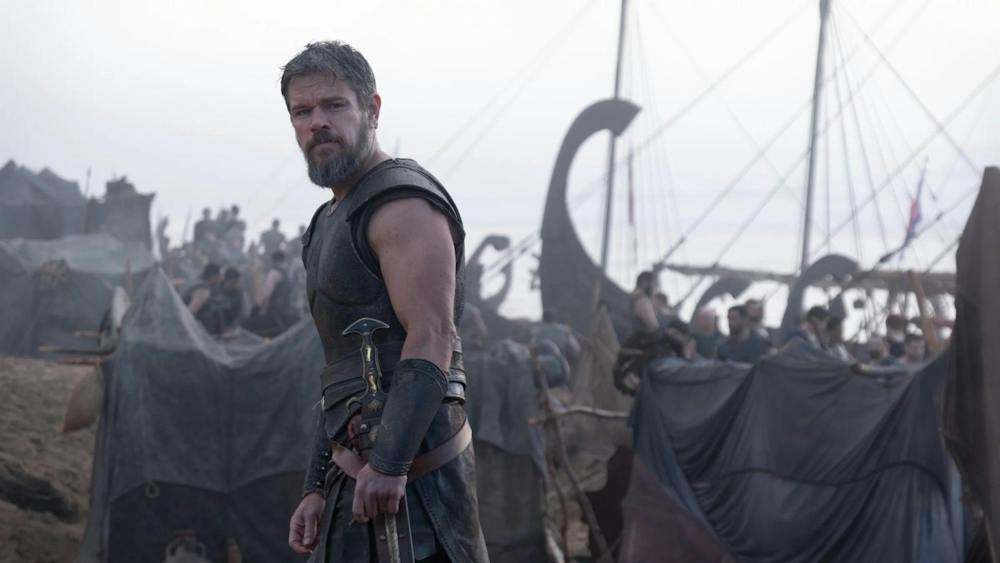
The epic story of the cunning Trojan War hero of Homer’s epic poem, “The Iliad,” and the story of his tumultuous 10-year journey home in "The Odyssey" has been retold for millennia. It makes sense that Christopher Nolan — one of today’s most critically acclaimed storytellers — would choose to continue this tradition.
Nolan’s much anticipated film, “The Odyssey,” came out on July 17 and was the first feature film to ever be shot entirely on IMAX 70mm film, making for a visually beautiful film with amazing practical effects. The stunning scenes are additionally backgrounded by the compositions of Ludwig Göransson, who collaborated with Nolan on “Oppenheimer.”
Yet while Nolan’s films are typically known for their non-linear narratives and explorations of time and memory, his usual themes are left disappointingly under-explored in his newest production — despite their significance in the original story. The film thrives visually and sonically, but its potential is ultimately lost in the narrative arc.
The story seems well executed at first glance. Like many of Nolan’s other features, the film focuses on the journey of a singular central character racked with guilt and moral anguish over their past actions. The movie’s themes of warfare, destruction and personal responsibility are pertinent in today’s world. But for those at all familiar with the original text, the film’s glaring shortcomings are evident in its inability to capture the nuanced approach of its source.
In the original text, the aforementioned themes are learned throughout Odysseus’s adventures to the island of Scheria, home of the Phaeacians — the final stop on his way back to Ithaca. By removing the Phaeacians from the narrative altogether, Nolan squanders the potential for playing with ideas of time, memory and truth. It is an even stranger choice considering that in Homer’s Odyssey, the greek concept of xenia — or Zeus’s law, as it is known in the movie — is given dimension by the Phaeacian’s hospitable treatment of Odysseus.
This concept of xenia, an unwritten contract between host and guest, is thoroughly explored in the original text. But the dilution of the idea in the film is further compounded in Nolan’s adaptation of the Cyclops scene. In Homer’s version of the story, Odysseus’ men only seek out the island’s rulers at Odysseus’ insistence, as he believes that they will receive the customary gift bestowed upon visitors — even though they have already stolen a sheep. In Nolan’s version, Odysseus and his men stumble upon the Cyclops as they search the island for food. These two thematic misses are made even more egregious as the themes are handed directly to Nolan by the original text and are motifs he has previously explored and executed brilliantly.
The film’s emphasis on Odysseus left other characters’ development to the backburner. The desires and complexities of Penelope, Athena and Calypso conveyed in the original text are deprioritized in favour of characters whose interests revolve around Odysseus.
Without an emotional core, neither the potency of the movie’s attempted message nor the incitement of emotional investment in its characters are executed particularly well. This is frustrating in the context of Nolan’s prior successes: “Interstellar” does a phenomenal job depicting the bond between a father and child separated by distance.
Nolan’s Odyssey is by no means a bad movie. It is well worth the watch, with a decent (if somewhat underwhelming) story and an excellent cinematic experience. But it is painful to see a project with the budget, cast and creative direction of a Nolan film leave so much on the cutting board, untapped and unexplored in favor of a blander reimagination of the source material.


