
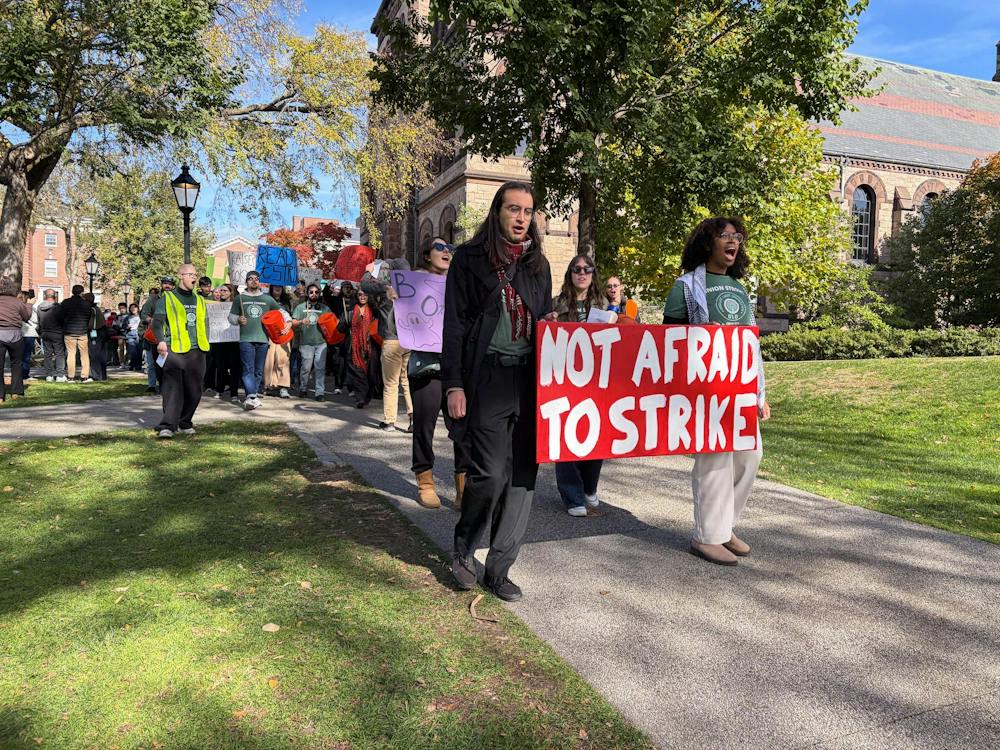
On Saturday, the Labor Organization of Community Coordinators and Graduate Labor Organization held a joint picket to raise awareness about the unions’ complaints surrounding contract negotiations. Both LOCC and GLO’s collective bargaining agreements expired over the summer.
At the peak of the three-hour picket, which took place during Family Weekend, the protest boasted over 100 demonstrators. City Councilwoman Jill Davidson ’89 (D-Ward 2), State Rep. David Morales MPA’19 (D-Providence) — the Democratic nominee for Providence Mayor — and Annajane Yolken ’11, Democratic nominee for City Council’s Ward 13, all made appearances.
“You have allies on and off of this campus that stand with you, and we’re going to ensure that you have a fair contract that allows you to live and afford a life here in Providence,” Morales said in a speech at the picket.
Throughout the morning, the picket attendees marched across campus behind a sign that read “NOT AFRAID TO STRIKE.” GLO bargaining committee co-chair Sam Bisno GS and LOCC bargaining committee and driving committee member Mikhaila Reid ’27 said that a strike is their ultimate bargaining tool — and one they were prepared to invoke if negotiations continued to stall.

GLO and the University began bargaining for a new contract in February. Eight months later, negotiations have stalled due to three main issues: wage increases, recognition of graduate fellows as members of the bargaining unit and language surrounding grievance processes for union members, according to Bisno.
The union initially proposed a 12% wage increase for fiscal year 2027, followed by 11% and 10% increases in the following two fiscal years. The University countered with a 0% increase for fiscal year, followed by 1.5% increases for three years and a 2% increase in the contract’s final year.
Over the summer, GLO reduced their initial “admittedly ambitious ask” of a 12% wage increase for fiscal year 2027 to an 11% increase as a “show of good faith” in negotiation, Bisno said.
But Brown has not relented from a 0% wage increase this year. By proposing a five-year contract, Bisno said the University is also breaking a “precedent” of three-year contracts.
“We don’t expect our first ask to be the ask we come away with,” Bisno said. “But we feel that when Brown doesn’t budge on a 0% raise, that we have no reason to come down from our asks.”
According to University spokesperson Brian Clark, Brown requested that both parties enter a neutral, third-party mediation to reach a compromise in August, but GLO has continued to decline the invitation to participate.
“Entering mediation would reflect a shared commitment by the University and GLO to reach a fair, long-term agreement,” Clark wrote in an email to The Herald.
“We have communicated to the University that we don’t feel mediation is appropriate at this time,” Michael Ziegler GS, president of GLO’s parent group RIFT-AFT Local 6516, wrote in a message to The Herald. “Both parties were able to bridge substantial gaps through direct bargaining three years ago, and we feel a similar process has yielded some progress recently.”
“While Brown’s administration has now twice proposed a 0% raise for grads in the current fiscal year, nothing prevents them from offering a proposal on wages that moves in the right direction,” Ziegler added. “They shouldn’t need to have their hand held by a third party to reach fair compromises.”
The stipend and benefit support currently provided to graduate students “exceeds that of nearly every college and university in the United States,” Clark wrote. Over the summer, Provost Francis Doyle and Executive Vice President for Finance and Administration Sarah Latham wrote that the current base salary for Brown’s doctoral students is the highest of all Ivy-plus schools, with the exception of Stanford University, which is located in an area with a higher cost of living.
According to calculations by the Massachusetts Institute of Technology’s Graduate Student Union, the doctoral stipend at Brown during academic year 2025-26 was 104.26% of a living wage in Providence — the highest of all schools they calculated. MIT GSU did not respond to The Herald’s request for explanation of their calculation methodology.
But Bisno said that graduate students are “feeling the pinch” of rent inflation and increasing living costs.
“When you’re already starting to have to crunch the numbers and get down to whether we’re slightly above a living wage or are we below a living wage, I think that tells you something,” he added. “We want everyone, across the country, across the higher ed landscape to be able to make ends meet.”
The contract for LOCC expired in June, and negotiations were initially expected to be “pretty brief,” Reid said. The union has tentative agreements for “quite a few articles,” but are stuck on similar impasses to GLO: wage increases and grievance processes. Still, Reid remains “tentatively hopeful.”
In negotiations, LOCC was looking for a CC stipend that matches the cost of housing and the University’s most expensive meal plan — currently $19,464 — with increases each year to match the cost. Under the previous one-year contract for the 2025-26 academic year, the stipend for CCs was $12,875, a 3% increase from the previous year.
Over the summer, the University countered LOCC’s stipend proposal with approximately $13,000 each year with 1.5% increases in future years, Reid said. LOCC is currently working on a counterproposal to the University’s offer, Reid said.
Both unions also protested the University’s proposal to remove language providing an external grievance process for Title IX related issues.
The updated language is “to clarify University processes and reflect updates to the ways in which Brown addresses complaints of discrimination and harassment through the Office of Equity Compliance and Reporting,” Clark wrote in an April email to The Herald.
“They’re actually trying to roll back rights that we have already won through previous negotiations,” Bisno said.
“Complaints of protected class discrimination and harassment, including sexual harassment, are processed through OECR because to meet federal compliance obligations, the University is required to address those complaints using specific procedures,” Clark wrote in April.
But Reid said that since this provision was previously included in the contract, “it is not clear to us why anything in that contract is a violation (of federal mandatory reporting obligations).”
“Addressing concerns of discrimination and harassment through established institutional processes also ensures consistent, comprehensive support for all community members beyond what a grievance procedure in a collective bargaining agreement can provide,” Clark wrote.
The final sticking point in GLO negotiations is whether or not graduate fellows are included in their bargaining unit.
In March, leaders from Local 6516 announced that graduate fellows would be seeking recognition as part of the GLO bargaining unit following new Rhode Island legislation that codified graduate student worker unionization rights.
A few weeks later, the University declined to voluntarily recognize fellows, arguing that the National Labor Relations Act, which governs private employers, preempts the Rhode Island law.

Ian Ritter is a university news and science & research editor, covering graduate schools and students. He is a senior concentrating in chemistry. When he isn’t at The Herald or exploding lab experiments, you can find him playing the clarinet or watching the Mets.


