
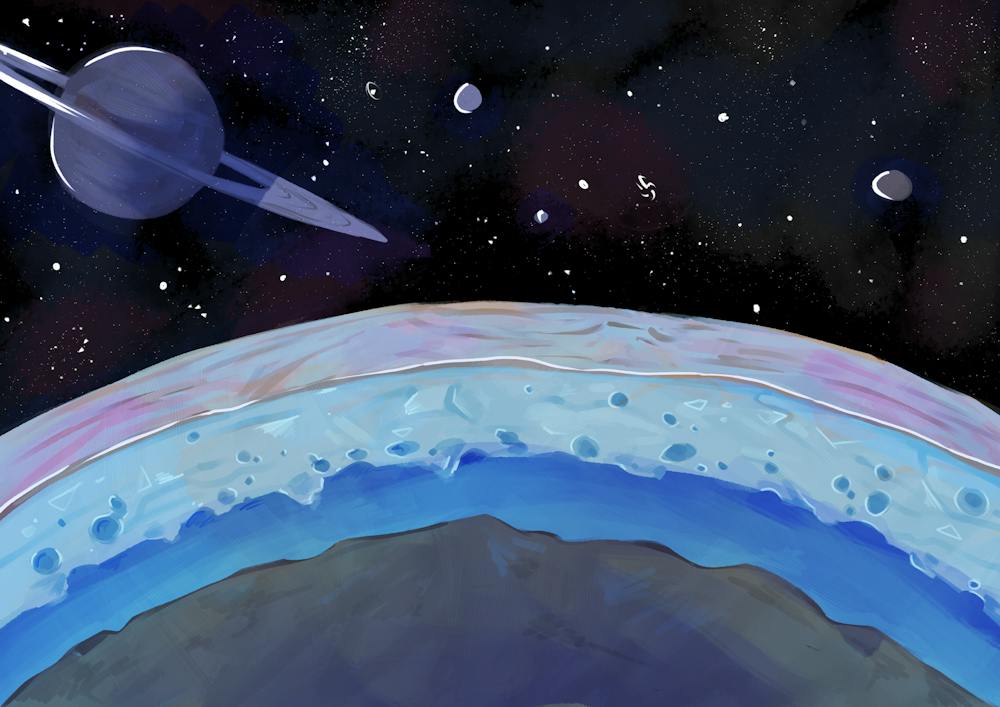
Though researchers have long suspected the existence of oceans beneath the ice of several moons in our solar system, their chemical composition remains underexplored — in large part because many are buried beneath hundreds of kilometers of ice. Brown researchers recently published a study examining how salt levels in these oceans affect the growth of these icy shells.
Much previous research on moons’ ice layers did not consider brine — which includes things like salt — in their models, said Nina Gilkyson GS, the paper’s first author and a Ph.D. student in the Department of Earth, Environmental and Planetary Sciences.
But, for the same reason people salt roads to prevent ice when it’s snowy, salt lowers the freezing point of water, which could have implications for how long the moons’ oceans can last before freezing.
But when analyzing the ice shells, the researchers found that additional salinity actually increased the growth rate — a pattern the researchers did not expect, Gilkyson said.
Christian Huber, an author on the study and professor of Earth, environmental and planetary sciences, said that those results of the study were “quite counterintuitive,” as his “first intuition would be that (salt) would slow down the freezing rate and therefore the growth rate of the ice shell.”
According to Gilkyson, the paper’s models were built on calculations by Jacob Buffo, an author on the study and assistant professor of engineering at Dartmouth.
The study’s models analyzed ocean salinities while accounting for subsurface saltwater compartments — known as brine pockets — on those moons. Because the actual salt levels of these oceans are unknown, the researchers analyzed a range of possible salinities. The models were based on measurements from the moons Europa, Enceladus, Dione and Mimas.
According to Gilkyson, the models allowed them to create salinity profiles for each icy body, which will be relevant for interpreting data from the upcoming missions to Jupiter’s moons. NASA’s Europa Clipper and the European Space Agency’s Jupiter Icy Moons Explorer — set to reach Jupiter and its moons in 2030 and 2031, respectively — both carry radar instruments to study the subsurface of the icy moons.
Researchers are able to calculate the depth that radar waves can reach into these icy shells. But the subsurface saltwater pockets could interfere with those measurements.
“Radar is particularly sensitive to salt in the ice shell, especially salt that is incorporated in a liquid form, because that salty liquid is very conductive,” Gilkyson said. The radar waves are sensitive to those electromagnetic properties of the ice shell — enabled by the salt water’s conductivity.
But the researchers ended up finding that in the majority of cases, radar signals were able to make it through the ice and brine pockets to reach the boundary where the icy shell transitions to ocean.
The models that researchers used in this study are important due to how salts affect ocean world habitability, according to Buffo.
“We see salts almost everywhere, from Mars to Europa to Enceladus to Ceres,” Buffo wrote in an email to The Herald. “Understanding the roles they play in the dynamics, evolution and habitability of these worlds is pretty important.”
According to Gilkyson, while habitability of these icy worlds is still a largely unknown area, “seeing water on other worlds is always so exciting” because of the vital role it plays in supporting life on Earth.
While the study only modeled the freezing of these bodies, the melting of the shells could release trapped nutrients that could potentially support life, Gilkyson added. But, she said, factors like limited sunlight could make the environment less hospitable.
Looking ahead, Stephen Parman, a professor of Earth, environmental and planetary sciences who was not affiliated with the study, noted that a next step is to “have the missions get to these icy moons and actually observe the icy moons and see how well they match or don’t match the models here.”


