
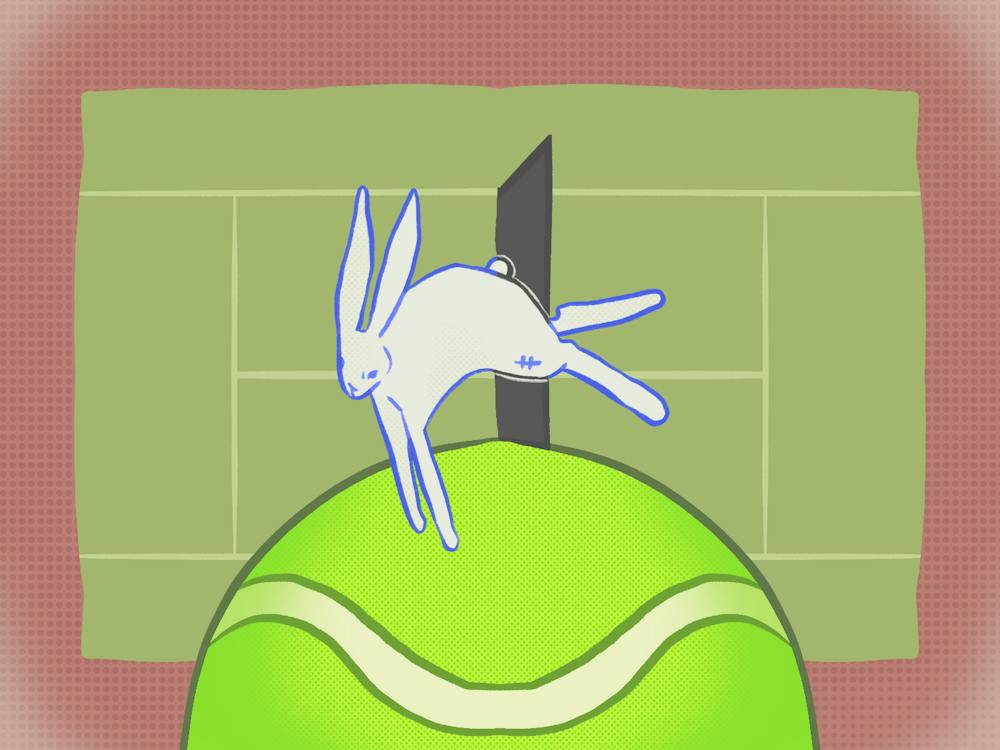
They say all is fair in love and war. Except when the war is between you, a yellow ball, and the grown man chasing said ball around a court approximately 200 miles away.
There are perhaps, if you boil everything down to its bare sociological structure, two core types of college students the day before classes start. There is the student who carefully plugs in each part of their little ecosystem to their respective chargers. Laptop—check! Phone—check! Noise-cancelling, over-ear headphones plus the one and only iPad—check, and check! They set their alarm for 7:00 a.m. sharp, ready to conquer their 8:30 a.m. seminar and start the semester on the right foot, which entails a proper gym routine and actually eating breakfast everyday. Maybe they are a doe-eyed freshman, or a senior hoping to stake a last-ditch effort to fix all their previous life choices. Either way, they are in bed by 11:00 p.m.at the latest, outfit already laid out in their dorm, equal parts eager to get the ball rolling and dreading the true end of summer. You know, the universal feeling. Then, there is the human-shaped creature you find crouched beneath their sheets, frantically typing up a storm on their phone, cheeks flushed and heart clenched. In this dark enclosure, only the blue light illuminates their face, and only the phone speakers fill the dead air with a cacophony of shoe squeaks and ball thwacks.
The latter position is where you would have found me in the wee hours of one September 9th, 2026 in Providence, Rhode Island—about five hours before the first day of classes at a certain Brown University. It is also the night of the US Open Quarterfinals, and the last match of the day is finally underway: Ben Shelton, the blockbuster American hero, versus Carlos Alcaraz, the Spanish superstar prodigy. Both are only twenty-three years old and currently in a complete, utter brawl. And I, hiding beneath my covers and biting at my nails, feel like my life is also on the line—alone on court, racket in hand, ball in play, and opponent across the net.
Tues, Sept. 8 at 11:59 p.m.
MY ADRENALINE RN
WTFFFFFF
SOMEBODY SEDATE ME
ᯓ᳂?
LOVE-ALL
It was not necessarily that tennis chose me, but more so that I chose tennis, latched on, and never quite let go.
When I was thirteen, I decided that I needed to play a sport in high school. Having freshly quit competitive swimming, I must’ve had some sort of itch to be scratched. In elementary school, our gym teachers taught us hand-eye coordination by handing each of us a mini-racket and tennis ball. The goal? Hold your racket facing up, with the yellow fuzzy thing sitting precariously in the center, and begin bouncing the ball up and down, keeping it in the air for as long as you could. It was a test of balance, control, and strength. Amidst the echoes of laughter that ricocheted within the tall, hollow space, I placed my tongue between my lips in concentration. I liked the way it felt when the ball hit the strings. I liked the way my wrist dipped and absorbed the velocity each bounce. I liked the steady, hypnotic rhythm it created. My highest record was maybe an abysmal five or so bounces, and when we began practicing hitting the ball against the wall in later years, I was even worse—but something stuck.
And so, after years of my parents’ futile attempts to get me into their own dream sports—like soccer (in which I blindly ran to wherever the ball was, no regard given to the concept of goals) and swimming (in which I thrashed around and fought for my life anytime I was forced to do butterfly)—I ditched everything. My gut, in all her might, kept on tugging me toward that silly sport with the fuzzy ball for some reason. I tagged along on one of my dad’s weekly grocery runs, made a Target stop, and bought the most affordable Wilson racket. I took some lessons with D, a junior guy from the high school team, on the nearest courts in a neighborhood neither of us lived in. Was I any good? By most standards, absolutely not—but I chose it, and I suppose that meant something.
Wed, Sept. 9 at 12:32 a.m.
this match about to go until 3am
glorious lob
Jesus Christ
mamma mia santa italia
LOVE-FIFTEEN
As freshman tryouts drew closer, I had an admittedly late epiphany: How the hell do tennis matches even work? Besides some brief rallies, most of my time was devoted to drilling the basics: forehands, backhands, volleys, and the most cursed of them all, serves. When the opponent fails to hit the ball back, you win a point. When you completely shank the ball and hit it humiliatingly outside of the lines, you lose a point. When I raised this question to D, he began his explanation: A match is broken down into sets, which are broken down into games, and you win a game by either winning four points first or winning two in a row if at deuce… Then he paused, considering his words, and said, “Actually, I think it would be easiest to learn the scoring system if you watch a match.”
I did not watch any matches; instead, most of my hours that spring were dedicated to playing The Sims 4 and reading through the Percy Jackson universe for the first time. I watched a couple YouTube explanations and advice videos, generally getting the hang of this through that alone. (15 means one point, and 30 means two points, therefore three points is… 40. Okay then.) I had never really been a big sports person anyway, something of an anomaly considering how massive basketball and football are back home. While in this shotgun mentality, I made it through tryouts—mainly because they took anyone who showed up that year—and found myself on the junior varsity team. I lost a lot, and I won very few times. I learned that one of my favorite things in the world is a clean, beautiful backhand, topped off with the most glorious pop! It really helped that it was by far my best stroke. Most of all, however, I realized that although I liked playing fine enough, it was the entire atmosphere that overtook my heart—the blazing sun hitting the blue-green courts, burning our arms, and setting over the horizon at the end of a long match day. It was watching the ball fly between rackets, travelling impossible arcs over the net and slamming like bullets down onto the concrete. It was all of my teammates, crowded around the fence as our number two doubles team battled it out, our heads swivelling left and right in sync as we tracked the ball’s movement. It was electrifying.
When I was fifteen, I decided that I needed to watch the US Open. My parents and siblings shot passing glances of confusion and judgment as I sat hunched over, hogging the family computer. A single Google tab laid open on the monitor: the live scoreboard of the 2021 US Open Men’s Singles Final. The day before, I scrolled through dozens of news articles as they reported on the Women’s Final—a nearly unprecedented match-up between two unseeded, teenage finalists. There was Leylah Fernandez, who knocked out multiple top five players on her historic run, and there was Emma Raducanu, who proceeded to complete her flawless run to the title, never dropping a single set along the way. Earlier that week, I also caught sight of another teenage phenom on the rise: a certain eighteen-year-old Spaniard making his New York debut. In the third round, Carlos Alcaraz defeated third seed and top ten player Stefanos Tsitsipas in a five-set thriller, awkward teenage boy haircut and all. His playing was pure firepower and impossible magic, a generational talent that unfolded before your eyes—culminating in a run straight to the quarterfinals. Among the players, Alcaraz’s polar opposite also stood: a slightly older Jannik Sinner, a strikingly red-headed native German speaker from the mountains of Northern Italy. He had grown up a national champion skier and only committed to tennis at age thirteen; now, he was playing here as the reigning ATP Next Gen champion. That entire week, it felt like I was unlocking characters one after another, fascinated by all the storylines that converged with and diverged from each other.
Finally, it all ended here. On one side was Novak Djokovic, a member of the “Big Three” rivalry with Roger Federer and Rafael Nadal, the only players I had held a vague sense of prior to falling down the rabbit hole, alongside Naomi Osaka and the Williams sisters. Now, only one man stood in the way between him and a historic calendar-year Grand Slam: Russian player Daniil Medvedev, a relative mystery to me. As I watched the live score tick point by point on Google, Medvedev chipped away at the twenty-time slam champion and pressed his back against the wall, his blistering forehead and staggering agility on full display. By the third set, with Medvedev up two sets to nothing, Djokovic was in tears and the crowd in shock. I hung on every update and every tweet in disbelief. At championship point, the Russian served, and the Serbian swung to return the ball. Ball and racket made contact before it ricocheted off, flying through the air and then, inevitably, straight into the net. Game, Set, Match. Medvedev. The stands erupted, and yet, instead of raising his arms in victory or crying out of joy over his first Grand Slam title, Medvedev blinked, dropped his racket, and proceeded to completely flop onto the ground, sticking his tongue out and mimicking a dead fish. The live scoreboard froze: a straight set victory. I sat in front of the computer, jaw dropped, brain fried. I leaned back in my chair, kept my eyes on the screen as the reactions streamed in, and felt something inexplicable take root in me, burgeoning and blossoming.
Wed, Sept. 9 at 12:42 a.m.
my morale is dropping call me a 19th century sailor
LMAO what
are we going to make it home.
the ship is beginning to take on some water
i can’t let this set the tone for my semester
OH I’M NOT HUNGRY
#scurvy
J laughed at “#scurvy”
LOVE-THIRTY
According to Merriam-Webster, no one, not even etymologists, know how the modern tennis scoring system came to be. Of all the little, peculiar terminologies that float around this sport—deuce, ad, tweener, bagel—there is one that produces the most curiosity. In tennis, “love” means nothing. More precisely, it represents a score of zero. There have been several theories as to why this is.
The first theory finds its roots in the sport’s medieval French origins; it proposes that the use of “love” is derived from the French “l'œuf,” or “egg,” due to the written number “0” resembling “one.” When the game was adopted by English players, it is said they confused “l'œuf” with “love” over time, and eventually it stuck—becoming an integral part of the system. A second theory argues that the origins of love come from a different expression: “to play for love.” Essentially, even if a player has zero points, they still continue playing out of love for the game. Therefore, despite a losing position from 40 or 30 down, one still plays on, not for the win or wealth, but for love. No matter its true origins, you can always—with no doubt—find fragments of it woven into every game, every match, every tournament, every breath.
Wed, Sept. 9 at 1:03 a.m.
watch out i might have to resort to pinterest again
praying that this turns into when we were watching jannik flop a little at wimbledon and he still came out on top
haha. ha.
You doing this before FDOC
Carlos Alcaraz’s strongest soldier
LOVE-FORTY
Unlike Jannik Sinner, I ultimately did not commit to the “process” and find myself a five-time Grand Slam champion a mere nine or so years later.
Following the end of my own short-lived playing career—which concluded after my junior year and a one-time stint as a varsity doubles player—my watching career lingered a little longer. Throughout high school, among tabs of documents and assignments, there would be a perpetual Google tab open, rotating between different tournaments during the calendar year. October marked the Shanghai Masters, then November did the same for the Paris Masters and ATP Finals before January signalled the beginning of another season with the Australian Open. I would talk tennis with D and some friends from my team, then go home to watch compilation and “funny moments” videos by myself. My obsession came in waves, flaring up during Grand Slam seasons and whenever my favorite players won. Sometimes I went months without following the tour; other times, I had one feverish week where I caught up on where everyone was in the rankings. Unlike most sports, tennis essentially operates with no offseason and on a year-round calendar—condemning players to a brutal schedule of constant competition, and fans to utter insanity.
Perhaps naturally, life took over. My racket collected dust, and the world rolled on. When Sinner finally had his major breakthrough and won the 2024 Australian Open, I was in the thick of college applications. When Nadal officially retired from tennis at the Davis Cup, I was busy navigating my first semester of college. As Alcaraz and Sinner fought their now legendary 2025 Roland Garros Final, I was beginning work at my summer job. When they had their third final rematch in a row at the 2025 US Open, I was spiraling in academic crisis over the beginning of sophomore year. All this time, however, my Instagram still followed Tennis TV, and my Twitter account still followed some twenty-odd players.
This past summer, at twenty, I never—and I mean, never—could have predicted that I would tumble straight into another all-consuming love affair. It was my first Providence summer, and my friends and I were horribly bored. Lucky for us, a sports summer was in the forecast with the World Cup creating a constant buzz in the air. As had become my routine, though, I was quietly keeping up with Wimbledon through the occasional Instagram notifications. Whenever my friends asked how that archaic scoring system works in tennis, usually when we made nonexistent plans to play on campus, I gave the same answer I received years before: “It’s easier to explain if we watch a match in real time together.” This is how, on a sweltering Sunday in July, I found myself sitting on a couch with J, one of my best friends at Brown, watching the final in her sublet. It was the first full match I had watched since a Musetti-Fritz match, also at Wimbledon, in 2024. For the next close to four hours, it was like nothing had changed—I shouted when a ball looked like it was going out, only for it to land comfortably in (my horrible depth perception at its finest), and I shielded my eyes out of fear during tense break points. We laughed at Twitter commentary throughout the match, in typical screen-ager fashion, and began to comment on everything but the tennis being played. Sure enough, Jannik Sinner prevailed in four sets over the universal villain Alexander Zverev—to which, when Sinner finally took off his white cap and released his glorious, ginger curls from their confinement, I heard J exclaim, "Wait, why does he look kinda amazing?”
What follows is something akin to floodgates bursting open; it is a whirlwind of all the videos and matches and players I watched years ago in high school, rediscovering them through watch parties with J and our friend T. I show them the stupid “Guess the Grunt” videos and challenge reels that treat these professional athletes like hostages. It gets so bad we make a group chat, where we trade Twitter posts for Tumblr fanart, and TikTok edits for personal thinkpieces. When we are invited to Boston for a mutual friend’s joint birthday and World Cup Final watch party, we completely lose our minds every time the camera pans over to Alcaraz, who was then on injury hiatus from the tour, watching from the stands. It did, in fact, get so bad that for J’s birthday, I may or may not have created a TikTok account and may or may not have cooked up my own, home-cooked ship edit as a gift. (And no, I will not be disclosing any further information on this particular subject.)
Sometimes, it feels like I can never love anything “normally.” When I fall in love, I dive head first into the deep end, letting total obsession consume my whole being. There is something about sharing this love with others that heightens this phenomenon, but also makes it all, truly, worth it. In tennis, to love is to lose. This summer, I hit a serve and found my losing game.
Wed, Sept. 9 at 3:12 a.m.
OMG SERVE HOLD I COULD CRY AGAIN
FREE US
i’m crying this is prob gonna go to a tiebreak
the ship is teetering, the sailors are yelling HEAVE
There’s something wrong with you
I fear for you
Please sleep now
GAME, SET, MATCH
Months later, the current state of the group chat has devolved into this: my nineteenth-century ship metaphors (which is most definitely rooted in my futile attempt to read Moby Dick this summer), potential research studies on Carlos Alcaraz-induced psychosis, primal stress noises, talk of bakery products, threats of quitting the whole sport altogether, and hundreds of more incoherent shreds of consciousness written out in text form.
The past two weeks have been filled with the most tennis I have ever watched in my life, a metric I would not have believed true if you told me at the beginning of the year. I watch at least two matches a day, from Gauff v. Badosa to Medvedev v. Tiafoe—savoring the last boundless days of summer. Even as J is off campus, back home preparing for her study abroad, we still share tweets back and forth, nearly twenty at a time—T is our resident hostage in the group chat, though she appears once in a blue moon whenever a particularly gorgeous editorial shoot of Sinner pops up. Even if she’ll be across the pond now, I know who I can always rely on to complain about tournament withdrawals or trade Pinterest finds. It all comes to a head at the US Open, where—after 139 days—Jesus Christ (commonly referred to as Carlos Alcaraz) has been resurrected from the dead (wrist injury).
Five matches later, after five sets and a super tiebreak, after vomiting into a towel on court, his first tournament run in nearly five months comes to an end. I am completely wrecked, in a sleepless state of delirium. I can barely stomach a single glance at my screen. I have been watching through J’s free ESPN trial since 11:00 p.m., after some horribly planned scheduling on the tournament directors’ part. As I prepare to pull up some previous match highlights to settle the adrenaline and reflect on my life decisions, the footage pans to Alcaraz waving New York goodbye, then cuts to the exit tunnel. It is there where, rackets and bag in hand, he walks off the court—a walk all players typically dread. It is there where, instead of hanging his head, he smiles. A full, toothy smile. Now returning to the tournament as a seven-time Grand Slam champion, two of those being US Open titles, but most of all after months of uncertainty and recovery, he is not merely playing to win.
It is a feeling both indescribable and inevitable. There is only one name for it.
ᯓ᳂?
Wed, Sept. 9 at 10:52 a.m.
carlos alcaraz may have died at 3:30 am last night
as i watched on BUT I’M STILL HERE #FDOC2026


