My brain was sliced clean through in the middle of the work week and the soundtrack was everyone’s least favorite Taylor Swift album. This is, perhaps, the most poignant lesson that brain surgery taught me: the worst moment of your life will happen, and you won’t get to pick the song when it does. Your aggravation will worsen when the song blares through tinny dollar store headphones with exposed wiring. Mid-ugly cry, you will shimmy the cord to stop the feedback, but it won’t matter. The universe has a funny way of teaching lessons in patience.
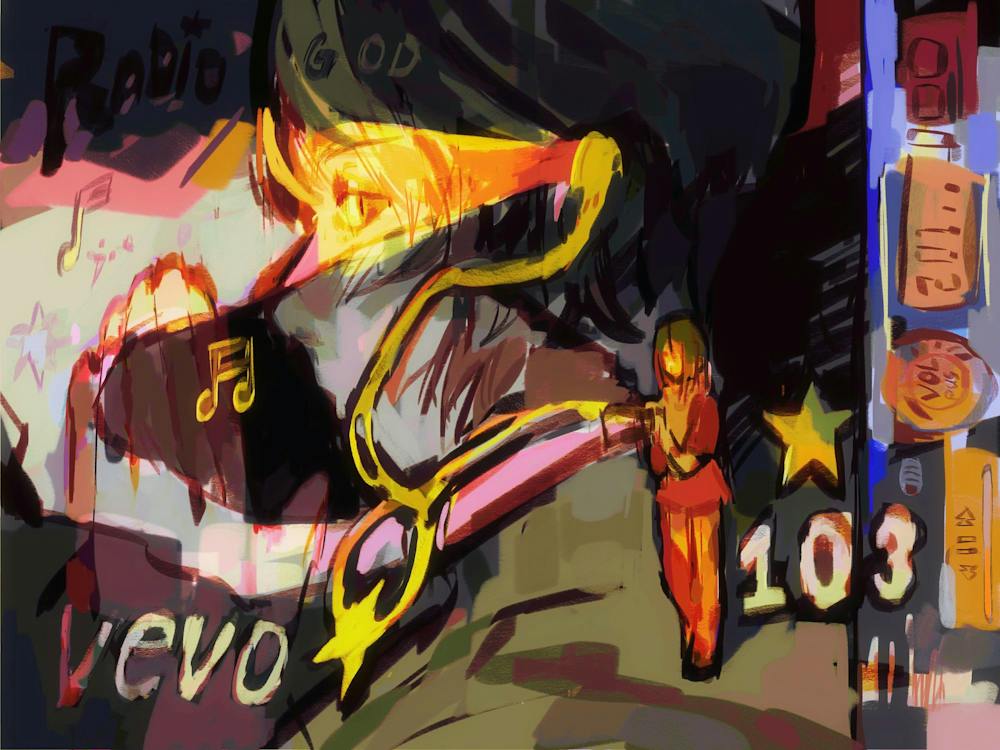
Radios were the deities of my youth, signposts that my small world was trudging along the cosmos at exactly the right pace. My parents’ first car was a 2005 Chrysler Sebring with a humble stereo setup. The vacuum fluorescent display was a small strip that informed you only of the channel as you turned the small grey knob. I relished the feeling of its glossy surface. The sides were etched with small, thin grooves that clicked gently as it turned. My sister and I had regular demands:
“102.7!"
“Z100!”
“103.5!”
We eventually discovered 95.5 FM amid the static, long before its devastating transformation into a Christian music station in 2019. But before worship music was all that played, 95.5 FM was added to our rotation to ensure a constant stream of Hot 100 Hits. Car rides were an endless circuit of Katy Perry, Taylor Swift, OneRepublic, Pitbull, and Justin Bieber. On his days off from work, my dad would bring the car to the empty lot outside the Wholesale Liquidators off Route 440. I’d tag along to watch him duck underneath the metal body, twiddling away at some issue that never quite resolved. The car often stalled at unlucky intervals, leaving my whole family stranded on the side of the road. On those days, I wished I were clairvoyant—a juvenile hope that still trails me on occasion. Back then though, seeing the future just meant being able to prepare myself for hours of waiting for a tow truck. My beloved distraction of choice? A pocket radio my dad found, picked up, and brought home.
The pocket radio’s coolest feature was the clip attached to its black, plastic shell. This made it possible to secure the rectangular device’s thick body to the waistband of my pants or—my preferred placement—the breast pocket of my T-shirt. Luxury had a loose definition during my childhood. In 2011, it meant having a pair of airplane headphones with a jack that wasn’t so loose, two AAA batteries, and a sister with an iPod Touch that outshined a pocket radio in both functionality and customization. Her new tech signified an end to our constant fights over ownership of the unwieldy device. I was filled with pride to call that little radio my own, even when the batteries came tumbling out every time it hit the floor.
Before all this was the stereo in our one-bedroom apartment. My family moved there when I was two and didn’t leave until I was six. Inside our tiny kitchen my mom would leave the music on, long after she finished cooking. While everyone watched television in the living room, I would tiptoe down the short hallway to practice my breakdancing to Taio Cruz songs, the linoleum absorbing the sound of my stomping. Someone would always catch me mid-spin. Red-faced and embarrassed, I scurried away.
Long after the stereo broke and batteries would no longer stay put in my pocket radio, I found a new icon: a radio housed in the body of a flashlight. This was the radio of Hurricane Sandy, circa 2012. Before we hunkered down at our next-door neighbor’s apartment, my mom watched over my siblings and I by herself, at home; my dad spent most of the storm at the airport where he worked, unable to make it back safely. My sister and I huddled on the floor of the bedroom we shared—she sat atop the pink bedside rug shaped like a heart, while I crossed my legs over the blue rug shaped like a blocky house. I had tried to convince her to give me the heart one, but it was no use. Birth order always prevails.
In front of our knobbly knees was the flashlight radio. Its body was thick, with many dark and complicated buttons and knobs. On the side was a long lever, and at the base was the opening for batteries. There were not many batteries to go around in the middle of Hurricane Sandy. My sister insisted we used the two powering my prized Password Journal. I so badly wanted to hear a Ke$ha song. Nobly, I obliged.
The batteries, on their last leg, produced only a flicker of light and a faint hum of static. So began the hard labor. I was tasked with working the hand crank on the side of the flashlight radio. My sister braced the device on the ground while I spun the lever furiously, huffing and puffing as I tightened my grip.
“Go Aly!” my sister whisper-yelled, careful not to wake our baby brother.
I imagined the opening of “TiK ToK” and gritted my teeth, the hum of static growing louder. The sound reached a fever pitch that eventually broke into the classic “...like a plastic bag, drifting through the wind, wanting to start again…”
We got a few more seconds of music before the connection broke and descended back into static. I had wanted to hear Ke$ha, but Katy Perry’s brief appearance sufficed. Anything that crackled out of the flashlight radio felt like a gift from God. As a child, I believed in earnest that rain was God’s tears falling onto Earth. I understood radio to have the same mysterious origins, airwaves and FM magical contrivances that gave meaning to my life. Culture did not come from museums or catalogs in my house—it instead emerged sloppily, during on-air interviews with pop stars and celebrity gossip segments. I coveted the DJs’ jobs.
But the world was already beginning to change. The iHeart Radio app was rolled out in 2011. This meant I could listen to my favorite stations whenever I wanted on my family’s iPad 2. Vevo also stole radio’s thunder. I was utterly enamored with music videos, new and old. It annoyed me when a video had seemingly nothing to do with the song’s content; “Little Talks” by Of Monsters and Men was particularly confusing.
Music was always a three-minute reprieve from adolescence, but radio’s self-assured scheduled programming was constant salvation from the uncertainty of burgeoning adulthood. As I grew older, radio remained one of the few things that demanded nothing of me—especially as I recovered from a craniotomy. “Sunday Night Slow Jams” on 102.7 FM replaced the tension in my body with pure elation. I adored the love confessions people would call in with. Better yet were the apology call-ins. The insight into other people’s intimate lives was potent. I was astounded by human nature’s capacity for change; love could easily collapse into hatred just as fast as a chance encounter developed into marriage. What did I’m sorry even mean in the face of a years-long betrayal, or a forgotten anniversary? In between my commentary about the quality of these strangers’ remorse, I felt myself reaching an equilibrium.
Yes, my brain pounds as though it’s been set on fire. I can’t talk about how scared I am of all that I have lost, including the futures I didn’t even know were mine to lose. My body is rebelling and I am called to the impossible task of forgiving it.
But this hour of music is known. The album release date is secured. The trivia questions and scripts have been written.
And when I did get better, I remembered cruising through a dark Stephen R. Gregg Park, quiet in the backseat of my parent’s car. Too tired and in pain to speak, I listened to my sweet mom and gentle dad engrossed in a murmured conversation, the September evening air drifting through the open windows. And the radio, always the radio, humming quietly and faithfully in the background. I thought of God and His tears and of wind-up flashlight radios and cheap headphones. I imagined airwaves as a long, wide bridge, full of listeners as small as ants. The sorrow and joy and heartbreak and hope upon it is constant and exciting, reliable in its intensity. My own fit perfectly on this path. Yet another signpost, the continuum winking in the distance with the promise that I would be okay.

Alyssia Ouhocine is a Senior Staff Writer covering Arts & Culture. Hailing from Bayonne, New Jersey, she is concentrating in English and History with a particular interest in Algerian history and literature. When she’s not writing, she can be found listening to music and sending Google Calendar invites.


