
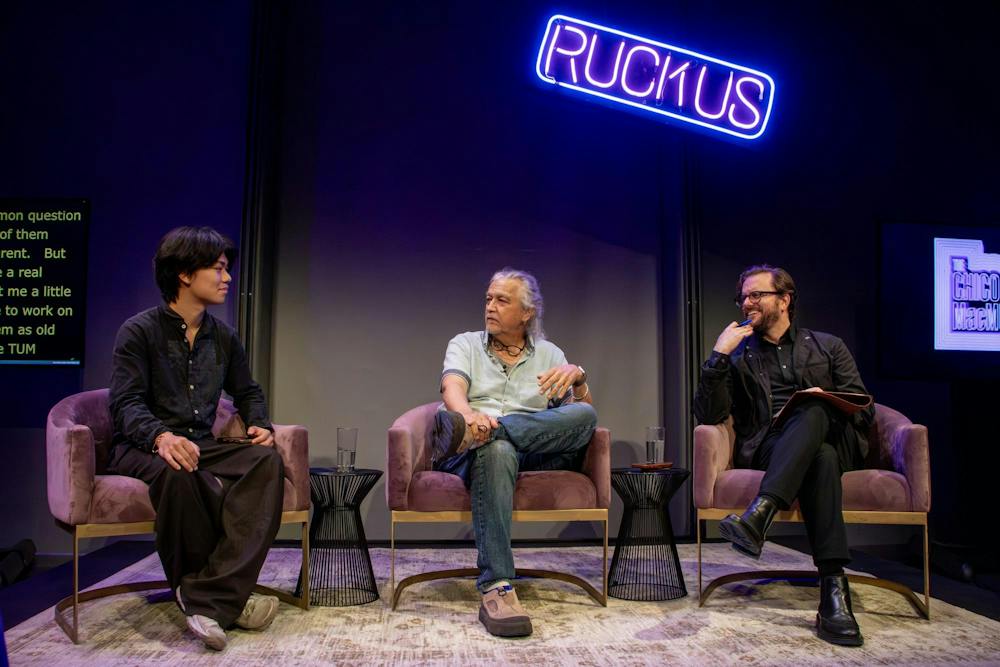
Following in the footsteps of cultural leaders such as actor Tim Blake Nelson ’86 and designer Sasha Costanza-Chock, Chico MacMurtrie joins a long line of artistic icons who have spoken at the Brown Art Institute’s “Ruckus Sessions.” The newest addition to the recurring series — which BAI advertises as “debate club meets house party” — showcased a candid conversation on MacMurtrie’s life, work and influences.
MacMurtrie described the process of how he came to the unique field of robotic sculpture. He recalled when he walked into his still-wet artwork, covering himself in paint. While peeling off the dry paint from his body, he “thought that the skin was much better than the painting” and he “started thinking about how it would be to perform in that skin.”
Today, human bodily movements, functions and performance serve as inspiration in MacMurtrie’s robotic artworks.
“I stepped away from the physical body and started mechanizing those skins,” he said. “I was interested in the awkwardness of being human and how it’s more beautiful than choreographed humans.”
MacMurtrie’s artistic process involves a lot of collaboration. His main workshopping and performance installation space, The Robotic Church in New York City, features many of MacMurtrie’s machines and can house up to 120 audience members.
Later in the semester, students in ARTS 1550: “Robots (re)Imagined: Art, Engineering and Speculative Futures” will be taking a field trip to The Robotic Church.
According to Nora Ayanian, a professor of the course and an associate professor of computer science and engineering, the goal of the class is to bring students from different academic backgrounds together.
Paula Gaetano-Adi — a RISD professor of experimental and foundation studies and computation, technology and culture — co-teaches the class with Ayanian. “Whether you’re doing art robots or engineering robots, you need to… start bringing to the table different perspectives,” Gaetano-Adi said in an interview with The Herald.
Both professors have taught classes involving robotics and art before, but this is the first class to be entirely collaborative between Brown and RISD. Gaetano-Adi said she hopes this kind of collaboration with “two faculties coming from very individual, different worlds” will continue into the future.
Ayanian shared a similar sentiment, noting that she hopes arts-students in the audience would be inspired by MacMurtrie’s collaboration with engineers. In his talk, MacMurtrie brought up his collaborators, saying, “I work them really hard and put them through a lot, and they come out of it being really skilled.”
Gaetano-Adi said she hopes MacMurtrie’s “Ruckus Session” will show students how people can explore the intersection of art and engineering “in the real world.”
During the event, MacMurtrie talked about how he finds inspiration in the world around him. For example, one of his machines mimics the action of a woman throwing a rock, a scene he saw while traveling.
“You work on the machine, it comes to life,” MacMurtrie said.
The session later turned to a discussion on artificial intelligence, where MacMurtrie emphasized the “super special” role of the artist. “Stay true to yourself and don’t pull from the giant library of knowledge and stolen art,” he said.
MacMurtrie asked the audience: “Why do we need (artificial) intelligence? … Don’t we want to keep using our brains?” By asking these questions, he emphasized that young people can bring hope for the future of art.
Millie Barter is a senior staff writer covering RISD.


