
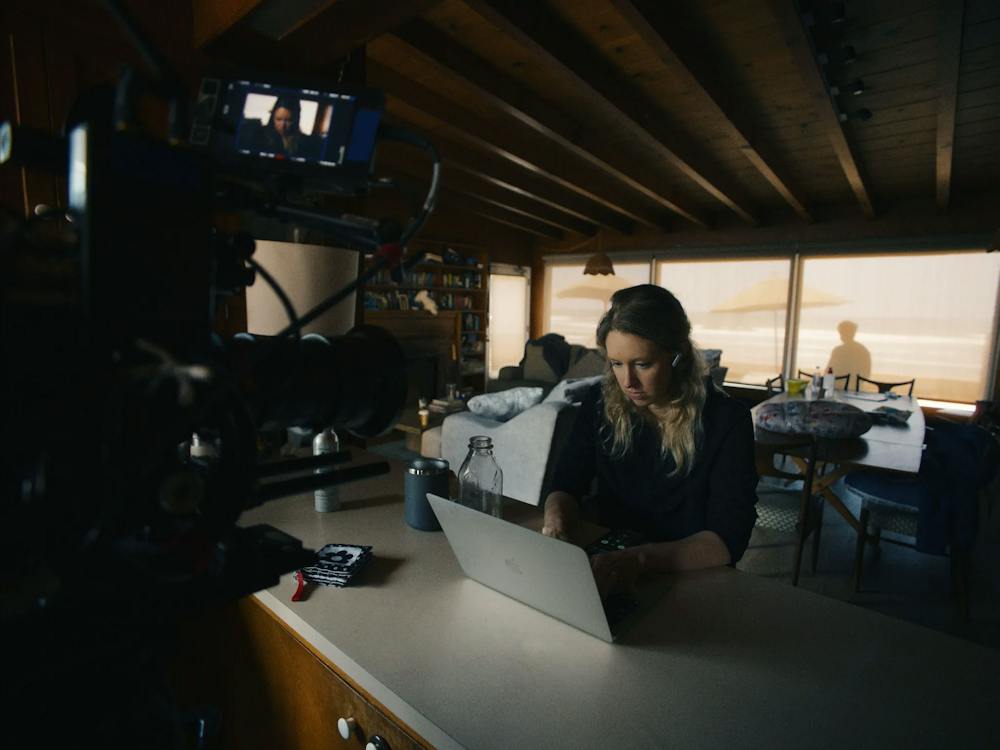
The best review of Nathan Fielder and Lance Oppenheim’s documentary “You Can See Everything” would say nothing at all. For a film that bends genre as much as this one, the ideal preparation is none. Whatever you think you know and whatever you expect, Fielder and Oppenheim’s documentary on disgraced Theranos founder Elizabeth Holmes will stun you in every possible way.
Thirty four days before beginning her prison sentence, Holmes invited Fielder and Oppenheim — and with them, the public — into her life with her fiance Billy Evans and their two children. The result is, at the very least, the standout movie of the year so far.
What begins as a bizarre slice-of-life story unfolds into something akin to a psychological thriller — perhaps even more for the audience than the people on screen. Just when you think the film cannot possibly go further, it does.
In 2003, at the age of 19, Holmes founded Theranos — a company that promised a device that could perform the testing of conventional labs with only a pinprick of blood. In 2015, Forbes named Holmes the youngest female self-made billionaire. But when it came to light that the technology did not work, her empire fell apart. In 2022, she was convicted of multiple counts of fraud and sentenced to over 11 years in federal prison.
But even with the force of law against her, truth is slippery in the face of Holmes, whose piercing gaze and beady blue eyes are almost impossible to read.
One especially revealing moment comes when Fielder shows Holmes Abbott and Costello’s famous “Who’s On First?” comedy bit. Holmes’s reaction to the routine and apparent inability to understand its basic humor seemingly confirms the unique, impenetrable quality of her mind. It begs the question: Did she knowingly defraud investors at Theranos, or did she truly believe she was telling the truth? Fielder seems to struggle with the question.
Fielder — the mind behind “The Rehearsal” and “Nathan for You” — is likely the only filmmaker who could have gone toe to toe with Holmes for this movie. It’s three hours of the irresistible force paradox — Fielder, of course, the unstoppable force and Holmes the immovable object. Locked in intense conversations framed on screen as though their faces are centimeters apart, it often feels like the two are about to kiss.
Alongside the captivating dynamic between Fielder and Holmes, Evans — Holmes’s fiance — is an unexpected and entirely bizarre addition. His eyes are almost as blue, wide and shifty as his fiancee’s, and the two share an unabashed commitment to Holmes’s innocence. Evans bares all in this documentary: the good, the bad and the ugly (but mostly the latter two).
The camera work from cinematographer David Bolen is intimate and severe, providing a visceral view of the inner workings of this absolutely nutty group of people. Just as he captures the almost-sexual tension between Fielder and Holmes, Bolen crafts laugh-out-loud framing moments where Fielder, lurking behind Holmes, comes into focus with his characteristically penetrating expression.
As wild as this film is, it is also exceptionally funny. Whether in moments when Fielder breaks the fourth wall or lapses in his serious demeanor to reply incredulously to Evans or Holmes, the film capitalizes on its palpable tension with comic relief.
This inclination toward laughter is perhaps rooted in the fact that neither Fielder nor the audience know what to make of what they’re seeing. Holmes claims to sincerely believe that she did nothing wrong — but belief is just as elusive as truth.
Watch this documentary with a crowd. You might leave the theater knowing even less than when you walked in. In any case, you will see absolutely everything.
Rebecca Goodman is an arts & culture and university news editor covering career and alumni. She is a senior from Cambridge, MA, studying English. Outside of writing, you can find her at the Avon or in the basement of the Rock.


