
CW: childhood sexual assault
I’m a sucker for beautiful things, and that was what she was—beautiful. June looked just like how I imagined someone named June would look, hair the color of sun-soaked autumn leaves and eyes that I could never quite decide on as hazel or flecked brown.
But I didn’t notice any of this until we were fifteen. It was the summer our arms and legs became lanky and long like the limbs of the oak tree and I decided to cut my hair short. Boy-short, and Johnny and Chris from down the street chased after me on their bicycles, laughing because I looked like Uncle Joe, who staggered around the neighborhood drunk.
June shook her fist at them then, like how they would in a cartoon, and she pelted our empty cans of Coke in their direction. She was always doing things like that, like she was a personal superhero, my own Jean Grey holding back the universe. Perhaps I was that to her, and she was the type of hero who could not tear herself away.
. . .
If there was something that we could never agree on, it would be the preacher. Whenever I mentioned him, June’s face puckered like an unhappy lemon, and I couldn't get the furrow between her brows to disappear. He was an odd man, the preacher was. Not odd in the way Uncle Joe was—he was sort of nice-odd, one of those people who talked and talked and you couldn’t help listening to. His voice pulled you in the way you would coax a timid dog to draw near enough for you to pat.
Sometimes, when he really got talking, it built a rippling in your chest so that when you closed your eyes, you could almost convince yourself that you saw the yellow-gold shadows of God Almighty beckoning to you.
So that Sunday, when June told me she would rather go anywhere than sit and listen to the preacher’s sermon, I wasn’t surprised. But I wasn’t too pleased about it either. Ma would have been waiting for us at the steps of the church, scanning for our smudged forms on the horizon. By the time we clambered up the crumbling granite, her foot would have tapped out all stanzas of Matthew 24:10 and Luke 17.
When I left June at the crossroads of the dirt path, I could feel her eyes bore into my back while she watched me leave. I didn’t turn around, just in case she really was watching. So I nodded and waved my goodbyes to the sky. Sometimes, I imagine I still feel the heat of that look she gave me, pressing against my skin, burrowing itself deep, deep. I couldn’t stop myself from flushing crimson.
. . .
It was June I thought of when I sat in the pews that day. It was usually her—sometimes my mind bounced to the words that spilled off the preacher’s tongue, then hazel-brown eyes, the sweet smell of sunshine, rain-kissed earth. It always came back to her. She was sugar-spun cotton, and like those many-legged ants, I raced to her.
I think the preacher must have noticed this. Perhaps he could see June’s eyes when he peered past the shutters of mine, or his eye caught on the empty, should-be-filled gap between me and the door. But that piercing gaze anchored on me instead and it stayed there. When the preacher looked at me, it felt like he was looking through me, peering straight at the light of my eternal soul—something along those lines. The difference was when June looked at me, I felt seen; when the preacher looked, I felt seen too, but in a grown-up sort of way.
When the service ended, I slipped away from the chatter of housewives and handymen, ducking so that Ma couldn't see me behind the paisley skirts gathered ‘round her. I was so focused on don’t-be-seen don’t-be-seen, that I didn't even notice the preacher until I bowled straight into him. He caught me on my upper biceps until I found my balance. He kept them there after too, but his voice was friendly and he smiled.
“In a rush?”
I flushed and shook my head in response.
His eyes did a once-over, the kind Ma gives new dresses in the catalogue before deciding they run too short. “You’ve gotten so grown up, you know that? Feels like just yesterday you were still in pigtails, chasing birds around the churchyard.”
I didn’t know what to do with my hands, so I folded them in front of me and murmured something like a thank you. It felt wrong to argue with a compliment, but it sat strangely in my stomach.
“Where’s your friend today? You and June are usually good as two peas in a pod.”
I gave a noncommittal shrug, and said, “She wasn’t feeling well this morning.” June had better thank me for this.
“Tell her to come visit when she gets better.” The grin returned, brighter than ever.
I mumbled my assent and shuffled past. I always felt this way around the preacher—self-conscious and a little flustered. Being around him was like stepping out of a movie theater and blinking into the midday sun, where everything was suddenly too bright, too alive. I didn’t know what to make of it.
I shook these thoughts off and went to meet June under our tree.
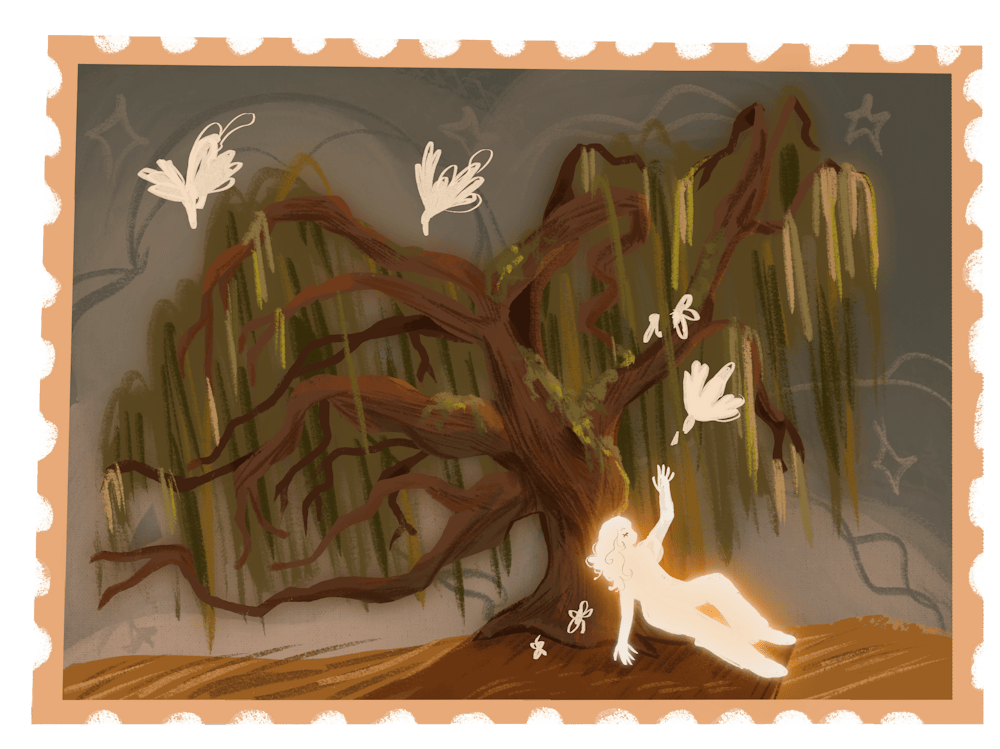
It had long, beckoning branches that reached out in every direction, scattering light in a way that always made me think: this is what people must mean when they say ‘sun-dappled.’
I was taken by surprise when June spoke. “Why do you always hang around that preacher?” She said it more than asked it, and I watched as her fingers traced the tree’s gnarled root. I could hear the disapproval in her voice and suddenly, I felt defensive.
“What do you mean?”
“He’s not as cracked up as you make him out to be, you know.”
June’s voice wavered, and I needed to spin around and look right at her face because June’s voice never wavered. She looked away when I turned.
“He doesn’t like you like that anyway.”
My voice sounded muffled when I spoke and I said the only thing I could think to: “What the hell, June?” And then I was up and moving away from the oak tree as fast as could still be considered walking.
. . .
I didn’t see the preacher again until Wednesday, when Ma sent me to drop off a casserole. He was sorting hymnals, and when I handed it over, he asked, “How’s June?”
His voice went soft and confiding, the way you talked over someone in their sickbed. “She's always been a worrier, that one. Takes things harder than she needs to, I think. It comes from not having a father around.” He shook his head. “You’re different, though. You’ve always had more grit than the other girls your age—June included. But don't tell her I said so.”
He said this like a secret just for me and something in my chest went warm and confused all at once.
Later, I felt a pang of regret for not defending June, and the feeling lingered.
. . .
Choir practice ran long that week and the preacher found me again. He led me out toward the side door when the others had already gone, catching me at the doorframe, one hand braced against it like he meant to block the sun from my eyes. His hand found the small of my back to guide me through—nothing, really, just a hand. But it stayed there a few steps longer than the doorway needed, and when he finally dropped it I could still feel the shape of his palm as if it had burned right through my shirt.
“Careful on the steps,” he said.
. . .
It was Saturday when I saw June again, with her mother hosting weekly neighborhood lemonade-and-quiches. The preacher was there too—he was always invited because June’s mother fawned over him. He approached me first this time, gesturing hello with that same broad smile.
I could feel June’s eyes searching for me, but I made a point to avoid her gaze. That’s why she didn’t see when his hand wandered to rest on my shoulder, fingertips digging warm imprints into my spine, or when he gently steered me back toward the house.
My head felt fuzzy this time, but instead of being full of cotton-soft wool it brimmed with static. That’s why it was hard to think when the preacher pulled my face up to his. He asked me if I liked it, and my traitor-body and static-brain responded by nodding, because I knew if I spoke the words would come out all wrong.
I felt like a shooting star,
falling,
falling,
falling.
When it was all over, the preacher patted my hand and winked his eye. He looked strange that way, face too flushed and glistening. I must have looked strange too, I felt floaty and couldn't move my limbs quite right. His palm on my shoulder was sweaty and his breath heady as he tilted my jaw up to his mouth. Not for a kiss, only so that my hair covered his lips as he whispered, “Our little secret.”
. . .
The summer heat kept me up long after Ma had gone to bed, or maybe it was my brain that refused to quiet. Humid air seeped between the window panes and through the floorboards, but I pulled the covers up to my chin. I could still feel his eyes roving over me and the guilty-sick threatened to come up from my throat in heaving bile.
In the morning there were mottled purples and greens marching up the column of my throat, so I stood my collar up like I was attending a formal and prayed Ma wouldn't notice. Bruises, I thought. Bruises like butterflies, with multicolored wings.
There were scabs like beetles on my skin too, where nails dug too deep. They itched like they were still alive just under the surface, and I peeled them back to reveal a bright beaded jewel⎯red. Butterflies and beetles, they made me think of June, and before I knew it my feet were racing toward the oak. I saw her there, perched on a branch like a mockingbird.
“The preacher,” it was all I could warble out before my throat constricted in that too-tight way and I felt the muscles around my eyes aching before I swiped and swiped at them because my vision went blurred.
She jumped off the branch and suddenly it was all strawberry shampoo and arms around me and I knew everything about our fight had been forgiven. “It’s okay, I know. You’re not the first,” she said.
He left butterflies on my skin, and she kissed them, gently, coaxingly, on their fragile new wings. I went still, but not the stiff, bracing kind like I did around the preacher. I didn’t pull away, and some small, clear-headed part of me noticed that I didn’t want to. I could feel her breath graze over the shell of my ear as she went on about citrus trees that superbloom, forests that make their own rain, birds that stay airborne while sleeping. Her words made my bones stop acting like snakes writhing out of my skin and more like bones.
She talked and talked and suddenly there was a steely glint in her eye, like she was about to do something crazy. Or maybe that was me, leaning into her. The air between us was solid, like the tiny particles of gas had suddenly turned to stone. Then there was no between-us at all.
. . .
The next Sunday, Ma was waiting at the bottom of the church steps like always, shading her eyes against the sun to find me on the horizon. Her feet were still tap-tap-tapping out stanzas I knew by heart. I heard them all the way down the dirt path, but I didn’t turn around.


