
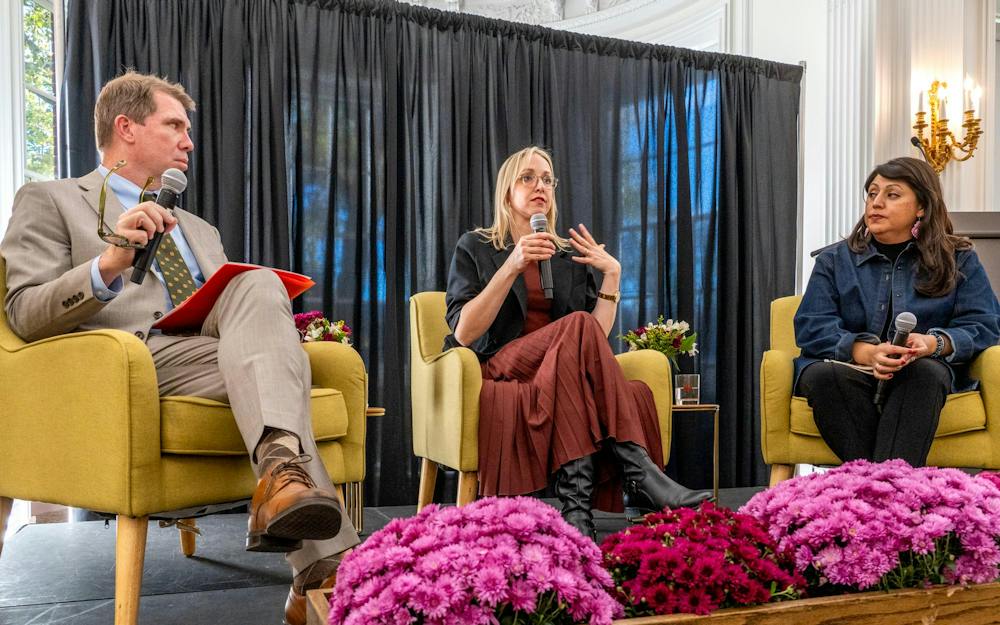
In a conversation hosted by the Office of Diversity and Inclusion Thursday afternoon, historians Kathleen Belew and Monica Muñoz Martinez shared how historical perspectives can help frame gun violence and inform paths to community recovery. The talk, titled “Honest Conversations: To Name the Terror (Gun Violence in America),” came as part of the ODI’s Honest Conversations series, which aims to cultivate discussion across a wide range of perspectives.
“Mass shootings and gun violence are not isolated aberrations; they are connected to longer histories of racial terror, paramilitary culture, state-sanctioned violence and to the stories we choose to tell or forget about,” said Vice President for Diversity and Inclusion Matthew Guterl, who introduced the speakers. “If this violence has a history, it can be understood, and what can be understood can be changed.”
Belew, who is an associate professor of history at Northwestern University, cited the 1999 shooting at Columbine High School as the beginning of an “era of thoughts and prayers,” marked by an exponential increase in mass shootings. But she emphasized that each instance of violence is “singular and can’t be collapsed in with any other experience.”
“I don’t think we need one solution,” Belew said. “I think we need thousands of solutions.”
Martinez, an associate professor of history at the University of Texas at Austin, has applied her background studying the history of mass violence to her related to the 2022 mass shooting at Robb Elementary School in Uvalde, Texas.
She explained that it is important to consider both the history and individualized needs of a community after a traumatic event.
“Cultures of violence — when they’re not addressed — they continue,” Martinez said. “We can bring that historical perspective … to mass violence and shootings at large.”
Both speakers drew attention to the role of the media in sensationalizing mass shootings.
Columbine, Belew said, was the first school shooting to be recorded and publicized. “We’re in a cycle where we consume horror in a really specific way,” she added.
Martinez said she received multiple calls from journalists “pleading with (her) to convince parents who lost children in Uvalde to publish photographs of their bodies.”
Belew explained that while recording oral histories, it is important to “actually create a story that’s in partnership with the people that are telling” the story. In conversations for her book “Home at the End of the World,” Belew said she conducted multiple interviews over the course of a few weeks and provided transcript checks so that individuals could “decide if they really wanted to share information.”
“One of the reasons that I think Columbine is such a devastating break that leads us into this period of gun violence is because the community was already torn apart and polarized and isolated,” Belew said. “We find ourselves unable to respond.”
Looking forward, Belew said she believes a grassroots shift in mindset is necessary before significant legislative change occurs. With Colorado in particular, she explained, there is a “push-pull” relationship where an act of violence leads to gun control legislation, which then faces backlash.
“It’s a conversation we have to approach from a different direction,” she said.

Zarina Hamilton is a university news editor covering activism and affinity & identity. She is junior from near Baltimore, Maryland and is studying mechanical engineering. In her free time, you can find her reading, journaling, or doing the NYT mini crossword.


