
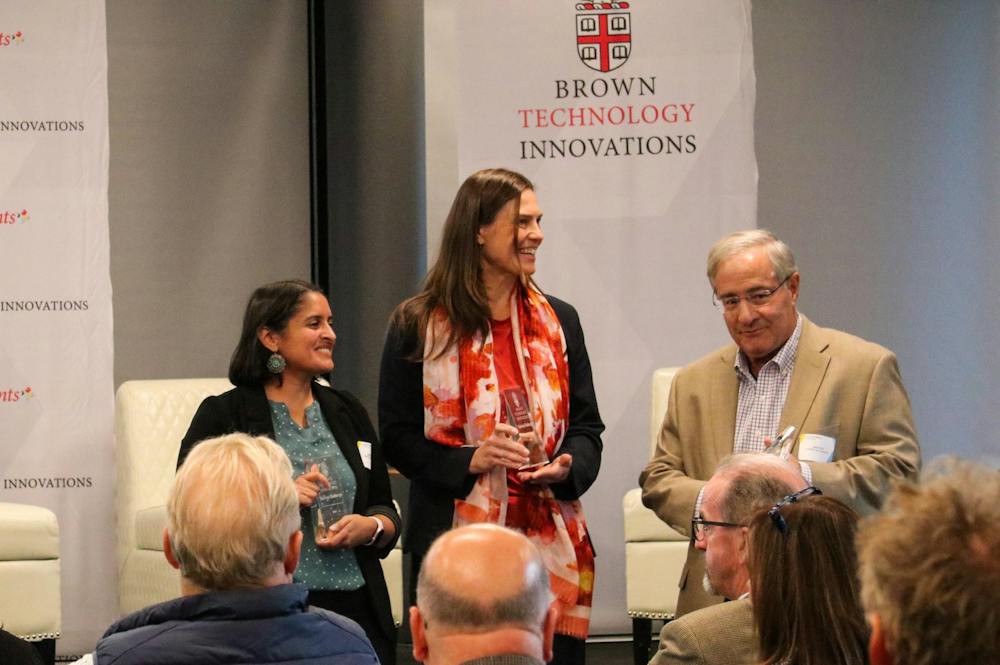
On Thursday, Brown Technology Innovations held its fourth Innovation@Brown Showcase: an annual exhibit of Brown-affiliated projects with a goal of shining a spotlight on these innovations, while possibly drawing investors’ eyes.
Awards were given for the inventor, startup and innovation of the year, and selected ventures tabled outside the showcase.
Inventor of the Year was awarded to Professor of Engineering Anita Shukla. Lilac Biosciences, a Providence-based biotech company co-founded by a Brown alum, won Startup of the Year. Assistant Professor of Earth, Environmental and Planetary Science Christopher Horvat’s EMPIRIC, a machine-learning-aided model that aims to predict future impacts of cyclones on coastal environments, won Innovation of the Year.
These awards are not just participation prizes — Adept Materials won Startup of the Year last year and their humidity-regulating Lilypad Paint recently made Time Magazine’s Best Inventions of 2026 list.
According to Melissa Simon — senior director of business development at BTI — while all the ventures “have some type of connection with Brown,” not all are “direct Brown spinouts.” Several participants are from the University of Rhode Island, while others “are exploring collaborations with either Brown faculty or clinicians at the hospital,” Simon said.
Simon told The Herald that Brown’s research may not have previously been “top of mind” for investors who “were thinking of Brown more as sort of a liberal arts institution,” and “not necessarily the R1 research institution that we actually are.”
The Innovation@Brown Showcase aimed to change this narrative.
“We want the attendees to come here and be really impressed by just the breadth and quality of the ventures that are here,” Simon said.
Projects at the showcase ranged from Modulus Joint’s ACL Armor, a newly developed chewable supplement designed to reduce the risk of ACL tears, to RI-Spheres, a National Institute of Health-funded postpartum blood-pressure cuff that provides free, high-quality postpartum healthcare to birth-givers at home.
According to Simon, the Inventor of the Year award was chosen based on new invention disclosures, the number of patents filed from these disclosures and the number of patents issued, among other criteria. Startup of the Year was based on the company’s development. The three finalists for Innovation of the Year were chosen by a public vote from the BTI team’s shortlist of 10. Those finalists were given the chance to present their projects, and the audience voted for the winner live.
Horvat’s EMPIRIC project uses machine learning to transform coarse weather data into forecasts for coastal locations and islands. “Those are the places at the highest risk of sea level rise and potential extremes, cyclones, hurricanes,” Horvat told The Herald. “But they’re also the ones that are the hardest to resolve when you’re trying to simulate all of the globe’s climate.”
“If we can make high-quality forecasts, they can make high-quality decisions about where to site critical infrastructure,” explained Horvat.
The other finalists were Abdelfattah Labs’s FiRE and ACT Labs’s Project Aerolink.
FiRE is a newly engineered molecule that allows neuroscientists to examine brain activity to test drugs faster and study brain disease.
“This molecule effectively translates the electrical signals in the cells into light,” said Flavia Maria Galeazzi GS, a first-year Ph.D. student in biomedical engineering at Brown and a researcher on the project. She added that far-red light allows FiRe to “get a much clearer signal from much deeper inside the tissue.”
Second-year computer science Ph.D. student Will Wu, who works on Aerolink, told The Herald that the project offers “a modular drone platform that gives you 3-D stackability.” This means that “individual modules can not only dock horizontally but also vertically,” unlike other modular drones, he explained.
Thinking about the movie “Big Hero 6 in real time,” Wu had wondered, “what’s stopping us from making any sort of arbitrary 3-D structure?” Aerolink’s lightweight frame can stack vertically, connect horizontally and form a shape with a hole that can carry a payload.
Ella Blanco ’28 told The Herald that Aerolink has “gotten successful flight tests,” and the team is “fine-tuning the hardware and seeing just how big we can scale it.”
Associate Professor of Computer Science and Engineering Nora Ayanian expressed excitement for Aerolink’s opportunities for synthetic aperture photography, which allows for high resolution images to be derived from low resolution sensors.
Wu hopes to keep Aerolink’s “roots” in art “because technology can easily steer into defense,” he said. “But before we get there, I just want to keep working on the technology itself.”
Clarification: This article has been updated to better reflect the selection criteria behind the Inventor of the Year award.


