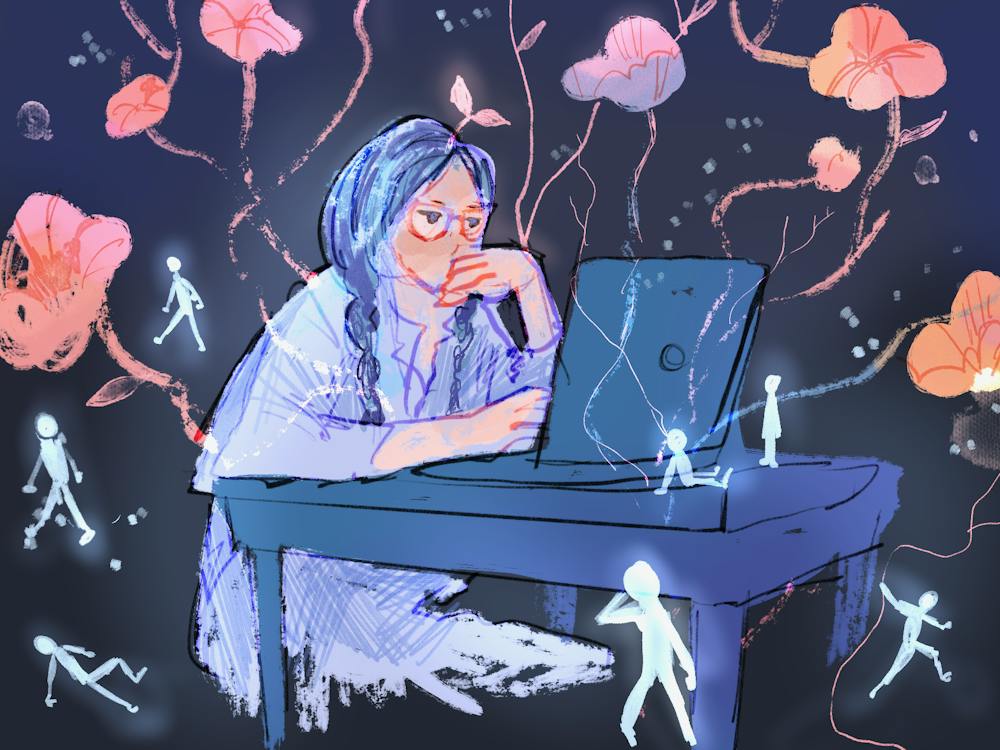
My sister is one of the biggest mysteries of my life. She came into the world in the first month of 2000, while I was born at the tail of 2004; so though the subtraction works out to four, she is basically five years older than me. Energetic and filled to the brim with creativity, my sister reigned as the natural ringleader of our childhood playmates. She was pretty and lively. She was good at everything. She was my idol.
When she began high school, my sister entered a strange stage in her metamorphosis. She stopped pouring out an abundance of energy. She became moody and secretive. She often physically shut herself in her room, telling me off when I was being too loud. In any case, she did not want to build a snowman. This more distant and subdued version of my sister soon left for college, ending the thirteen years we lived under the same roof.
About two years ago—six years after she had moved out—while staying home on a weekend off from work, my sister announced both that she had recently started to believe in the MBTI and that she possessed the ENFP-A personality type.
It seemed to me that my sister had become ensnared by pseudoscience. I don’t remember when I first learned about the MBTI—possibly, I was made to take it in school, or possibly, a friend had recommended it. Either way, the test had always struck me as more of a party activity: a cute way to kill time, rather than bearing any real insight on my character.
The Myer-Briggs Type Indicator (MBTI) is a set of questions developed by Katharine Cook Briggs and her daughter, Isabel Briggs Myers, based on psychologist Carl Jung’s theory of cognitive functions. The questions rely on a person’s perception of their own character and social habits to assign them to one of sixteen personality types. A personality type comprises five letters, each encapsulating a different trait.
Here is my best attempt at demystifying the MBTI personality types based on their descriptions on 16personalities.com, a popular platform that hosts MBTI tests and related theory. The first letter is either E or I, indicating extraversion—Jung had advocated for the use of “extraversion” rather than “extroversion” in his theories—or introversion. The second pair, S and N, determines whether a person leans more pragmatic or intuitive. The third pair, T and F, determines whether someone is more inclined to be thinking or feeling. The fourth pair, P and J, distinguishes spontaneous free spirits from detail-oriented planners. Finally, A and T represent self-assuredness and self-consciousness, respectively. The final letter acts as a filter on the previous four traits, reflecting how a person perceives themselves.
All of this seems…arbitrary. There are days on which I feel more extraverted and sociable than others. I can be more “thinking” in some regards and more “feeling” in others. What does it even mean to be more “intuitive” than “pragmatic”?
I had my doubts about the reliability of the questionnaire. However, my sister explained her results so animatedly and with such conviction, that I put away my skepticism for the time being and focused on the theory. Suppose that there is something to these letter combinations. What if they encode aspects of my sister that can help me demystify, if only partially, the enigma that she is?
But how could my sister possibly be an ENFP-A?
Though E represents extraversion, I’ve long perceived my sister as being quite introverted. She loves nothing more than a quiet weekend with the cats. She rarely attends large social gatherings, like a night out with college friends or happy hour with work buddies. In fact, she has shared with the family multiple times that she greatly appreciates that her job allows her to work independently most of the time.
In regards to being both intuitive (N) and deeply feeling (F), my sister has always struck me as being practical and rather stoic. For instance, after an argument, I tend to dwell on the uncomfortable aftermath for a while, hashing and rehashing the situation in my mind. I also feel an itch to approach the other party and discuss the matter, or apologize, or come to some sort of a resolution. My sister, on the other hand, appears to possess the happy gift of flipping over chapters expeditiously. Fights within the family rarely seem to bother her for more than a few hours. She usually goes on with her daily life and shows little signs of wanting to “talk about it” afterwards.
My sister’s MBTI result confuses me, but maybe this just attests to the fact that the theory is largely unsound. Human beings are so complex that it is impossible to distill the galaxy of possibilities within each of us into a personality type. Indeed, it is widely accepted that the MBTI theory has no rigorous empirical backings. The definitions for each personality type are rather hand-wavy. Test results could vary significantly based on the test-taker’s mood on a given day.
Despite these defects, the test can still be quite alluring—it is an easy way to avoid reckoning with the intricacies of human connections. With personality types, our quirks and preferences and messy attempts at reaching others can be distilled into five orderly letters. You don’t get along with someone? No wonder! That person is an ISTP-A, your polar opposite MBTI type. Scared to go to the function alone? Don’t even try. You are an introvert, and therefore can’t be expected to enjoy raucous spaces. The MBTI trait descriptions draw lines in the sand, and we can be confined by their rigidity should we put too much trust into their ability to interpret selfhood. Unfortunately, there are many instances where the supposed science of personality types is used to justify the categorization of people. Corporations sometimes use personality tests in their hiring process to determine fit or competency. I’ve seen dating shows that open with the participants sharing their MBTI types as a part of their introductions. Social media can also propagate rather questionable guidance on navigating relationships based on the MBTI.
The Chinese social media app Xiaohongshu has become one of my doomscrolling platforms of choice in recent years. Many Xiaohongshu accounts claim to be gurus in the way of navigating relationships using MBTI. There are all sorts of arguments regarding how different personality types would behave in given scenarios as well as instructional videos demanding that I avoid associating with people with certain personality types.
If I had taken these posts seriously, I would sadly have to sever all ties with my parents, for they both tested to have my nemesis personality type—the evil ISTJ.
And according to the videos, all that it would take to fill the void for me is an INTJ man. Someone who shares my discerning eye for people and social situations but intuitively interacts with the world through logic and reasoning, while I supposedly default to emotional connection. According to the videos, I will fall irredeemably for the INTJ man. The two of us will share a connection that is almost psychic and like no other, and we will perfectly complement one another.
The videos leave the impression that relationships can be explained in binaries and extremes. It’s almost as if an MBTI mastermind were in charge of programming people’s brains: ISTJ people would act a certain way, and this is what INTJ people would do under the same circumstances. It seems to me that if one uses the MBTI as a North Star in their relationships, they risk massively oversimplifying others and limiting themselves socially.
Of course, it may still be wise to keep an eye out for that INTJ man.
—------------------------------------------------------------------------------------------------------
“The problem with playing hide-and-seek with your sister is that sometimes she gets bored and stops looking for you.”—Fangirl, Rainbow Rowell.
I’ve learned a lot about my sister in recent years. Both of us began new chapters in our lives. Both of us encountered an inundation of different and new experiences. There have been celebrations, but also the pain, doubt, and nostalgia that are injected into all doses of growing up.
It is both painfully obvious and deeply shocking to me that my sister processed many of our childhood memories differently than I did. I discovered this through conversations that occurred in the narrow strips of time when we overlapped in our parents’ home from school and work. Time and distance apart made it easier for us to air out the interiors of our minds, but we still approached these attempts gently, clumsily. We were a little rusty at connecting with each other. Our shared archive of childhood memories became the building blocks of conversations that surround those touchy, tingling things called “feelings.”
Despite all my misgivings, the MBTI has emerged as a vocabulary with which we can communicate about ourselves. It is a limited vocabulary, and plenty gets lost in translation. But it is enough for now. After all, so much context needed to be explained; what was it like for her during all these years? For two people who are learning how to talk with one another in a new dimension, a plethora of language can be overwhelming.
What we need is a language through the keyhole. When it doesn’t seem like she would want to come out and build a snowman, I can read my sister through the lens of ENFP-A. She is someone who gains energy from the vast world around her. Traveling and exploring new destinations inspire her. She loves the bustling city that she lives in. At the same time, she is often introspective and resides in an internal world populated by pet fancies. She is reluctant to divulge the geography of that world, but it is pulsing and alive nevertheless. Oh, and she is spontaneous and free, plans be damned.
One day, we will adopt a more sophisticated language with which to communicate—one as intricate as the childhood riddles that we spoke in, I believe. Oftentimes, my sister is frustrating and still utterly confusing. But that is the way with all good mysteries, I guess.


