
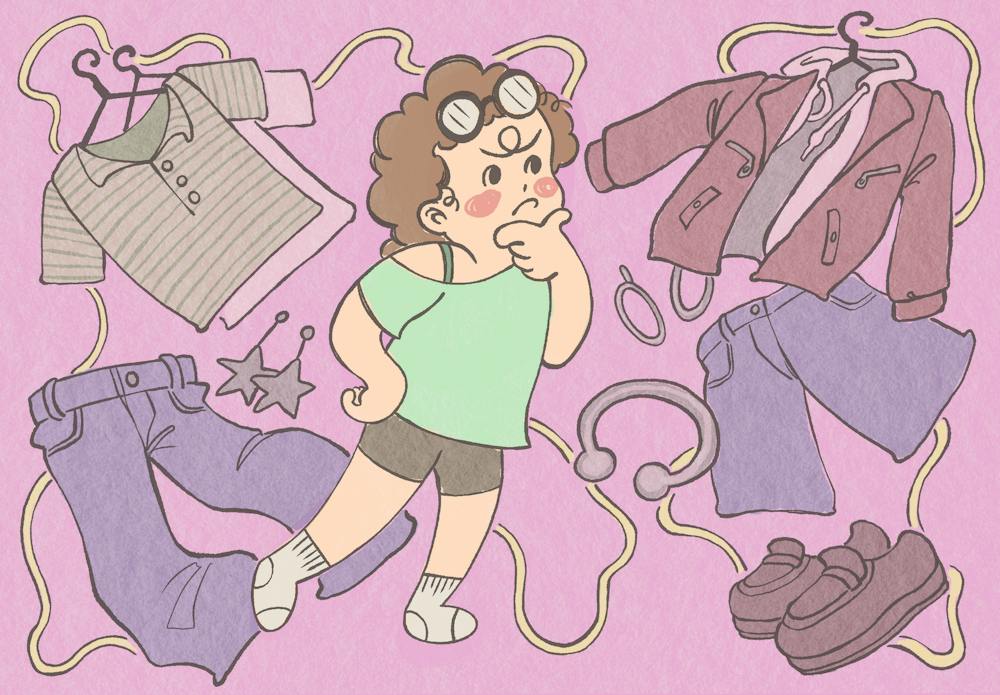
It’s Monday. I wake up covered in grime and glitter and the dull stickiness of dry sweat. My mouth is full of cotton. It’s time for class.
For all the fanfare of studying at a famously creative school, the average Brown student’s morning closet-scavenging is relatively mundane. Is this shirt too dirty for me to rewear? What does the CPax weather machine have waiting to torment you outside the lukewarm comfort of your room? How many layers do you need, what classes do you have, where is that bra that you literally laundered yesterday? I can never find the answer to that last one; luckily, this campus seems to have a happily functional approach to underwear, where if (like me) you aren’t a fan, no one’s going to call you out on freeing the nipple.
I’m running a few minutes late for my 10 a.m., as usual, and I don’t have the time to wash my hair. I don’t really have the privilege of throwing it up in a bun, either, since I’ve opted for the “hi-I-am-transgender” curly mullet, so I sacrifice doing my makeup in favor of assembling some vertical monstrosity from three claw clips and lots of curl cream. I definitely didn’t get enough sleep, so I slap on blush and pray that some color in my cheeks and the giant lenses of my glasses will lend me some illusion of wakefulness, grab my reliable leather jacket, and sprint out the door.
Realistically, this is what college fashion is: a creature born of ideas and raised by cheap detergent, rushed mornings, and infinitely hostile weather. You’re faced with the concept of having to construct a new outfit every day (or most days; hey, the Tuesday-Thursday people don’t have to know what you wear on your Monday-Wednesday-Friday circuit), within infinite other constraints. This is the environment that breeds functional fashion: clothing that does its job without sacrificing style.
As someone who likes to pretend they’re fashion-conscious, but is burdened with the inability to actually wake up on time, I had set three rules for getting ready by the end of my freshman year. This is how I, and most Brown students I see around campus, seem to approach our functional fashion:
#1: Carry a default layer that works. I adopted a burgundy faux-leather fleece-lined jacket from Macy’s Backstage in my first semester, and I take her pretty much everywhere, because New England really hates my Indian temperature preferences.
#2: If you think it’s boring, add jewelry. If there’s one thing Brown students are good at, it’s the art of dressing up a T-shirt and regular pants, whether it’s a silver ear cuff, thrifted belt, or dangly earrings. I have a piercing-inspired necklace from Nostalgia that I love, and seldom go out without some giant earrings.
#3: If you have any semi-formal event that’s not class, a TA section, or a meeting with a professor, you invoke the Brown Smart Casual Guide. This is a nebulous, vague affair involving baggy jeans, collared shirts, bomber jackets, and chunky cardigans. Think boxy but slim; the actual pieces are simple because you want it to look like your clothes are just this nice every day. To get it right, you have to come across neat, yet appropriately slouchy. Don’t ask me how; I mostly just make sure my pants look inconvenient enough, and pray.
Being a college student is often an exercise in the art of trying to look good enough to make a good impression without sacrificing your time, body, or sanity in the process. Coming from a big city and a background in both art and fashion design, I think Brown does functional fashion uniquely well. Beauty doesn’t have to be pain, minus many students’ stubborn refusal to wear a backpack (guilty as charged; I’ve been loving my burgundy weatherproof sling, though its wider strap and durable outer layer makes it a bit better than the totes I used to carry around). Or maybe I just visited Harvard a couple times and saw way too many guys in cargos and polos, and girls tripping over painful-looking brown leather boots (sorry, Harvard, no shade). Either way, it got me thinking: What differentiates a fashionable casual ’fit from the rest?
The “right kind of slouch”
The shape of the era is the trapezoid. Most women who’ve scrolled through enough social media feeds will have heard of the loose-to-tight split: tight top goes with giant pants, giant top goes with short pants, or if appropriately pinned, a giant top can go with giant pants as long as you still have some shape. This is undoubtedly the time for the low-rise and the wide-cut. The thing that people often don’t tell you is that there’s a “right kind” of baggy.
As we re-enter early 2000s skinny chic with Ozempic, gymfluencers, and the revival of the Victoria’s Secret fashion show, it seems pertinent to point out that baggy clothes aren’t necessarily a throw-on-and-go situation for everyone. Note that a fitted crew neck on an oversized t-shirt is a huge no-no: People tend to opt for loose collars, a boat neck, or a stretched crew, all with giant sleeves that make the arms and shoulders look delicate. On men, fitted shirts are still the rage, and looser cuts come with the caveat that they be cropped so that the legs look longer and the shoulders wider. The shorter or fuller your figure, the more difficult achieving these proportions becomes.
- If you have a large chest, a giant t-shirt doesn’t delicately hang off your shoulders like it’s supposed to. I’ve found that cutting up my shirts to an off-the-shoulder wide neck gives me a nice shape while keeping the comfort of a baggy outfit.
- If your legs are any shorter than a supermodel’s, wide-legged jeans can be an absolute pain. Hemming is always an option; buying culottes can be a nice trick, and if for some reason you want your legs to look longer, a tapered boot cut creates a good illusion. Some people consider these overly feminine: A bow-legged pant that stops right after your ankle can also lengthen your figure.
It seems that the “correct slouch” lies on the fine line between too structured and too loose. Stiff T-shirts aren’t really the most comfortable, but overly wrinkly oversized tops are often considered underdressed. Baggy jeans aren’t just jeans three sizes too big, obviously: They come in trapezoids or hourglass cuts that create a geometric lower body shape. I’ve recently ended up playing with this structured/casual dichotomy by trying out a fitted collared half-sleeve shirt with my giant sweatpants. As someone who can never find a pair of jeans that fits both my hips and my waist, I live in sweats, and realised that they become less controversial when they’re ironed and paired with a structured top and the right shoes.
It’s still interesting to note that I probably get away with my sweats because I’m on the skinnier end of midsize (though god knows what dress size that actually translates into these days) and have legs skinny enough to make sweatpants look rectangular (this happens when the band hangs off your hips and the rest of the pant is loose around your thighs). It’s no secret that if you’re fat (not Hollywood fat, real-people fat) your casuals are considered a lot less “smart,” especially given that your body doesn’t fit into this angular ideal of the contemporary fashion world. Consider the low-waisted jean, slightly-cropped shirt combination that’s meant to show off one’s lower midriff. On someone larger you’d probably judge it to be an ill-fitting shirt, not a planned fashion moment. Just food for thought.
Distorting the silhouette
Another interesting thing about the modern college student is our turn away from the high-waisted and the skinny-fitted. The traditional silhouette for female-presenting bodies used to be a pant that cut off at the narrowest point of the waist and a top that was cropped appropriately to match. Male-presenting bodies were assigned a relatively fitted top and tapered pants. This hourglass/rectangle dichotomy between the traditionally female and the traditionally male body is probably the most noticeable when you look at the cut of a typical cotton short. Notice that men’s shorts are cut rectangularly and end around the knee, where women’s shorts are cut trapezoidally, start at the narrow waist and end at mid-thigh.
To no one’s surprise given the contemporary propensity of the oversized jort, we seem to have eschewed these silhouettes in favour of new cuts that focus on different parts of the body. In feminine fashion, it’s the collarbones and the lower belly; we’re done with crew-cut shirts and are moving forward with loose sweaters, sharply dropped sleeves, and all kinds of alternative necklines that make the neck look longer and the shoulders less round. We’ve brought back the low-rise (huge, in my opinion, given the sensory nightmare that is high-waisted jeans), drawing attention to the little strip of skin at the lower abdomen instead of the actual waistline. Of course, we’re still obsessed with cinching our shirts; the internet abounds with tricks to give your oversized tops a taper at the waist, and Missguided recently came out with a “fitted oversized” shirt that pulls in under the ribs and flares out again over the hips. The hourglass will never fully die.
But the advent of loose pants is huge for functional dressing. You might notice you feel a lot worse about your body when you’re squeezed into pants that are fitted around the lower waist or the upper thighs, as opposed to one that hangs off your hips without clinging to your legs. Of course, it’s highly possible that the social permissibility of these kinds of pants draws on the fashion world’s expectation that your body is thin enough to provide an artistic contrast to the giant clothing. I’m still optimistic enough to believe that this is changing, though, and that loose dressing can genuinely be a move towards enjoying a new and more diverse array of silhouettes. To hell with the fashionable body. Anyone looks good in baggy pants, if just for the fact that you’re not being expected to squash yourself into a pair of jeans that are essentially laminated to every part of your lower half.
Of course, I can’t praise the functionality of baggy pants without taking a moment to mourn their fatal flaw. Most of us are no strangers to heel bites, or the nightmare of encountering an unexpected puddle when the hems of your pants are trailing on the ground. The price you often pay for flowy comfort is the ever-present risk of eating shit on the sidewalk. But for students spending their day traipsing around campus, the outfit doesn’t end at the pants, anyway: This is where finding the perfect shoe becomes important.
Boots that are made for walking
I mentioned earlier that I thought my sweatpants were passable as Brown Smart Casual partially because of my shoes. Here’s the thing about shoes. New England is cold, cobbled, and wet. Brown’s campus, despite our beloved (ha!) Facilities Management, isn’t exactly any smoother. I have an incredible admiration for this girl in my TAPS class who walked in the other day with a pair of lovely, delicate gold sandals, but for those of us who aren’t as strong of will, the default shoe looks more like a worn pair of sneakers.
I don’t need to comment on the rise of the chunky shoe or the thigh-high boot; we all know what the typical Brown student shoe looks like, if not just for the fact that we’re all looking down while we walk to class so that we don’t trip on the pavement. It’s still worth noting that a small twist on the classic sneaker can level up a casual outfit almost immediately, without sacrificing any of the shoe’s practicality. My brother got me to put some riveted spikes into my pair of New Balances (which, by the way, are a great shoe if you’re looking for something that’ll last: Their average lifespan is five to six years, even more if you’re not wearing them every day). The traditional Onitsuka Tigers or Adidas Sambas are popular precisely because they’re a good way to add a pop of color to your outfit without trying too hard; just buy a statement color. I’m a particular fan of the new Adidas ballet flats, which are basically the sneaker equivalent of those sweatpants that look like they’re made of denim: They’re easy to slip on but have all the comfort of a full-fledged sneaker, plus they provide some visual interest. Charms, colored laces, rivets, or just a standout pattern—these are all ways to dress up the college walking shoe.
In the wintertime, we’ve got to stick to our boots, and not all of us can afford UGGs (they wear out quick, too). But I’ve found that wearing leg warmers or just opting for more interesting pants can make even the plainest water-resistant winter boot look smart. It’s impressive what a simple accessory can do.
Bits and bobs
Which brings us to the piece de resistance in a Brown student’s dresser: the trinket. Think about it this way: the more interesting detail there is to your overall silhouette, the more people assume you’re putting effort into what you’re wearing, and their eye falls forgivingly on the wrinkles or stains or unfortunately ugly outerwear that we all end up with at some point in our college workweek. Most of Brown’s student population seems to have mastered the art of the earring, so I will refrain from recommendations and only briefly note that the simple ear cuff, dainty helix, thin chain, or minimalist hoop (ranging from tiny to bangle-sized) are tried-and-tested defaults. But it doesn’t have to stop here. I’m a big fan of a “default necklace,” or an easy chain that you can wear every day. For me, it’s an easy outlet for sentimentality (my default is a pendant my parents gave me for my eighteenth). But it’s also a way to add to your outfit without having to spend extra time picking out jewelry in the morning.
Advocates of “easy fashion” and “simple style guides” have often espoused the 30/70 rule, where seventy percent of your wardrobe is comfortable and thirty percent is fun or interesting without necessarily being practical. Given our often-tight budgets, tiny closets, and the pain of doing laundry, I propose a conversion: Seventy percent of your outfit should be things you literally need to get through your day, and thirty percent should be jazzed up a little. If you’re feeling a comfy hoodie, consider grabbing a bright pair of earrings or adding some patches or embellishments to the lower half of your pants. A cute belt or a bandana tied through your belt loops/to some part of your jeans/around your hair can do the same job. In the hell season between spring and fall, where the weather changes every hour, I’m a big advocate for a flashy light jacket or a patterned shawl, something with a rich color or tassels or a fun texture which you can drape over your shoulders, lay on the ground, or wrap around yourself as needed. For people who find lots of jewellery overtly feminine, a simple silver cuff, chunky dark beaded bracelet, leather cord necklace, or even a nice watch all fall into this same thirty percent category. Besides, all these things are great excuses to go thrifting or trinket shopping, and we’re always looking for permission to let ourselves buy fun things, aren’t we?
Putting an end to the one size
If you’ve made it this far, part of you is probably wondering why some student writer feels qualified to dispense fashion advice to college students, especially if you’re already someone who considers yourself pretty fashionable. The answer is that you really don’t have to listen to me. You’ll notice that a lot of this article is general observations that you can probably pick up by people-watching on the Main Green for, like, ten minutes. What I’m trying to get at is that Brown’s student fashion seems to be an interesting look into how we can convert the idea of dressing well to become something relevant to the average person’s life, with its bralessness and slouchiness and scrappiness and functionality.
The ideal we’ve set doesn’t work for everyone; the rectangular, trapezoidal shapes of the era aren’t naturally performed by the majority of real human bodies, and putting effort into finding the perfect wardrobe isn’t really something we all have the time or money to do. But it’s a shift toward something more practical, more real, and I’m all for examining that critically. So, the next time you notice someone’s outfit on your way to class, or are sleepily picking out your own in the morning, I’m advocating that instead of trying to think about what’s in Vogue, you stick with the practicality you already live by. That’s the Brown way to do functional fashion: learning to style your own, unique body; experimenting a little without sacrificing your time; and, of course, remembering to check that damn weather app.


